





India and Japan have signed 120 Memorandums of Understanding since August 2025, representing an investment of nearly ₹1 lakh crore
The capital is distributed across diverse sectors including manufacturing, semiconductors, artificial intelligence, clean energy, finance, and digital infrastructure
Toyota is establishing a new manufacturing facility in Bidkin, Maharashtra, with an annual production capacity of 1 lakh vehicles to generate thousands of jobs
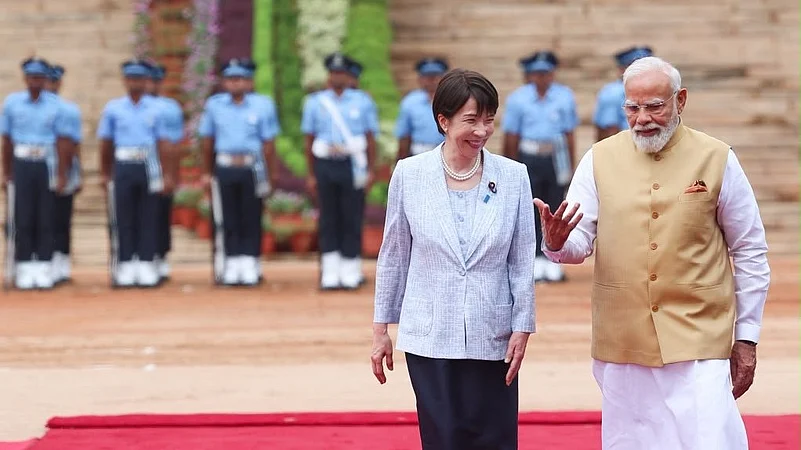
As Prime Minister Narendra Modi and Japanese PM Sanae Takaichi outlined a broader roadmap for deeper strategic ties, Japanese capital is flowing into India. A massive ₹1 lakh crore funding push spans diverse sectors including semiconductors, artificial intelligence, clean energy, finance, digital infrastructure and manufacturing.
This broad-based economic expansion follows the signing of 120 Memorandums of Understanding (MoUs) between the two nations since August 2025.

1 September 2026
Get the latest issue of Outlook Business

The investment map reveals that capital flows across multiple states rather than concentrating in a single industrial hub. Beneficiary states include Haryana, Gujarat, Maharashtra, Telangana, Assam and Meghalaya.
These companies are helping shape the next phase of Indian industrial growth. The investments span from automobile operations in the west to green energy and technology production in the east.
Haryana: The Manufacturing Magnet
Haryana has emerged as one of the biggest winners in this investment wave. Daikin is building out a new R&D centre in the state, Sumitomo is deepening its industrial footprint, and Suzuki continues to expand its manufacturing and mobility operations there.
Advertisement
The state's pitch to Japanese investors rests on three pillars: solid infrastructure, closeness to Delhi-NCR, and an already-mature industrial ecosystem.
Maharashtra: Focusing on Industry and Finance
As India's commercial and financial capital, Maharashtra continues to pull in heavyweight investment. Toyota is setting up a new facility in Bidkin with a capacity for 1 lakh vehicles annually, a plant expected to generate substantial employment.
Meanwhile, financial players like MUFG are scaling up operations in the state, reinforcing Maharashtra's dual identity as both a manufacturing base and a financial nerve centre.
Gujarat: Betting on Semiconductors
Gujarat is positioning itself as a key player in India's semiconductor ambitions.
Advertisement
Japanese firms, including Fujifilm and Toho Koki, working alongside academic institutions and technology partners, are involved in projects aimed at strengthening chip manufacturing, R&D, and supply chain resilience in the state.
Telangana: The Digital Play
Telangana's Japanese investments are concentrated in digital infrastructure, AI and advanced technology.
Partnerships involving NTT Data, Persistent Systems and Mitsubishi Electric span AI, quantum computing, telecom infrastructure and cybersecurity, building on Hyderabad's reputation as a major tech hub, powered by a strong IT talent base.
The Northeast Joins the Map
Perhaps the most striking shift is Japan's growing interest in India's Northeast, a region historically outside the country's core industrial corridors.
Assam has drawn semiconductor and green energy projects, including a Suzuki-led biogas initiative, while Meghalaya is attracting renewable energy collaborations.
This inclusion fits into India's broader push for balanced regional growth and tighter connectivity with Southeast Asia.
Beyond State Lines: A Pan-India Approach
Many initiatives do not fall cleanly within a single state, instead extending across regions through research collaborations, digital infrastructure, and financial partnerships. Sector-wise, the investments touch steel manufacturing, renewable energy, AI, quantum computing, logistics and financial services.




Taken together, the scale of ₹1 lakh crore investment and pace of 120 MoUs in under a year of this partnership mark a shift in how Japan approaches India. Instead of anchoring investment in a few established manufacturing centres, Japanese companies are now chasing sector-specific strengths wherever they exist.
For states like Haryana, Gujarat, Maharashtra, Telangana, Assam and Meghalaya, that translates into new jobs, technology transfer, infrastructure upgrades and deeper integration into global supply chains, positioning them as active participants in India's next phase of economic expansion.









