A strengthening El Niño is disrupting the southwest monsoon, threatening kharif crop production and raising concerns over agricultural output, food prices and economic stability.
India may have to increase imports of edible oils, pulses and cotton as domestic production weakens, potentially driving up the country's import bill and exposing consumers to global price volatility.
Experts say long-term reforms, including climate-resilient seeds, stronger procurement for pulses and oilseeds, and expanded irrigation infrastructure, are critical to reducing India's dependence on agricultural imports.
A stronger El Nino cycle is once again looming large on the Indian economy with the erratic southwest monsoon threatening to impact the agricultural sector and a possibility of rise in food inflation.
This June had reported a 38 per cent shortfall in rains, and the overall southwest monsoon had been 24 per cent below the normal as the rains have disturbed the sowing in several rain-fed regions.

1 September 2026
Get the latest issue of Outlook Business

Not just lower crop production but policymakers also face the risk of a rise in imports of essential commodities such as vegetable oils, pulses, and cotton, thereby adding to the import bill and threatening to fan inflation in India.


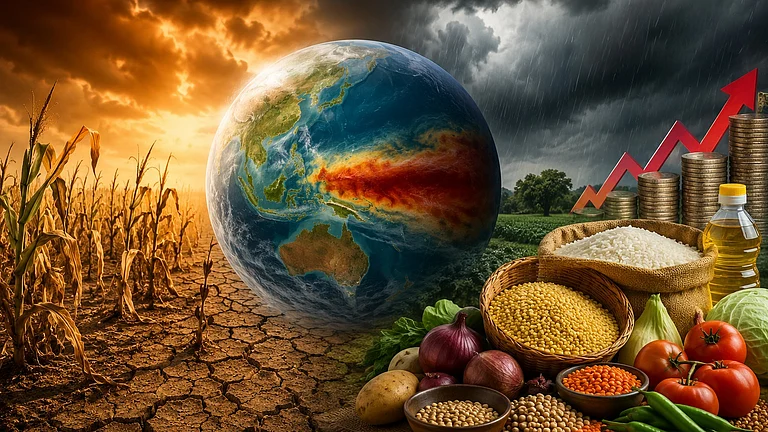
Why Is El Nino A Concern?
El Nino refers to the phenomenon when ocean surface waters in the central and eastern Pacific Ocean become warmer.
While the anomaly may be thousands of kilometres away from India, the phenomenon leads to a weakening of the southwest monsoon with the region receiving below-normal, late or patchy rainfall.
Advertisement
The reason behind the concern of weak monsoon is that over half of India's agricultural land depends completely on monsoon rainfall, and below normal monsoon can affect the planting of kharif crops and subsequent yield.
If the anomaly were to persist in winter months, increased temperatures could also negatively affect rabi crops like wheat, mustard and chickpeas.
Which Crops Are Under Pressure?
Most affected are the crops which are completely dependent on rains and have little access to irrigation.
Crops like groundnut and sesame in the oilseeds category, and arhar and urad from the pulses group, have faced delays in sowing as the rainfall remained patchy in the states.
Advertisement
Cotton also remains vulnerable with a protracted spell of dry days and high temperatures favouring pest infestation, which can bring down yields.
Why Imports May Go Up?
VEGETABLE OILS
India is the largest importer of vegetable oils in the world. More than 60 per cent of the country's vegetable oils are imported - mainly palm, soy and sunflower oils.
A weak monsoon can reduce the output of oilseeds, which means higher imports will be required. Added to that is the rise in global demand of edible oils for biofuels, which could keep the international prices elevated.
PULSES
While India has significantly reduced its dependence on pulses imports in recent years, output of some pulses remains vulnerable to weather shocks.
A continued disappointment with the rains can affect the production of arhar and urad, forcing India to ramp up its imports from countries like Canada, Australia, and various African countries.
COTTON
India, once a leading exporter of cotton, has turned to imports due to slowing productivity, recurring pest attacks and increased domestic consumption.
The decline in production due to weather conditions could further fuel imports.
Will This Lead to Higher Food Inflation?
Food prices have a more than 40 per cent share in the Consumer Price Index (CPI), and thus the impact of crop supply is directly reflected in inflation.
While India's rice and wheat prices are insulated to a large extent from shortages by government buffer stocks, both pulses and edible oils depend heavily on imports, leaving them vulnerable to supply and price shocks.
Any rise in import prices and a concurrent dip in domestic production will mean the country effectively imports inflation, compounding the challenge for the Reserve Bank of India.
Will Farmers Be Affected?
In rain-fed agriculture, which is predominant in India, poor rainfall can translate to lower yields and farmer incomes. Even though the government fixes Minimum Support Prices (MSPs) for pulses and oilseeds, it largely procures rice and wheat.
Many farmers end up selling their produce below MSP, hurting profitability and reducing their incentive to grow other crops that India badly needs to enhance its domestic output.
Can India Reduce Its Dependence On Imports
To reduce import dependence, structural reforms are needed, rather than mere trade interventions.
Reports citing industry experts suggest that an increase in the cultivation of climate-resilient and drought-tolerant varieties of seeds, a strong push for procurement of oilseeds and pulses and better investments in irrigation (micro-irrigation, watershed development) and processing infrastructure can build resilience against such weather shocks.