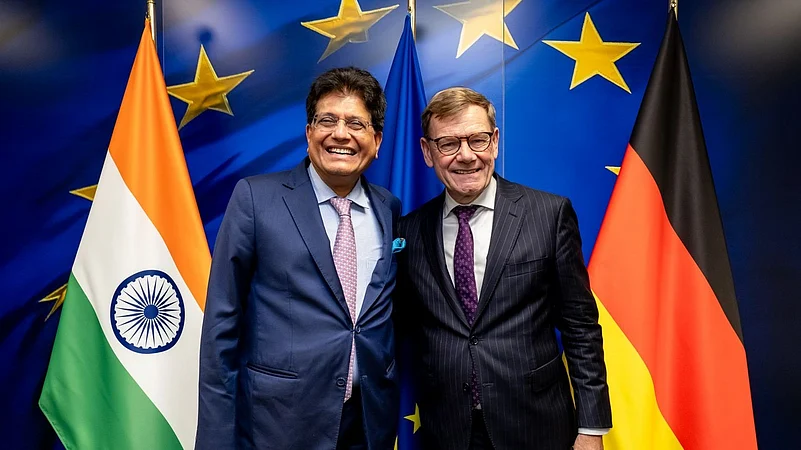

Germany’s economic reset adds urgency to concluding the India–EU FTA.
Berlin pivots to €1trn-plus domestic investment amid export-led slowdown.
India remains just 1% of Germany’s trade, signalling vast untapped potential.
Higher standards mean India must prove reliability, compliance and scale.
Europe is firmly in India’s strategic sights for 2026, with New Delhi keen to conclude a long-pending free trade agreement (FTA) with the European Union at the earliest. The original target of wrapping up negotiations by 2025 slipped, but the diplomatic tempo has clearly picked up.
External Affairs Minister S. Jaishankar and Commerce and Industry Minister Piyush Goyal were in Europe this week, even as a string of high-profile European leaders prepare to visit India over the next two months. The line-up includes German Chancellor Friedrich Merz, European Commission President Ursula von der Leyen, European Council President Antonio Costa, and French President Emmanuel Macron.

1 September 2026
Get the latest issue of Outlook Business

Trade is only one part of the conversation. Both Germany and France have publicly backed the swift finalisation of the India–EU FTA and increasingly see India as a critical partner in maintaining security and stability in the Indo-Pacific, particularly amid China’s continued assertiveness.
“Germany for India is our largest economic partner in the European Union. In recent years, our cooperation has acquired many more facets and gained much stronger momentum,” Jaishankar said in May last year after meeting German Foreign Minister Wadephul Johann.
That makes Germany central to India’s engagement with the EU. But Berlin itself is undergoing a difficult economic reset. And that reset could quietly shape the trajectory — and urgency — of the India–EU trade deal.
Advertisement

Germany's Economic Reset
The European economy has been severely disrupted by the Russia-Ukraine conflict. Germany, the world’s third-largest and Europe’s largest economy, is experiencing consecutive contractions in 2023 and 2024. It has been the only G7 economy to record stagnation over this period, reflecting structural vulnerabilities and energy dependence.
Germany’s economy showed no growth in the third quarter of 2025, underlining the continued difficulty faced by Europe’s largest economy in rebuilding momentum amid weakening external demand.
On paper, Germany is still the industrial heart of Europe: a roughly $5 trillion economy, where goods exports make up nearly 36% of GDP. Its exports, the traditional engine, were still being squeezed by weak global demand and the drag of US import tariffs.
Advertisement
The mood in Berlin, therefore, is no longer one of export triumphalism. It is closer to triage — followed by a determined attempt to rebuild.
A recent report by Rubix highlighted that Germany’s “reset” is essentially a pivot from export-led comfort to state-backed domestic demand, with infrastructure, energy systems and defence at the centre.
The report flags a massive fiscal turn: a EUR500bn infrastructure and defence fund and a wider investment push that could total over EUR1trn in the coming years.
Alongside that sits a corporate revival package of EUR 46 billion tax relief plan with accelerated depreciation (30% per year on new machinery/equipment/vehicles between July 2025 and December 2027), planned cuts in corporation tax from 15% to 10% over five years starting 2028, and generous depreciation for corporate e-mobility investments.
And then there’s the confidence pitch, the ‘Made for Germany’ initiative, where 61 major firms pledged EUR 631 billion in investment and R&D commitments by 2028.
The logic is simple: Germany has concluded that it must invest its way out. Even as inflation eases back towards the ECB’s comfort zone — down to around 2.1%–2.2% by early to mid-2025, alongside an ECB deposit rate cut to 2.5% — exports alone are no longer sufficient to revive growth.
Trade Anxiety
China and the US are competing neck to neck to emerge as Germany's top trading partners. However, Berlin is also trying to cut dependence from Beijing in some sectors and curbs on rare earth magnet just amplified this sentiment.
In the India–Germany corridor, the numbers are steady — but they also scream “headroom”. Germany is India’s 8th largest bilateral trade partner. From FY2021 to FY2025, ndia’s goods exports to Germany grew at 7% CAGR and crossed $10bn. Imports from Germany grew faster at 9% CAGR to nearly $19bn as well.
While India’s trade deficit with Germany widened to $8.4 billion, India’s share in Germany’s imports and exports has stayed at just 1%. In other words, the relationship is important, but India is still not central to Germany’s trade map yet.
There are, however, signs of movement. Electrical and electronic goods (HS 85) have become a growing driver of India’s exports to Germany — rising from 11% share in FY2021 to 16% in FY2025.
Furthermore, Post-war energy re-routing is quietly linking India to Europe’s energy security. The Rubix report notes that while India’s direct exports of refined petroleum products to Germany are negligible, German import records show inflows of Indian-origin petroleum products likely rerouted via hubs like the Netherlands. These indirect shipments rose from about $27mn (2020) to nearly $280mn (2024) — a 10x+ increase.
The absolute numbers are small within Germany’s energy basket, but the signal is large: supply chains are being reconfigured.

Opportunities and Challenges
Germany’s pivot will open doors but it also raises the bar.
When Germany invests heavily in infrastructure, defence, digitalisation and energy systems, suppliers don’t just need price competitiveness. They need traceable compliance, product reliability, and a comfort level with geopolitical risk.
If the trade deal with the EU moves, then Germany becomes a key gateway market for Indian firms into Europe — but also the strictest teacher. Because Germany’s manufacturing economy runs on exactness: standards, certification, and predictable delivery.
Add to that the corporate footprint: German giants like Mercedes-Benz, BASF, Bosch, Deutsche Bank and Siemens are active in India, while Indian companies such as Infosys, Mahindra Group, HCL Technologies and Dr Reddy’s operate in Germany. This existing lattice makes deeper trade less about introductions and more about scale and trust.
And Berlin is clearly leaning in. The report mentions Germany’s “Focus on India” strategic document, adopted in October 2024, spanning cooperation from security and defence to climate action and skilled workforce collaboration. Germany is also easing export restrictions in April 2024 to facilitate defence cooperation, including procurement of small arms — a meaningful political signal in a country traditionally cautious about defence exports.
For India, these developments are both an opportunity and a warning. Opportunity because “China+1” thinking is no longer a slogan; it is being written into industrial roadmaps. Warning because Germany will not swap dependence for “uncertainty”. India has to prove it can be an industrial partner at European standards, not merely an alternative.
Pressure Points Ahead
Germany’s trade with the US and China is now a moving target, influenced by tariffs and strategic positioning. If global firms reconfigure supply chains around tariff regimes, India could gain manufacturing slices — but only if it is faster than the paperwork and more reliable than the risk.
Germany is trying to rebuild competitiveness after an energy shock and export slowdown, and insulate itself from geopolitical dependencies by investing in domestic systems and trusted supply lines.
For India, that reordering creates a narrow but real opening. Not because Germany is “looking away from China” — but because Germany is trying to design resilience into its economy. If India can show up with credible manufacturing capacity especially in electronics, machinery components, and clean-tech supply chains, and if the India–EU trade deal lowers friction, India can move from being a 1% partner to a more consequential one.