
India and the EU have concluded negotiations on a long-pending FTA, with the pact expected to expand export access for Indian MSMEs across 12 states.
Textile, leather, gems and jewellery, engineering goods and seafood clusters are projected to benefit from tariff eliminations and reductions.
The agreement will require ratification by the European Parliament and approval by the Indian Cabinet.
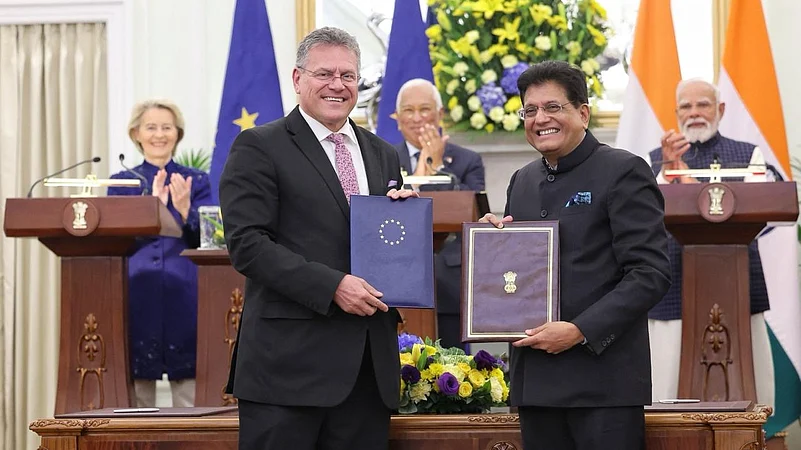
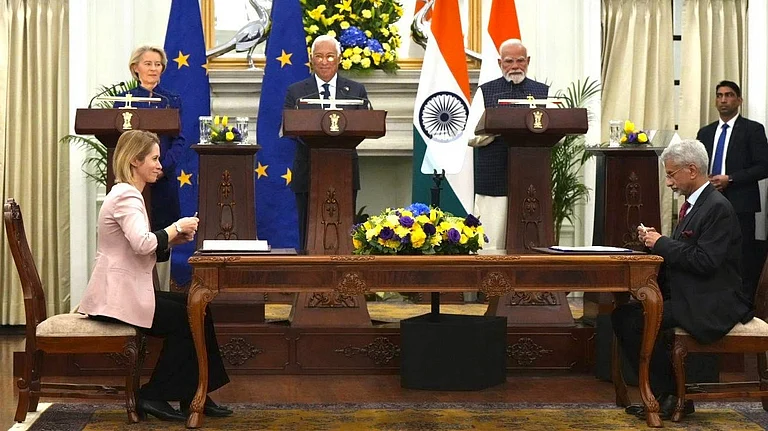
India and the European Union have concluded negotiations on their long-pending Free Trade Agreement (FTA) on Tuesday. Prime Minister Narendra Modi, European Commission President Ursula von der Leyen, and European Council President António Costa witnessed the signing of a political declaration marking the conclusion of trade talks.
The agreement will be formally signed later this year, while implementation is expected to begin next year. The pact will require approval from the Indian Cabinet and ratification by the European Parliament before it can come into force — a process that typically takes between 12 and 24 months.

1 September 2026
Get the latest issue of Outlook Business

The India–EU FTA is expected to provide a ₹6.4 lakh crore boost to Indian exports by expanding market access across the bloc for micro, small, and medium enterprises (MSMEs), manufacturers, farmers, students, and professionals, according to a government press release issued on Monday.
Advertisement
“The conclusion of the India–European Union Free Trade Agreement represents a defining achievement in India’s economic engagement and global outlook. This supports India’s approach to secure trusted, mutually beneficial, and balanced partnerships,” the Ministry of Commerce and Industry said on Tuesday.
Prime Minister Modi highlighted the scale of the bilateral trade pact, noting that the agreement spans economies accounting for nearly 25% of global GDP.
As many as 12 Indian states are expected to benefit from the agreement. “The gains will be broad-based and cluster-led, benefiting manufacturing and services hubs across multiple states, especially those anchored in MSMEs and labour-intensive value chains,” the press release said.
Advertisement
Uttar Pradesh is projected to see the highest employment multipliers, driven by its large labour-intensive base in leather and crafts. Saharanpur’s furniture and handicrafts exports, western Uttar Pradesh’s agri-products, and Noida’s electronics manufacturing sector are also expected to gain.
Tamil Nadu is likely to benefit from a boost to labour-intensive clusters. Apparel exports from Tiruppur are expected to become more competitive due to tariff reductions on textiles, while leather and footwear exporters in the Vellore–Ambur region are set to gain from the elimination of tariffs that currently stand at 17%. Major cities such as Chennai and Coimbatore are expected to strengthen their positions as hubs for engineering goods and electronics exports.
Telangana is also expected to benefit, particularly in textiles and advanced manufacturing sectors.
Maharashtra is projected to see strong demand from the EU, especially in textiles. With tariffs on textiles and electronics eliminated from earlier levels of 12% and 14%, clusters in garments manufacturing, engineering goods, and pharmaceuticals are expected to expand orders and deepen supply-chain linkages with Europe. Pharmaceutical exports from the Thane–Raigad region and gems and jewellery shipments from Mumbai are also expected to rise as tariffs fall and market access widens.
Alongside Mumbai, Surat in Gujarat is set to see strong growth in textiles and gems and jewellery exports, while the Bharuch–Vadodara belt is expected to scale up chemical exports, with tariffs reduced to zero from 12.8% on 97.5% of chemical exports to the EU. Jaipur’s jewellery exports are also projected to rise, while Jodhpur is likely to expand wooden handicrafts shipments with broader market access.
West Bengal is expected to leverage exports of Darjeeling tea, building on preferential access to European markets. “Seafood exports from Digha and Haldia, including shrimp and frozen fish that currently attract tariffs as high as 26%, will see preferential access to EU markets. Traditional handicrafts will also gain from improved access, supporting small producers and local value addition,” the release said. Farmers and artisans in Assam are also expected to benefit from enhanced market access, particularly for brand-led exports.
In spices and food categories, Kerala is projected to gain, with Kochi and Alappuzha likely to see expansion in shrimp and tuna exports through preferential access to European markets. Idukki and Wayanad are expected to benefit from increased demand for spices such as pepper and cardamom.
Karnataka is expected to gain from preferential access that supports growth in advanced manufacturing and export-oriented services. Andhra Pradesh is also well positioned to benefit from its coastal export economy. “Visakhapatnam will see gains in pharmaceuticals and electronics exports, strengthening the state’s manufacturing base,” the press release said.
Punjab is likely to benefit through MSME clusters, with Ludhiana expected to expand garments and knitwear exports, while Jalandhar is poised to push sports goods deeper into EU markets.