The Centre will release an AI regulation consultation paper within a month, covering safety, deepfakes and emerging risks.
India is targeting indigenous GPUs for AI inference within three to four years.
The government is also expanding AI infrastructure, adoption and skilling under the IndiaAI Mission.
India is moving closer to putting a regulatory framework around artificial intelligence. The Ministry of Electronics and Information Technology (MeitY) is set to release a consultation paper on artificial intelligence (AI) regulation within a month, laying the groundwork for India's future regulatory framework for the rapidly evolving technology.
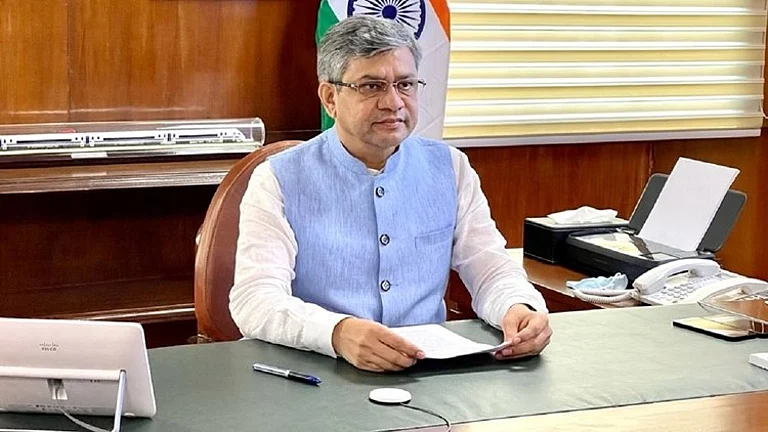
Union IT minister Ashwini Vaishnaw said the proposed framework would focus on AI safety, human-centric development, skilling, inclusive access and emerging risks, including deepfakes and psychological harms arising from AI use.

1 October 2026
Get the latest issue of Outlook Business

Speaking at an event involving the World Bank, Vaishnaw said the government would follow a techno-legal approach to AI regulation rather than relying exclusively on legislation.
“That consultation paper will form the base for the regulation which has to come,” Vaishnaw said.
The minister emphasised that AI companies and other industry stakeholders would have to shoulder primary responsibility for addressing cybersecurity threats, user safety concerns and potential psychological harms associated with AI-powered platforms.
He also flagged the growing sophistication of AI-generated deepfakes, warning that such content could mislead users, spread false narratives and create wider societal risks.
The proposed consultation paper will serve as the starting point for the Centre's next phase of AI regulation, with industry participation expected to play a central role in implementing safeguards.
Advertisement
The regulatory push comes as the Centre is also working on a UPI-like public digital infrastructure for AI under the IndiaAI Mission. At the India AI Impact Summit 2026, Vaishnaw outlined plans for an interoperable framework that would allow multiple AI models to operate on a common infrastructure, potentially making AI-powered services more accessible and affordable.
India Sets Sights On Indigenous GPUs
Meanwhile, Vaishnaw said the government now has a clearer roadmap for developing indigenous graphics processing units (GPUs), potentially reducing India's dependence on imported AI computing hardware.
The minister said India's existing semiconductor ecosystem and engineering talent could enable the development of domestically designed GPUs, initially targeting AI inference workloads, within the next three to four years.
Advertisement
He added that the roadmap had become clearer in recent months and that the government would share further progress in the coming weeks.
The push also aligns with the Centre's broader ambitions to build domestic AI hardware capabilities. At the AI Impact Summit, Vaishnaw said several companies had expressed interest in establishing AI server manufacturing facilities in India, as the country seeks to position itself as a major global AI processing hub.
On government AI adoption, Vaishnaw outlined a procurement framework under which AI startups and technology companies would first be empanelled before becoming eligible to participate in tenders floated by government departments.
The Centre is also pursuing five-year supply agreements to provide vendors with greater demand visibility. According to Vaishnaw, the government estimates demand for 10,000 GPUs, with an initial tender covering 5,000 units.

AI Education And Skilling Push
The minister also stressed the importance of AI education and skilling to ensure that the technology's economic benefits reach a wider population.
Echoing these concerns, MeitY secretary S Krishnan said the rise of AI was creating new categories of jobs, including prompt engineering and other specialised roles associated with deploying and managing AI systems. He highlighted the need to equip India's workforce with the skills required to take up these emerging opportunities.
On concerns surrounding AI-driven job displacement, Krishnan argued that the technology could complement existing roles rather than simply replace workers. Citing healthcare as an example, he said cheaper AI-enabled diagnostics could expand access to medical services while creating demand for additional technicians.



Krishnan also emphasised the importance of moving beyond technological experimentation to deploying AI solutions at scale. He expressed optimism about the growing momentum around practical AI applications, particularly those capable of addressing everyday challenges faced by Indian citizens.
Vaishnaw, meanwhile, highlighted the potential for AI to improve productivity and lower costs across agriculture, healthcare and MSMEs, particularly through applications accessible in regional languages.
At the AI Impact Summit, Vaishnaw had also identified personalised education as a major opportunity for AI adoption, alongside agriculture and MSMEs. He said some AI solutions developed under the IndiaAI Mission would be made available free of cost to a large section of the population, reinforcing the government's emphasis on affordable and inclusive access.
The emphasis on workforce readiness comes as the World Bank's latest India Development Update identifies skills development, wider AI adoption and stronger digital infrastructure as key priorities for translating AI advances into productivity gains and employment opportunities. The report also highlights India's sizeable technical workforce as an advantage in expanding AI adoption.
The Centre has also been working on integrating AI into education, including curriculum development, industry-linked training and efforts to equip students with skills required for an AI-driven economy.