


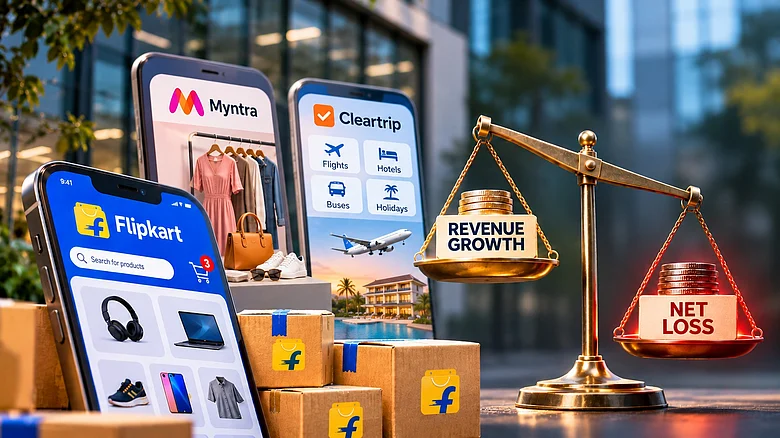

Flipkart Group’s revenue from operations increased to ₹1,45,880 crore in FY26, while its consolidated net loss stood at ₹8,468 crore.
Adjusted operating losses narrowed by about ₹1,600 crore, but higher finance costs and other adjustments limited the net-loss improvement.
Better order-level economics, advertising revenue and cash generation will be important to achieving sustainable profitability.
Flipkart Group’s latest financial results show the difference between growing a business and making it profitable. Revenue from operations rose 18% year-on-year to ₹1,45,880 crore in FY26, but the group’s consolidated net loss narrowed by just ₹178 crore to ₹8,468 crore from ₹8,646 crore in FY25.
The operating performance improved more substantially. Adjusted operating losses narrowed by around ₹1,600 crore, while the adjusted operating margin improved from -7.7% to -5.4%.

1 October 2026
Get the latest issue of Outlook Business

The figures are for the year ended March 2026 and cover the wider Flipkart Group, including the Flipkart marketplace, Myntra, Cleartrip, logistics and other businesses. They were published following the group’s redomiciliation to India and provide a consolidated view rather than reflecting the financial performance of the Flipkart shopping marketplace alone.
The question is why improvements in revenue and operating margins have not translated into a comparable reduction in the group’s net loss.
Growth Comes With Costs
Running a large e-commerce business involves more than bringing buyers and sellers together. Each order can involve merchandise costs, warehousing, packing, delivery, customer support and returns. Technology, marketing and discounts add to the expense of attracting and retaining customers.
Advertisement
Flipkart Group’s total expenses rose 16% to ₹1,54,781 crore in FY26, according to its reported financial results. Purchases of stock-in-trade, its largest expense item, increased 17% to ₹1,17,617 crore. Finance costs climbed to ₹1,209 crore from ₹649 crore.
Professor Manish Gangwar of the Indian School of Business says the economics of each order are central to understanding profitability. “What matters is how much remains after serving each order,” he says.
Notably, a platform may sell more products but still struggle to improve its margins if the cost of fulfilling those orders rises alongside sales. Delivery and returns are particularly difficult to reduce because they involve physical operations. Gangwar notes that the number of orders concentrated within a neighbourhood can matter more than national scale alone: a dense delivery network can improve productivity, while entering new areas may raise costs before demand builds.
Advertisement
The revenue mix also matters. Merchandise sales, marketplace fees and advertising do not generate the same margins, making the composition of revenue as important as its growth.

Advertising Offers A Lever
Advertising is one area where Flipkart Group is growing faster than its overall business. Flipkart Ads expanded 31% in FY26, compared with 18% growth in consolidated revenue from operations. The group also reported 23% year-on-year growth in gross margins in absolute terms.
Advertising allows sellers and brands to pay for greater visibility among shoppers already using the platform. Because it does not require the same direct handling and delivery of additional merchandise, it can offer an attractive source of incremental revenue.
“Advertising can be an important source of profit because it earns revenue from shopping traffic the platform has already attracted, with relatively little additional physical cost,” Gangwar says.
However, growth in advertising revenue alone does not establish how much it contributes to the group’s profitability. Gangwar cautions that without absolute revenue and profitability figures, it is not possible to determine how much Flipkart Ads offsets the group’s losses.
Salman Waris, founder of TechLegis LLC, also identifies advertising and seller services as important potential contributors to margins. But he notes that sellers must still earn a worthwhile return after paying commissions, advertising and other charges. Advertising can support profitability, but the underlying shopping and delivery operations must also become more efficient.

Why The Net Loss Persists
The difference between adjusted operating losses and net loss helps explain the FY26 results. Adjusted operating losses exclude finance costs, tax, other income and exceptional items. These measures therefore capture a narrower view of performance than the final consolidated net loss.
Waris says the operating gains are real, but the adjusted figures need to be understood in context. Finance costs rose by ₹560 crore during FY26, absorbing a significant part of the improvement in operating performance. The group also cited the derecognition of deferred tax assets and certain one-off exceptional items as factors limiting the reduction in net loss.
The previous year had included a ₹524 crore gain from reversing a tax provision, according to Business Standard. That also affects the year-on-year comparison.
Performance across individual businesses adds another layer. Myntra, part of Flipkart Group, swung from a net profit of ₹548.5 crore in FY25 to a net loss of ₹579.4 crore in FY26, according to its reported financial statements. The loss included a ₹137.5 crore write-off of deferred tax assets. These factors do not negate the improvement in adjusted operating performance. They show why that improvement does not automatically flow through to the group’s bottom line.

What Profitability Requires
For Flipkart Group, the next test is whether it can improve the economics of individual orders while controlling the costs of expansion. Gangwar says businesses need to monitor delivery and return costs, warehouse utilisation, repeat purchases without heavy incentives, and the actual profit contribution from advertising and seller services.
Cash flow is another important measure. Reporting the group’s financial results, a Business Standard report stated that cash used in operations increased to ₹6,525 crore in FY26 from ₹4,086 crore in FY25. Borrowings more than doubled to ₹13,708 crore from ₹5,900 crore.
These figures show why narrower adjusted operating losses alone are not enough. The group must also manage its financing needs and generate sufficient cash to support operations and meet financial obligations.




Flipkart Group has reported progress in gross margins and adjusted operating losses, but its net loss remains substantial. The path to sustainable profitability will depend on whether it can make each order more economical, grow revenue streams with stronger margins and turn operating improvements into better overall financial results.