FIFA World Cup 2026 India media rights remain unsold despite 110M viewers
Late match timings weaken advertising value and prime-time audience reach
Cricket dominance limits football’s advertising inventory and commercial appeal in India
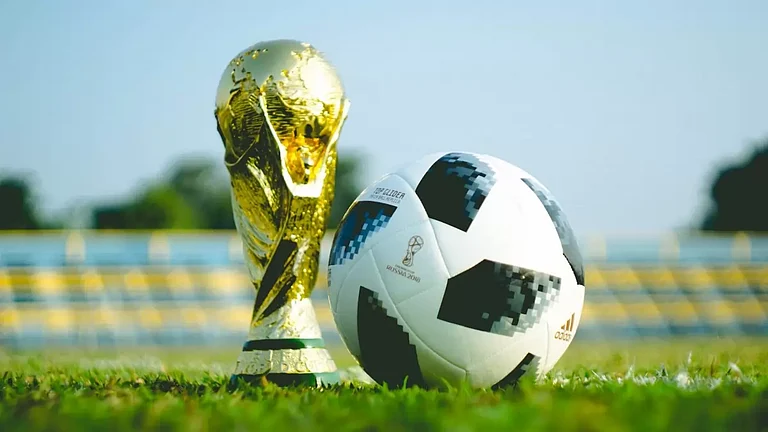
Every four years, the FIFA World Cup reorganises the world's attention. The 2026 edition, spread across 16 cities in the United States, Canada, and Mexico, is the largest in the tournament's history. With the field expanding from 32 to 48 teams and the total number of matches growing to 104, FIFA billed it as the most inclusive World Cup ever staged.
Globally, the commercial machinery around it is operating as expected. In India, however, there is an uncomfortable silence where a bidding war should have been.

4 July 2026
Get the latest issue of Outlook Business

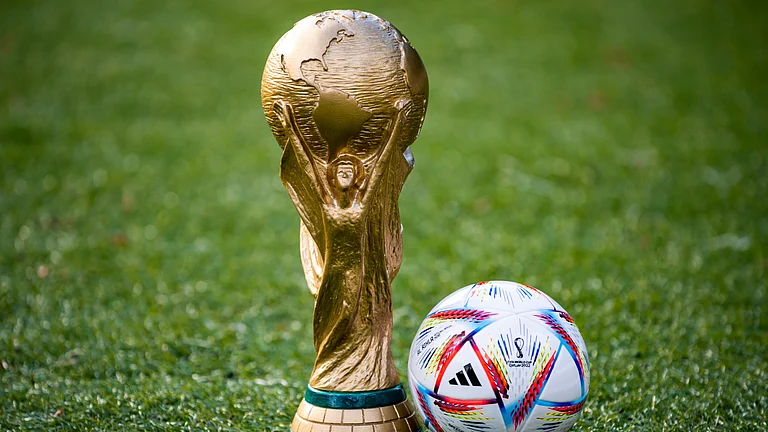
With less than two months to go before the tournament kicks off, the Indian media rights remain unsold — an unusual and worrying development this close to kickoff. For a country that produced over 110 million digital viewers during the 2022 Qatar edition, the situation reads as a paradox. It is not.
Numbers That Led Here
On the final day of the 2022 World Cup, which featured Argentina's first triumph since 1986, a record 32 million viewers tuned in to JioCinema alone. The tournament clocked 40 billion minutes of watch time across Sports18 and JioCinema.
The Viacom18 paid over $62 million for digital rights in India for the 2022 edition, setting a record at the time. Sony Sports Network had held television rights for the 2014 and 2018 editions before that.
Advertisement
FIFA launched fresh tenders for the Indian subcontinent in July 2025, requesting around $100 million for the combined rights to the 2026 and 2030 competitions.
The market did not respond. The asking price was then slashed to $35 million. Even so, no buyer has come forward, with rights now valued by industry insiders at closer to $25 million. That is a drop of $65 million from where FIFA started. It has not been enough.

The Midnight Problem
The first and most immediate issue is geography. In 2022, matches ran in the evening and late evening in India. Qatar 2022 saw 44 matches air before midnight in India. Russia 2018 had 63 such matches. For the 2026 edition, only 14 of the 104 games begin before midnight IST.
Advertisement
More than 87% of the tournament's 104 games will air after 10 pm IST. At GMT+5:30, India will get just 13 games, barely 12.5 per cent of the total, during daylight hours.
For advertisers, it is a structural problem. Prime-time viewership is what sells inventory. A match airing at 3 am IST cannot deliver the audience numbers that justify premium ad rates, no matter how competitive.
Despite the tournament is expanding, WARC's latest data shows the football World Cup's measurable ad market impact declining from $12.6 billion in 2018 to a forecast $10.5 billion in 2026.
Cricket's Grip
Timing alone does not explain the reluctance. India's sports advertising market has a deeper architectural problem for any non-cricket property trying to command serious money. Cricket allows brands to secure ad slots after every over, every dismissal, and every boundary. Football's commercial opportunities are restricted to pre-match, half-time, and full-time. In a market where advertisers have come to expect near-constant inventory, football simply cannot compete for the same rupees.
It is also unlikely that India will qualify for the World Cup anytime soon. The team sits well outside the top 100 in the FIFA rankings. Without the nationalist hook that drives cricket viewership into the hundreds of millions, the tournament relies entirely on the appeal of foreign stars and neutral interest. That audience exists in India, but it has limits.
Digital Dilemma
The 2022 tournament created another problem by streaming it for free, supercharging digital viewing on JioCinema. The 2022 World Cup triggered a dramatic transformation in football viewership patterns among Indians, leading to a loss of 87 million traditional television viewers.
Audiences moved to digital, not away from football. But digital football audiences in India have proved resistant to subscriptions, and their advertising value is lower than linear TV viewers.
Linear TV viewership for the World Cup fell 11.9% globally between 2018 and 2022. India saw one of the steepest individual market drops. The audience did not disappear; it fragmented. Fragmented audiences are harder to monetise and, crucially, harder to sell to advertisers who still write cheques on the basis of consolidated reach.
It is the most visible symptom of a broader collapse in football's commercial value in India. FanCode secured the Indian Super League's broadcast rights for the 2025-26 season for just ₹8.5 crore — a staggering fall from the ₹550 crore paid by Viacom18 for the previous two seasons combined, representing a near 97% erosion in value. With 91 matches scheduled for that season, the value per match plummeted from ₹1.68 crore to just ₹9.47 lakh.