




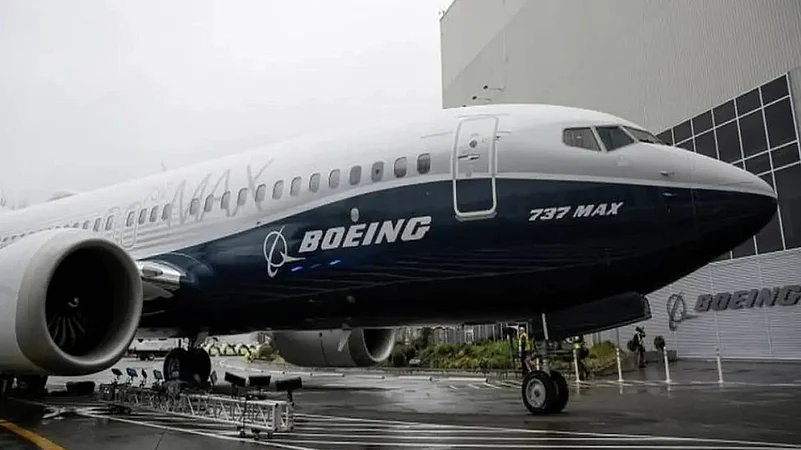

Boeing has flagged a 737 MAX software issue during missed approaches; it is working on a permanent fix.
Air India Express, Akasa Air and SpiceJet fly the type and hold 505 unfilled orders; Akasa says operations are unaffected.
The issue lands as Boeing has not stabilised 737 production at 47 a month, with Indian fleet expansion riding on timely deliveries.
Boeing has flagged a software anomaly that can surface during a missed approach. Indian carriers fly nearly 100 of the type and have around 500 more on order. The question is not whether the jet is safe to fly today, but how much of India's aviation expansion now rides on Boeing getting its house in order.
Boeing has told airlines that a software issue in some 737 MAX aircraft can arise during a specific landing scenario, and that its engineers are working on a permanent fix. The problem, the manufacturer says, can occur after a missed approach, when pilots alter the pre-programmed flight path. In that sequence, the flight management computer may cause the aircraft to transition out of vertical navigation mode into a simpler level of automation for pitch control, leaving the jet without the automated vertical guidance pilots would normally expect.

1 September 2026
Get the latest issue of Outlook Business

The company says it informed all 737 operators last month and issued material reinforcing existing procedures for the situation, and that it is working with airlines on a method that would let pilots re-enable automated vertical navigation should it occur. Boeing also stressed what it has said repeatedly since the MAX returned to service; pilots are trained to land the aircraft without automated vertical navigation, and the manual skill set is a routine part of type training.



Advertisement
Akasa Air said that it was coordinating closely with Boeing and that there was "no impact" on the safety of its operations, adding that its aircraft continued to fly according to established procedures and applicable regulatory requirements. That is the standard airline response to a manufacturer service bulletin, and it is technically accurate. It is also not the whole story of why this matters in India.
A Jet India Is Betting On
The 737 MAX has quietly become one of the load-bearing walls of Indian fleet planning. Air India Express and Akasa Air together operate around 96 of the aircraft, roughly 53 and 43 respectively, according to PTI. Neither is a legacy carrier with a diversified fleet. Air India Express is the low-cost international arm of the Air India group and the vehicle for the Tatas' ambitions on short-haul international routes. Akasa Air has built its entire operation, and its identity, around the type.
Advertisement
The order books make the exposure clearer. Boeing customer order data shows 505 unfilled orders across Indian carriers; 167 for Air India, 183 for Akasa Air and 129 for SpiceJet. Air India additionally holds 10 unfilled orders for the 777X and 16 for the 787-9. In January, Boeing announced that Air India had ordered another 30 MAX aircraft, 20 of the 737-8 variant and 10 of the 737-10, taking its total order book to nearly 200 aircraft across single-aisle and widebody families. The 737-8s are earmarked for high-frequency domestic and short-haul regional routes.
Akasa, meanwhile, is in talks with Boeing to order more than 200 additional 737 MAX aircraft, according to Bloomberg, with a decision expected early next year and terms likely to be finalised in the second half of 2027. The proposed purchase would underwrite fleet growth beyond 2032. The airline is targeting a 30% increase in capacity by March 2027, which gives the delivery pipeline a hard deadline that has nothing to do with software bulletins.
Scale this up and the stakes become obvious. Boeing's own commercial market outlook projects that India and South Asia will need nearly 3,300 new aircraft over the next two decades, with 90% of them single-aisle jets of the MAX class. India is not a peripheral market for the programme. It is one of the reasons the programme has a future.
The context matters here, because the 737 MAX's name still carries the weight of its worst chapter. The aircraft was grounded worldwide after two fatal crashes: a Lion Air 737 MAX 8 that went down in Indonesia in October 2018, killing 189 people, and an Ethiopian Airlines 737 MAX 8 that crashed in March 2019, killing 157. India grounded the type in March 2019 and cleared it to fly again in August 2021, after software revisions and changes to pilot training.
The current issue is a different animal. It concerns flight management computer logic in a missed-approach scenario, not the flight control law tied to a single angle-of-attack sensor that defined the MCAS crisis. It affects how the aircraft moves between automation modes, not how it responds to erroneous stall warnings. Boeing has delivered more than 2,400 MAX aircraft globally and no regulator has moved to ground the fleet over this.
But reputational recovery is cumulative and fragile. Every new technical disclosure on the MAX is read by regulators, airlines and passengers through the lens of 2018 and 2019, whether or not the comparison is technically fair. That is the cost of the aircraft's history, and Boeing knows it.
The Production Problem Sitting Underneath
The software flag also lands at an awkward moment for Boeing's assembly lines. President and CEO Kelly Ortberg has said the company is producing 737s at 47 a month but has not stabilised output at that rate. "We're now driving at 47 a month, but we are not stable yet at 47 a month," he told an investor conference, adding that stabilising the production system was taking longer than he had anticipated.
Boeing has been under tighter regulatory oversight since a door plug blew out on an Alaska Airlines 737 MAX 9 in January 2024, after which the US Federal Aviation Administration capped production rates. Restoring confidence, lifting output and clearing a delivery backlog are three separate problems that compound each other.
For Indian carriers, that is where a software bulletin stops being an engineering footnote. A fix that requires fleet-wide software updates, a procedural change that requires recurrent training, or an FAA airworthiness directive that triggers a DGCA advisory all consume time. Deliveries slip. Capacity plans get revised. Route launches slip to the next season. Akasa's 30% capacity target for March 2027 and Air India Express's international expansion are both functions of how many aircraft arrive, and when.
What To Watch
The immediate question is regulatory. If the FAA issues a formal airworthiness directive, the DGCA will reportedly follow with its own directive or advisory, and operators will have a compliance window. If the FAA treats it as a service bulletin matter, the response stays at the manufacturer-airline level, as per media reports.
The second question is the fix itself. Boeing has not given a timeline for the permanent software update, and how it is deployed across a global fleet of more than 2,400 aircraft will determine whether this is a fortnight's paperwork or a quarters-long programme.
The third is whether any of it touches delivery schedules. That is the number Indian carriers will be watching most closely, and the one Boeing has the least room to get wrong.









