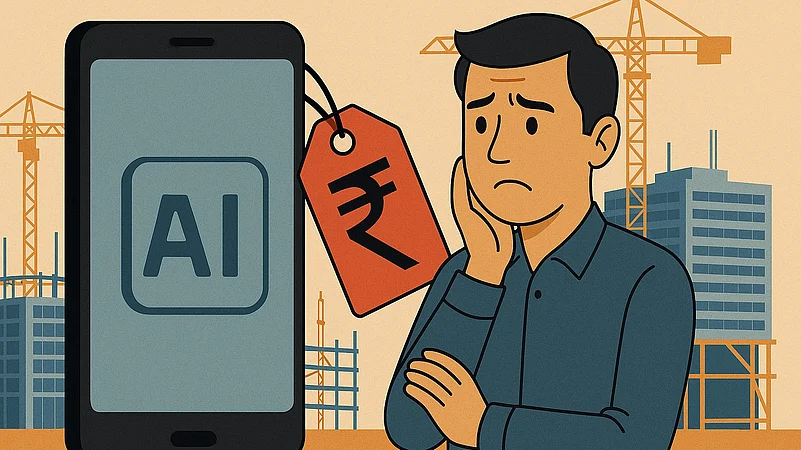

Smartphone brands have raised prices post-Diwali by ₹1,000–₹2,000, leading to weaker sales during the ongoing quarter.
Models from Vivo, Oppo, Xiaomi and Realme have seen price increases in November and December.
Retailers warn that more brands may hike prices soon, potentially deepening the sales slowdown.
The rising hype around artificial intelligence and robotics may seem a world away from the narrow lanes of Gaffar market in Delhi’s Karol Bagh. But for consumers and retailers in this bustling market—known for its rows and rows of phone shops—the AI revolution is having a very real impact—steeper price tags and lower sales.
"Post Diwali, brands have started raising prices," said All India Mobile Retailers Association (AIMRA) Founder-Chairman Kailash Lakhyani. He added that, although a post-Diwali dip was expected, the price rise has started impacting sales.
1 September 2026
Get the latest issue of Outlook Business

Lakhyani said October saw good numbers because of festive season sales, but he expects November and December to see a clear impact from the hikes.



Brands like Vivo, Oppo, Xiaomi and Realme increased prices on select models by around ₹1,000 to ₹2,000, according to dealers. The first price increase was communicated to retailers in early November. Vivo in that month increased prices of its T4x, T4R model. On December 1, it conveyed further revisions for T4 Lite, T4x, T4R and T4 models by as much as ₹2,000.
Retailers said Xiaomi also implemented similar hikes starting December 1. Xiaomi revised prices for the Redmi Pad 2 due to rising RAM and ROM costs, with the 4GB+128GB model increasing to ₹14,999, and the Wi-Fi + Cellular variants rising by ₹1,000 per model.
Advertisement
Lakhyani warned that more brands may follow with similar hikes, adding that the market is already weak and further hikes could dent smartphone sales in December.

K-Shaped Recovery
The price hikes, linked to the global AI revolution, is likely to exacerbate the bifurcation of the market into a dull entry- and mid-range segment and a vibrant premium segment—the so-called K-shaped recovery. The trend is not unique to the smartphone market, and has been seen in other categories such as automobiles and real estate.
In the smartphone category, this phenomenon has been reflected in the rising share of iPhone maker Apple. It sold nearly five million smartphones in India between July and September 2025, marking its highest-ever quarterly shipments in the country and securing the fourth position in a market dominated by low-cost Chinese brands.
Advertisement
Partly to revive demand in the mainstream market, the government of India in September rationalised the Goods and Services Tax (GST) structure from four slabs (5%, 12%, 18% and 28%) to a two-slab system of primarily 5% and 18% to spur buying sentiment among consumers. Although GST rates for smartphones were not changed, the move still helped lift sentiment among buyers. However, the latest round of price hikes appears to have undermined that strategy.
“...the positive sentiment driven by the GST rate cut has been paused due to the price hike," Lakhyani said.
Requests for comment from the smartphone brands largely went unanswered, with only Xiaomi responding. "The recent AI supercycle has triggered an industry-wide surge in memory costs," the Chinese firm told Outlook Business. The company, with brands like Redmi and POCO, holds around 15% of the Indian smartphone market.
The Beijing-based firm's President Weibing Lu had, on November 18, confirmed a "big cost increase" of internal memory chips and anticipated "a downturn in the smartphone market due to price increases". He was speaking to analysts during the quarterly earnings call.
It added that it would “take measured steps to ensure our consumers are impacted the least and continue to enjoy true value for money.”
Xiaomi is not alone in raising the alarm bell. Earlier, Chinese chip maker SMIC warned that there is a shortage of memory chips in the global market which may constrain car and consumer electronics production in 2026.

The Casualties of a Revolution
The biggest factor driving the price increases is the rising demand for AI chips. While smartphone chips are not used in the AI industry, semiconductor manufacturers such as TSMC, Samsung and SK Hynix have dedicated more of their chip fabrication capacity to producing the chips used in AI, constraining the output of chips used in other industries, including smartphones.
The race for dominance in AI has led to higher and higher demand for cutting-edge memory chips which are required to run AI accelerators like GPUs (Graphics Processing Units), TPUs (Tensor Processing Units) and NPUs (Neural Processing Units).
These accelerators use specialised high-bandwidth memory designed to move massive amounts of data. They are also made by the same companies that make internal memories for smartphones.
For instance, Samsung Electronics supplies HBM2, HBM2E and HBM3 for AI accelerators and also makes memory used in smartphones like LPDDR4X, LPDDR5 and LPDDR5X. Its local rival SK Hynix is the world’s largest supplier of HBM, with customers like Nvidia. The company also makes mobile DRAM and NAND flash.
"The global AI server boom has swallowed up the supply of high-end memory (DRAM/HBM), driving component prices up by 20-30%," said Neil Shah, Co-Founder of market research firm Counterpoint Research.
But AI is also pushing up smartphone prices in other ways, as manufacturers are forced to beef up their processing capacities to run AI applications. Shah pointed out that manufacturers are integrating advanced computing architectures, including larger neural processing units and cutting-edge GPUs and CPUs, in their smartphones.
“To run GenAI and agentic applications on-device, phones need significantly smarter brains (SoCs) and much larger memory buffers," said the Counterpoint Research Co-Founder.
Finally, AI has also led to an overall increase in costs for semiconductor manufacturers as the technology has forced them to accelerate the rollout of newer, and more expensive, manufacturing technologies.
"The move to cutting-edge 3nm and 2nm foundry nodes has nearly tripled chip manufacturing costs...We are effectively seeing an 'AI tax' on hardware,” he added.
Another factor is the depreciating value of the rupee compared to the dollar. So far this year, the Indian rupee has declined around 4.15% compared to the greenback. This has put pressure on the importers of smartphone components in India for assembly. The country, which in FY25 emerged as the world's second largest smartphone exporter, imported $7.15 billion worth of components at the same time. About 51.7% came from China, as per GTRI.
"Macroeconomic pressures, currency depreciation in import-heavy markets, and the industry’s pivot toward AI-first devices all converge to create a multi-year upward bias in pricing," said Prabhu Ram, Vice President (VP) - Industry Research Group (IRG), CyberMedia Research.
Impact on Indian Buyers
Experts say this increase will impact the Indian smartphone market, which is seeing a K-shaped recovery. "The wealthy are happily buying flagships, while the mass market (under ₹15k) is stalling because entry-level buyers are price-sensitive," said Shah.
He added that a further price hike here will likely freeze upgraders in the budget segment, forcing them to hold onto their old phones longer, effectively deepening the slowdown in the high-volume tiers.
This slowdown can be traced in quarterly smartphone shipment numbers released by agencies like IDC Research, Counterpoint, Omdia and others.
According to Omdia's quarterly smartphone shipment data for India, the market has seen volatile growth in the past seven quarters. After recovering in the final quarter of 2023, the market sharply slowed down in Q2 (Apr-Jun) 2024. It later went on to a sharper decline of 8% year -on-year in Q1 this year before recovering in Q2 by 7%. In Q3, 2025 the market saw modest 2% shipment growth. But it is expected to slow further in the coming quarters.

“With limited organic demand, Q3’s momentum was largely sustained through incentive-led channel push rather than pure consumer recovery,” said Sanyam Chaurasia, Principal Analyst at Omdia.
He noted that Q3’s gains are unlikely to sustain into a strong year-end.
"While government-led reforms such as GST reductions on large appliances lifted overall retail sentiment, smartphone-specific demand recovery remains limited. Urban consumers continue to delay upgrades due to employment uncertainties and rising cost sensitivity, despite better product availability and financing schemes," said Chaurasia in a report on October 21.
According to Shah, there could also be a few who would prefer spending on secondary market models such as refurbished or used two- or three-year-old flagships, further putting pressure on new smartphone sales in this segment.
Ram also agrees with the sentiment, adding that over the next few quarters, this will likely deepen the divergence between flat or declining shipments at the bottom and steady growth in mid-premium and premium segments.
"The premium and uber-premium smartphone segments will continue to remain stable as consumers in these segments are more accustomed to EMI-driven upgrades. As such, premium brands can still grow value and market share," he said.
The premium segment has been growing its presence in India as the adoption of premium products rises. Today, Apple has a bigger pie in India's smartphone market compared to a year ago.
According to Counterpoint Research, Apple increased its share of the Indian smartphone market to 9% from 7% in Q3 2024. In comparison, market leader Vivo has also grown from 20% to 24%, but others like Oppo have declined from 17% to 16%, Xiaomi is down from 17% to 13% and Samsung is down from 15% to 13%.

This divide between the mainstream segment and premium is expected to expand further as experts see the budget and mid-segment "feel the pinch the hardest" from the price hike cycle.
"Premium flagships have fat margins that can absorb some shock, but mass-market phones operate on razor-thin margins. When memory and processor costs jump, budget makers have nowhere to hide, they either have to hike the price tag or cut corners to optimise the Bill of Materials costs on other features like cameras, displays or build quality," said Shah.
He added that Apple has a unique cushion because it designs its own silicon and makes massive profits from its services business (App Store, iCloud), allowing it to subsidise hardware costs if needed and absorb the price increase in a way others can't.
Shah expects other brands to create ways to mask the hikes by likely introducing model 'tiering’, keeping the base model price stable but stripping it of features, while pushing the true upgrades to a much more expensive 'Pro' or 'Ultra' model.
On the consumer side, Prabhu Ram expects more "elongated replacement cycles" for buyers. He also expects some aspirational users being nudged "toward higher EMI-led upgrades in the premium segment."
The country is already seeing a reported rise in default rates on mobile-phone financing. As per an October report by the Economic Times (ET), delinquencies have risen to about 2.7–2.9%, higher than the usual 2% benchmark. With the expected rise in prices, EMI purchases could become a key way for buyers, something that might worry more Indian authorities.