JM Financial expects a possible excise duty hike in FY27 Budget, posing risks to downstream OMCs, while upstream players remain better placed.
Low global crude prices near $60 per barrel have pushed OMCs’ fuel marketing margins far above normal levels, as retail prices have not fallen proportionately.
With petrol and diesel GMMs nearly three times historical averages, JM Financial warns these "windfall" margins may trigger policy intervention.
As the Union Budget for the financial year 2026-27 (FY27) is approaching, stock broking major JM Financial is expecting a policy move by the government. The analyst flagged a possible increase in excise duty on petrol and diesel, a key policy move that could significantly risk India's downstream oil marketing companies (OMCs).
In its recent reports, the brokerage firm highlighted two main themes—first, that downstream OMCs like Hindustan Petroleum Corporation Limited (HPCL), Bharat Petroleum Corporation Limited (BPCL) and Indian Oil Corporation Limited (IOCL) may face fiscal pressure if the government uses excise duty to boost revenue.

1 September 2026
Get the latest issue of Outlook Business

Second, upstream oil producers like Oil India and Oil and Natural Gas Corporation (ONGC) will comparatively be in better position under such potential conditions.

Point to note: Upstream companies produce crude oil, while downstream OMCs refine and sell petrol and diesel to consumers.
What JM Financial is Expecting
A major reason the analysts are watching the Budget is the divergence between global crude oil prices and domestic fuel margins. Global crude oil prices have stayed relatively low, around $60 per barrel, due to oversupply in the international market. Historically, OMCs earned a normalised auto-fuel gross marketing margin (GMM) of about ₹3.5 per litre when Brent crude trades near $72 per barrel. However, with spot Brent currently around $61 per barrel, fuel marketing margins have surged beyond long-term averages.
Advertisement
Point to note: When crude oil prices fall, fuel prices don't always drop by the same amount because taxes such as excise duty form a large part of the pump price. This has allowed OMCs to earn higher-than-normal margins, especially on petrol and diesel.
The GMMs are sharply above historical averages, due to the difference between production cost and actual selling price. These higher margins mean bigger profits for OMCs.
JM Financial estimates that petrol and diesel GMMs are currently around ₹10.6 per litre, nearly three times more than the historical norm of ₹3.5 per litre. Integrated gross margins, which include refining and marketing profits, have expanded to roughly ₹19.2 per litre compared to a long-term average of about ₹12.2 per litre. Notbaly, OMCs are earning ₹6-7 per litre, more than what is considered a sustainable margin level.
Advertisement
These high margins have led to strong recent earnings for HPCL, BPCL and IOCL, the companies that typically operate in a tightly regulated environment with thin profitability. However, the brokerage warns that such "windfall-like" gains rarely persist without policy intervention, especially when fiscal pressures are building elsewhere in the economy.
What Govt is Expected to do in Budget
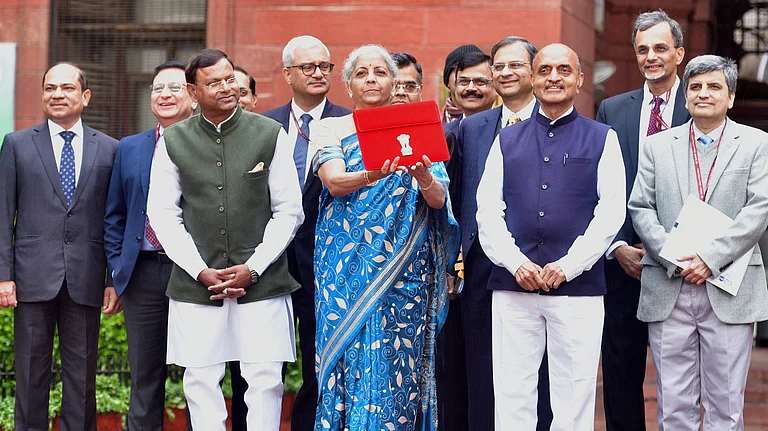
JM Financial highlighted that the government's FY26 revenue run-rate is lagging its budgeted estimate, as it is reflecting softer nominal growth and tax revenues growing more slowly than the economy in some segments. This has increased the challenge of meeting the government's 4.4% fiscal deficit target for FY26. JM Financial's economics team expects the Centre to further tighten its fiscal stance and lower the deficit target to 4% or 4.2% of GDP in FY27.
In this situation, fuel excise duty is seen as a dependable and easier way for the to raise revenue. Revenue from fuel taxes has historically remained stable even during economic slowdowns, and adjustments can be made without directly raising retail prices if global crude prices are falling.
The brokerage expects Brent crude prices to remain subdued around $65 per barrel until at least November 2026, aided by continued oversupply of 2-3 million barrels per day as Saudi Arabia-led OPEC+ manages production levels. This long period of soft crude prices, analysts say, provides room for the government to increase excise duty without passing on the burden to consumers.
The brokerage believes an excise duty hike of ₹3–₹4 per litre on petrol and diesel is likely ahead of the 2026 Union Budget. If the Centre would actually make this move, then it could generate additional annual revenue of ₹500-700 billion, which is equivalent to about 0.15-0.2% of GDP. The brokerage notes that the government has already shown its willingness to use indirect taxes to boost revenue, as it recently increased excise duty on cigarettes, effective February 1, 2026.
Its Effect on Oil Companies
While an excise duty hike would support the government's fiscal position, it would significantly hamper the earnings for downstream OMCs. According to JM Financial, every ₹1 per litre change in auto-fuel GMM leads to a 12-17% change in consolidated EBITDA ( Earnings Before Interest, Taxes, Depreciation, and Amortization). HPCL is the most sensitive, with EBITDA changing by about 16.6% for every ₹1 per litre movement in margins, followed by BPCL at 14.5% and IOCL at 12.4%.
A ₹3-4 per litre excise duty increase would make a sharp contraction in profitability. JM Financial maintains a “sell” rating on HPCL and “reduce” ratings on BPCL and IOCL, citing both policy risk and stretched valuation multiples. HPCL is seen as the most exposed due to its higher reliance on the fuel marketing business.
In contrast, upstream oil producers such as ONGC and Oil India are comparatively insulated from excise duty changes, as their revenues are linked to crude production rather than retail fuel pricing. Therefore, JM Financial continues to favour these companies.