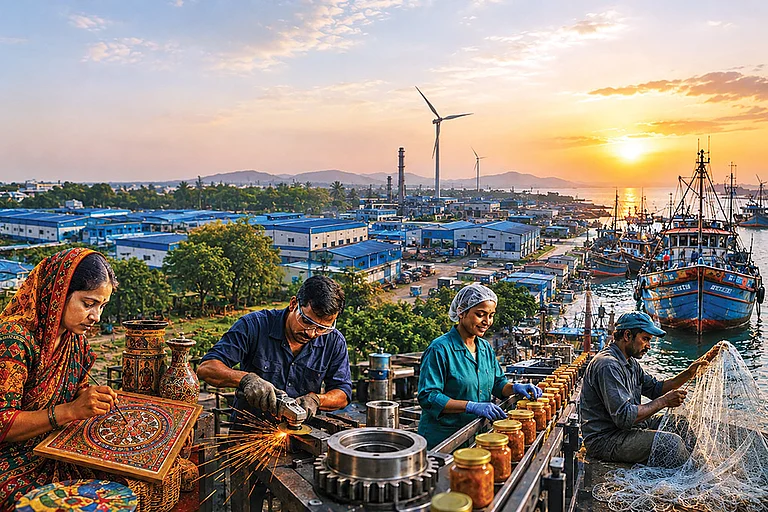

India’s climate transition hinges less on headline-grabbing gigafactories and more on MSMEs in the “missing middle."
The waste-to-energy firms, circular packaging startups and EV component makers starved of credit.
The article argues climate finance is shaped like an hourglass, with MSMEs structurally abandoned despite their huge role in GDP, jobs and emissions, and calls for blended finance and new underwriting models.
Ask anyone in climate finance where the action is, and they will point to the obvious landmarks; the sprawling solar parks in Rajasthan, the offshore wind pipelines, the battery gigafactories rising on the outskirts of industrial cities. These are real, necessary investments. They are also, frankly, the easy part.
The hard part, the part that will actually determine whether India meets its net-zero commitments, is happening in places with far less glamour. It's in the waste-to-energy startup in Pune, the circular packaging firm in Ahmedabad, the EV component manufacturer in Coimbatore who needs ₹3 crore to double capacity, but can't get a bank to return her calls. This is the missing middle of India's climate economy, and the silence around it is deafening.

1 September 2026
Get the latest issue of Outlook Business

The challenge is not the absence of capital. It's a wilful mismatch between the capital that exists and the businesses that need it.
The hourglass problem
Climate finance in India is shaped like an hourglass. Billions of Dollar flow from institutional investors into infrastructure projects backstopped by sovereign guarantees. At the other extreme, microfinance reaches individual households buying solar lanterns or clean cookstoves. The middle, MSMEs doing genuinely transformative work, has been structurally abandoned.
Advertisement
This isn't a rounding error. MSMEs account for roughly 30% of India's GDP, nearly half its manufacturing output, and employ over 110 million people. They also account for a substantial share of industrial emissions. Decarbonising this sector isn't optional. It is a prerequisite.

Why lenders look away
The problem isn't risk. It's unfamiliarity.
Climate-focused MSMEs tend to be younger companies in evolving sectors without extensive credit histories. Many operate asset-light models, there's no factory floor to pledge as collateral. Their sectors lack established benchmarks, and their impact measurement doesn't slot neatly into standard due diligence templates.
Advertisement
So, lenders pass. Not because these businesses are failing, many are growing quickly and profitably, but because the existing underwriting machinery simply wasn't built for them. The result is a paradox - the companies best positioned to accelerate India's energy transition are being excluded from the capital they need to do it.
Viable businesses are being turned away, not because they're failing, but because the underwriting machinery wasn't built for them.
What would help
Blended finance is the most promising structural solution. When concessional capital from development finance institutions acts as a first-loss buffer, it opens the door for private capital that would otherwise stay on the sidelines. Given that India needs somewhere between $253 and $263 billion annually in clean energy investment through 2030, these structures aren't optional extras, they are load-bearing.
Equally important is channelling development capital through alternative lenders and NBFCs who are already embedded in MSME ecosystems and understand how to price risk in these sectors. The bottleneck isn't ambition; it's distribution. Technical assistance, helping companies improve governance, data systems, and impact reporting closes the loop by making borrowers more legible to capital markets over time.

A call to the industry
Bridging this gap demands a collective shift in how the lending industry approaches risk. Underwriting climate MSMEs requires moving beyond collateral checklists and backward-looking credit scores toward forward-looking cash flow analysis and genuine sector expertise. The tools exist. What the industry lacks is the institutional will to deploy them at scale.
DFIs, banks, NBFCs, and alternative lenders each hold a piece of the solution. DFIs can anchor blended structures and absorb first-loss risk. Banks and NBFCs can extend reach through co-lending and green credit lines. Alternative lenders can bridge the last mile with speed and sector fluency. None of these actors can close the gap alone, but together, they can build a financing architecture that actually matches the shape of India's climate economy.
The capital exists. The demand is loud and visible. What the industry owes these businesses, and owes the climate, is a genuine reckoning with who gets left out when frameworks don't evolve. MSMEs will not just participate in India's climate transition. They will set its pace. The question is whether the financial system moves fast enough to keep up.
Disclaimer: The views expressed in this article are those of the author and do not necessarily reflect the views of the publication