
AgriPV (agrivoltaics) lets the same land produce both food and solar power simultaneously, offering India a way to expand renewables without adding pressure on scarce land.
Studies show significantly higher yields for crops like tomatoes and peppers under panels, better land-equivalent ratios, reduced water loss via lower evapotranspiration, and cooler-running (hence more efficient) solar panels.
India has moved past the pilot stage and should scale AgriPV into a national mission, calling for dedicated policy instruments, regulatory pathways, and farmer awareness programs rather than continued small-scale experimentation.
India has long punched above its weight on the global climate stage. From meeting its previous Nationally Determined Contribution targets well ahead of schedule to unveiling more ambitious NDCs for 2035, the country has consistently demonstrated that development and decarbonisation can go hand in hand. With a firm commitment to achieving net zero by 2070, India’s climate ambition is not merely rhetorical. Yet the next phase of climate leadership demands something even more practical — solving for growth, energy security, food security, water stress, and land scarcity all at once. That is exactly where AgriPV, or agrivoltaics, deserves a far bigger place in the national conversation.
India’s renewable energy expansion is both necessary and welcome. But the scale of that expansion forces harder questions about land and water. How do we add clean power without creating new pressure on land resources? How do we support farmers while also strengthening the energy transition? AgriPV offers a compelling answer because it uses the same land for two essential purposes simultaneously: food production and solar power generation.

1 October 2026
Get the latest issue of Outlook Business

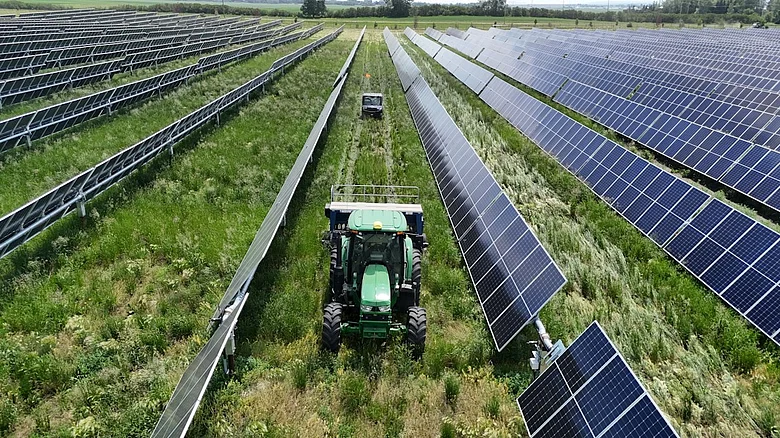
AgriPV is a simple idea. Solar photovoltaic panels are installed above or alongside agricultural land, allowing the same parcel to generate both electricity and food. Rather than displacing farmers, the technology works with them, creating a dual use of land that can redefine how India thinks about its energy transition.
Advertisement

Tangible gains
The benefits are both economic and ecological. On the economic front, AgriPV offers farmers a diversified income portfolio that reduces the inherent riskiness of agriculture. Monthly income can flow from lease rent from developers, revenue from electricity sales in farmer-owned systems, renewable energy credits, carbon credits, wages from servicing the panels, and the continued sale of agricultural produce. In a sector where a single bad monsoon can devastate livelihoods, spreading risk across energy and food markets makes farming a more financially resilient occupation.
On the ecological front, AgriPV reduces competition for land by allowing farming and solar to coexist productively. It also builds resilience to climate stress. The shade from panels reduces heat exposure, lowers ‘evapo-transpiration’ (the combined loss of water from soil evaporation and plant transpiration), and protects crops during periods of intense sunlight and drought. Studies have found yields of tomato and peppers grown under AgriPV to be 2.9 times and 2 times higher, respectively, than in traditional agricultural systems.
Advertisement
Further, the Land Equivalent Ratio or LER, rose to 1.5 (±3) and plant biomass LER to 1.6 (±3) in AgriPV systems compared with conventional ones, meaning the combined output from the same area of land is significantly greater when agriculture and solar are integrated. A separate study found that lettuce and potato biomass increased by 13 percent, driven by better photosynthetic efficiency and reduced photo-inhibition.
Water is another major reason India should take AgriPV seriously. Agriculture already accounts for up to 92% of global freshwater consumption, and four billion people already live under severe water scarcity for at least part of the year. As climate change intensifies, irrigation demand will only rise. AgriPV directly addresses the demand by reducing evapotranspiration, slowing evaporation, and improving water use efficiency. The combined effect of shade and lower air turbulence under the panels also reduces vapour pressure and water loss through transpiration. Moreover, rain and panel cleaning water can be channelled back onto the fields, closing a meaningful resource loop within the farm. In a water-stressed country, that is a powerful co-benefit.
Adding to the resource efficiency, the energy gains are real too. Field tests show that AgriPV panels run 5 to 10 degrees Celsius cooler than panels in conventional solar farms, producing a 3% increase in power generation during growing months. In India’s hot climate, that cooling effect improves solar performance while easing conditions for farming activity below. Women farmers in particular have voiced strong appreciation for working under solar canopies during scorching summers. Agricultural labour in India is disproportionately borne by women, and any intervention that makes their working environment safer and more dignified is an equity gain.
Importantly, all of the benefits have been documented and experienced by farmers across India who adopted AgriPV on their own land. The success stories exist. The data exists. What remains is the will to act at scale.
Needed: Leap in ambition
India has done enough on the pilot front. The time for cautious experimentation has passed. What is needed now is a leap in ambition, both at the Centre and at the state level. This means embedding AgriPV within India’s renewable energy vision, creating dedicated policy instruments that recognise its dual-use nature, and developing supportive regulatory pathways. It means expanding awareness programmes that help farmers understand the technology, addressing their concerns about yield loss, and building confidence in a model that has already proven itself.
India has already proven that it can lead on climate ambition. The next step is to lead on climate design. AgriPV offers a rare chance to produce more food, more power, and more resilience from the same land. India should turn this solution into a national mission.