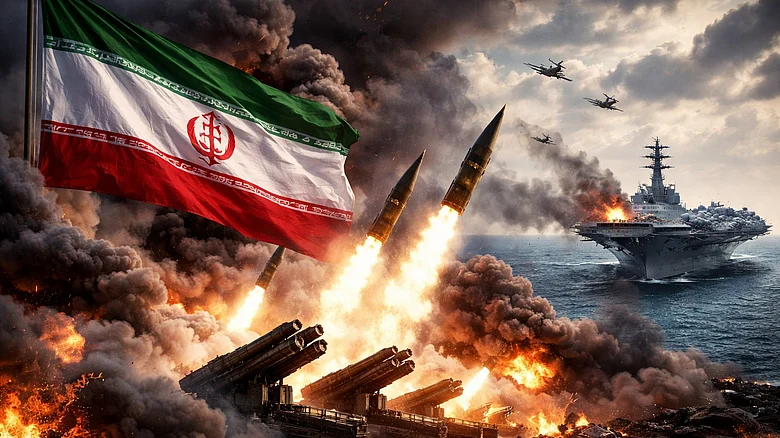

US President Donald Trump said Washington would "take over" the Strait of Hormuz, suggesting commercial ships could eventually pay for American protection.
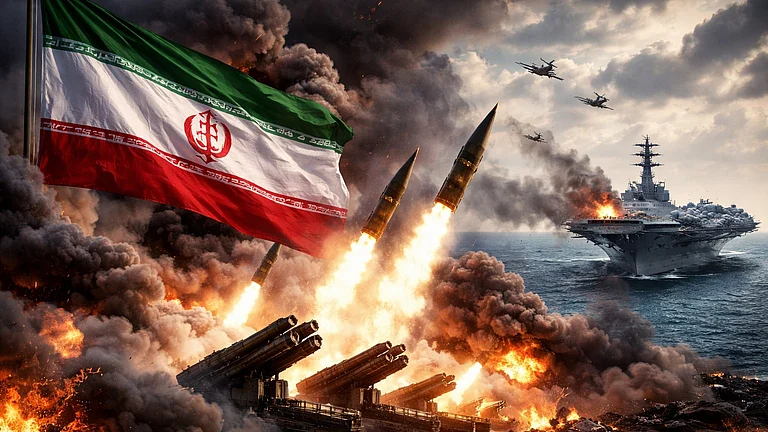
Iran claimed attacks on US military facilities in Bahrain and Kuwait, while the US said it struck Iranian air defence systems, radar sites, missile and drone capabilities.
The escalation around the Strait of Hormuz lifted crude prices as investors weighed the risk of disruptions to energy shipments.
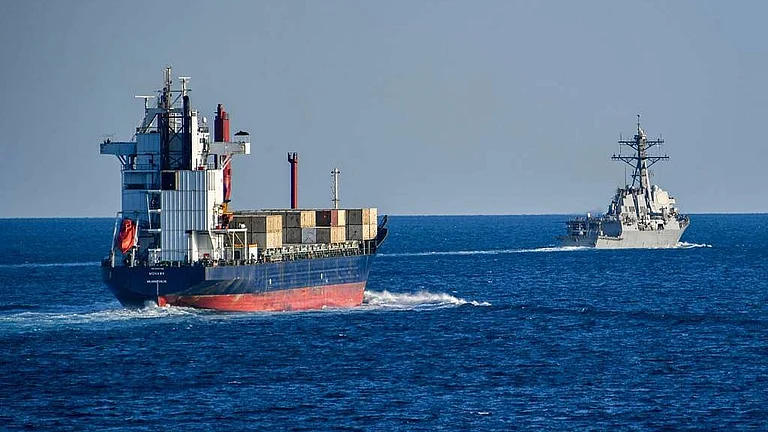
US President Donald Trump on Monday said the United States would take control of the Strait of Hormuz, one of the world's most important oil shipping routes, and suggested commercial vessels could eventually pay Washington for protecting maritime traffic.
He also accused Iran of violating the interim agreement reached between the two countries, according to a Moneycontrol report.

1 October 2026
Get the latest issue of Outlook Business

The remarks came as the US and Iran exchanged fresh missile and drone strikes for a second consecutive day, deepening tensions across the Gulf and fuelling concerns over global energy supplies.
Trump Signals Control of Strategic Waterway
Speaking to Fox News, Trump said the US intended to maintain control over the Strait of Hormuz and hinted that shipping companies could reimburse Washington for securing the route.
"We are taking over Hormuz... We're going to keep the strait, and we'll probably run it... Maybe we'll call it the guardian angel of the strait, and we should be reimbursed for that," he said.
Advertisement
Trump also blamed Tehran for breaking the interim agreement, saying, "We had an agreement, Iran was the one that broke the deal."
Missile Exchanges Continue
Iran's Islamic Revolutionary Guard Corps (IRGC) said it targeted US military facilities in Bahrain and Kuwait, while also striking radar installations in Oman and fuel storage and ammunition depots at Jordan's Prince Hassan Air Base.
Bahrain, Kuwait and Jordan said their air defence systems intercepted several Iranian missiles and drones.
The US military, meanwhile, said it carried out another round of strikes targeting Iran's air defence systems, coastal radar sites, missile and drone capabilities, and small naval vessels to reduce Tehran's ability to threaten shipping in the Strait of Hormuz.
Advertisement
Strait at Centre of Conflict
The latest fighting has centred on the Strait of Hormuz, through which roughly one-fifth of global oil supplies pass.

Iranian state media reported that Revolutionary Guard naval forces fired warning shots at two vessels attempting to pass through the waterway, claiming they were travelling illegally. Tehran maintained that the strait remained closed, while the US said commercial shipping continued under American protection.
Iranian media also reported explosions near Bandar Abbas and on Qeshm Island. Reuters said it could not independently verify the reports. Separately, Iranian news agencies said two people were killed and three others injured in US strikes in Khuzestan province.
The escalation pushed oil prices higher, with Brent crude rising as much as 5% before paring gains.

Despite the hostilities, Iran said it remained engaged with mediators from Qatar, Oman and Pakistan to prevent the conflict from widening further, while Trump maintained that the two sides had been close to an agreement before Iran allegedly violated its commitments.