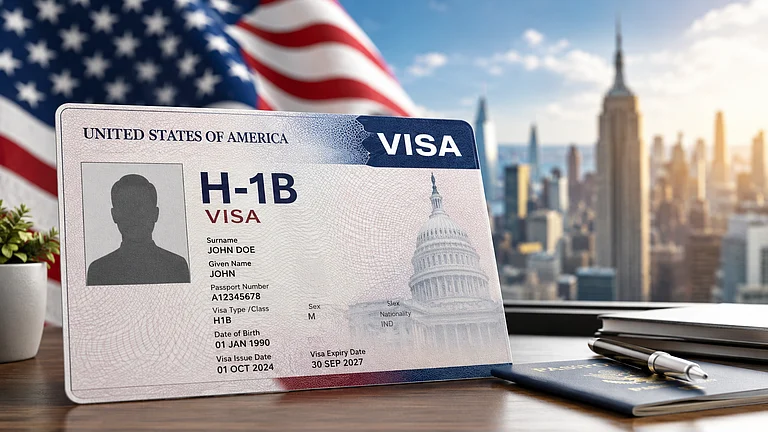
A federal judge in Boston has struck down the Trump administration’s $100,000 H-1B visa fee.
The lawsuit, led by 20 Democratic attorneys general, argued the charge would deter employers from hiring foreign talent.
The White House plans to appeal and maintains other restrictive measures.
A federal judge in Boston struck down the Trump administration's $100,000 fee on H-1B visa applications on Monday. The ruling deemed it an unauthorised tax that Congress never approved and that federal agencies had no authority to collect, according to a report by Reuters.
US District Judge Leo Sorokin issued the ruling in a lawsuit brought by 20 Democratic state attorneys general. The Judge concluded that the charge functioned as a tax rather than a lawful penalty, despite how the administration characterised it as a lawful monetary penalty that the president was authorised to impose.

1 October 2026
Get the latest issue of Outlook Business

US President Trump, described the ruling as "crazy", while speaking to reporters afters attending the NBA finals.
"These federal judges are really giving us a hard time. It's really crazy what's going on with the court system," he said.
Before the introduction of the fees, employers typically paid between $2,000 and $5,000 to sponsor a foreign worker for an H-1B visa.

What It Means for Indians
The decision is of particular interest for Indian nationals, who dominate the programme more than any other country.
US Citizenship and Immigration Service (USCIS) data revealed that Indian applicants received 283,397 H-1B visas in 2024, more than 70% of the total visas issued that year, six times higher than that of its predecessor, China, with 46,680 H-1B visas.
Advertisement
The fee, introduced by presidential proclamation in September last year, had raised serious concerns that employers would scale back hiring of skilled foreign workers, effectively choking a pipeline that Indian professionals have built careers around across sectors.
The USCIS has received just 85 payments as of February, the agency revealed in a March filing, according to the Reuters report.
Why Ruling May Not Be a Relief Yet
Indian diaspora organisations welcomed the ruling. Khanderao Kand of the Foundation for India and Indian Diaspora Studies said that the ruling has restored fairness to the employment-based immigration system.
Advertisement
However, Sanjeev Joshipura, Executive Director of Indiaspora, highlighted that the Trump administration still has the power to impose procedural barriers for H-1B visa holders through means that fall short of outright legal violations.
The White House, on the other hand, expressed its confidence that the ruling can be reversed on appeal. The spokesperson, Taylor Rogers, asserted that the president retains broad authority to restrict the entry of foreign nationals he deems detrimental to American interests.
The administration has also separately ordered enhanced vetting of H-1B applicants and proposed a new selection process weighted towards better skills and better-paid workers, measures that remain well in place regardless of the ruling.