India’s ₹62,500 crore Mobile Phone Manufacturing Scheme aims to expand the smartphone ecosystem beyond final assembly.
Electronics manufacturing services firms, component suppliers and localisation partners could benefit as domestic value addition increases.
The next phase of India’s mobile journey will depend on businesses that manufacture, supply and innovate behind the smartphone.
India’s smartphone manufacturing story has largely been measured through the growth of global brands producing devices in the country. Apple, Samsung and other companies expanding their manufacturing footprint have become symbols of India’s growing electronics ambitions.
But the next beneficiaries of India’s smartphone boom may not necessarily be companies whose names appear on the device.

1 September 2026
Get the latest issue of Outlook Business

They could be the businesses operating behind the smartphone — electronics manufacturing services (EMS) firms, component suppliers, precision manufacturers and technology companies that make large-scale production possible.
The recently notified Mobile Phone Manufacturing Scheme (MPMS), with an outlay of ₹62,500 crore, reflects this broader approach. According to Grant Thornton Bharat’s analysis of the scheme, the programme aims to strengthen India’s mobile manufacturing ecosystem by encouraging production, domestic sourcing, innovation, design capabilities and research and development.
The question now is: as India produces more smartphones, which businesses could benefit beyond the companies selling them?
Business Behind The Phone
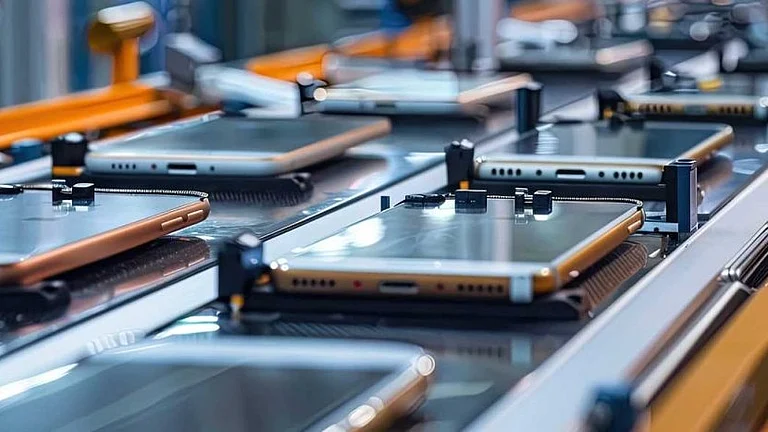
A smartphone may carry one brand name, but its manufacturing involves a wide network of companies. The ecosystem includes manufacturers that assemble devices for brands, suppliers producing components and sub-assemblies, companies involved in testing and businesses providing specialised manufacturing capabilities. This is where electronics manufacturing services (EMS) firms become important.
Advertisement
The MPMS specifically includes mobile phone manufacturers and Electronics Manufacturing Services firms registered in India as eligible participants, according to Grant Thornton Bharat’s analysis of the scheme.
EMS companies typically manufacture products or provide production support for larger brands. As global companies expand manufacturing capacity in India, these firms become an important link between smartphone brands and local production. This means the opportunity created by India’s mobile manufacturing push extends beyond companies directly selling smartphones to consumers.
India Has Built The Factory Base
India’s first phase of mobile manufacturing focused on creating large-scale production capacity.
That strategy has delivered significant results. According to the Ministry of Electronics and Information Technology (MeitY), India has emerged as one of the world’s largest mobile phone manufacturing bases, with domestic production meeting almost the entire demand for mobile phones in the country. The ministry has also highlighted the sharp growth in mobile phone exports over the past decade.
Advertisement
However, building assembly capacity is only the first step. The next challenge is increasing the amount of value created within India.
A smartphone assembled in India does not necessarily mean that all its critical components are manufactured domestically. Several high-value parts continue to come from global suppliers, creating an opportunity for companies that can build these capabilities locally.

The Missing Link: Components
India’s mobile manufacturing journey is now moving towards a deeper question: can the country make more of what goes inside a smartphone?
A Financial Express report citing Jefferies analysis noted that India assembles around 99% of mobile phones sold domestically, but domestic value addition remains below 20% because several high-value components continue to be imported. This gap highlights the opportunity for component manufacturers.
A smartphone depends on a wide range of inputs, including printed circuit boards, camera modules, battery systems, display assemblies and other electronic components. Building companies that manufacture these parts can help India capture a larger share of the value generated from every device.
Grant Thornton Bharat’s analysis of MPMS highlights that the scheme focuses on strengthening the mobile phone value chain through localisation, domestic sourcing and innovation.

The Localisation Push
The MPMS has been designed to encourage companies to deepen their manufacturing presence in India. According to Grant Thornton Bharat, the scheme provides a domestic sourcing incentive of up to 1.5% of eligible sales, linked to localisation conditions, including sourcing requirements for mobile phone units sold. The objective is to encourage companies to develop domestic capabilities for components and sub-assemblies.
This creates an opportunity for businesses that may never launch a smartphone brand but could become important suppliers to those that do. The shift is significant. Earlier, the focus was on bringing global manufacturers to India.
The next phase is about building the network of companies that support those manufacturers.

Why EMS Firms Matter
EMS companies could play an important role in India’s next phase of mobile manufacturing. Companies such as Dixon Technologies, Tata Electronics, Foxconn India, Kaynes Technology and Syrma SGS operate across different segments of the electronics manufacturing ecosystem.
Their opportunity comes from a structural shift in the industry: as more smartphone and electronics companies expand production in India, demand increases for partners that can provide large-scale manufacturing capabilities and production support.
A Financial Express report citing Jefferies analysis highlighted that the next stage of India’s EMS opportunity will depend on greater supply-chain integration and movement towards higher-value manufacturing.
For India, the growth of EMS companies will be an important part of the transition from a large assembly base to a more integrated electronics manufacturing ecosystem.
From Factories To Technology
The MPMS is also aimed at encouraging companies to move beyond manufacturing.
The scheme has a separate focus on supporting Indian mobile phone brands. According to Grant Thornton Bharat, companies seeking support under this segment need Indian-owned intellectual property or trademarks, at least 51% Indian ownership and control, and in-house research and development capabilities in India.
This reflects a broader ambition: creating companies that do not only manufacture devices for global brands but also develop technology, designs and intellectual property.
A Bigger Electronics Opportunity
The scale of the opportunity is significant. Grant Thornton Bharat’s analysis of MPMS estimates that the scheme could support mobile phone production of approximately ₹39 lakh crore and generate around 60,000 direct jobs during its implementation period.
But the impact could extend beyond direct manufacturing.
A larger mobile ecosystem could create opportunities across component manufacturing, electronics suppliers, testing services, engineering capabilities, logistics and technology development.


India’s first mobile manufacturing phase was about bringing production to the country. The next phase will decide whether India can build the businesses that power that production. The biggest winners of India’s smartphone boom may not always be the companies selling the phone. They could be the companies making the smartphone ecosystem possible.