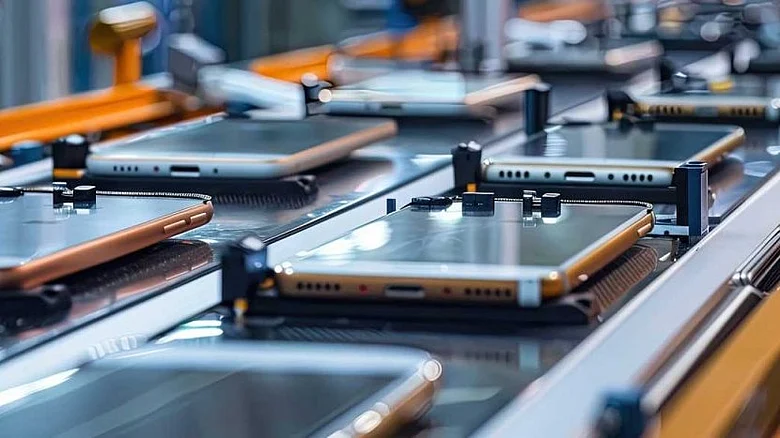

The Centre has scrapped 5% and 7.5% customs duties on select mobile phone and electronics components.
Neither the government nor companies have announced any reduction in handset prices.
Apple, Samsung, Xiaomi, Foxconn and Tata Electronics are among the likely beneficiaries.
The Centre has removed customs duties on several components used to manufacture mobile phones and other electronic devices. The move is aimed at strengthening India's electronics manufacturing base and lowering production costs for companies that make devices in the country, including Apple, Samsung and Xiaomi.
The decision was announced as part of the latest customs duty changes notified by the government. But does this mean cheaper smartphones for consumers?

1 October 2026
Get the latest issue of Outlook Business

Why Were The Duties Cut?
The government has scrapped customs duties of 5% and 7.5% on select components used in manufacturing smartphones and other electronic devices. According to the government, the move is meant to support domestic manufacturing by reducing the cost of importing essential parts that are not produced in sufficient quantities in India.




The duty rationalisation is also aimed at making India's electronics manufacturing sector more globally competitive and supporting exports, according to a report by the Indian Express. The measure forms part of India's broader strategy to position itself as a global electronics manufacturing hub and attract greater investment from multinational companies, Reuters reported.
Advertisement
By easing the cost of importing parts that domestic suppliers cannot yet produce at scale, the government is aiming to make India a more viable base for end-to-end device assembly, rather than one limited to final assembly alone.
Which Components Are Covered?
The duty exemption applies to components used in manufacturing mobile phones and electronic equipment. These include parts used for camera modules, USB cable components, Printed Circuit Board Assembly (PCBA) inputs, mobile phone sub-parts and other specified electronic components, as per the Indian Express.
The government has also extended exemptions on certain capital goods and machinery used in electronics manufacturing, a step intended to support companies investing in production infrastructure within the country.
Advertisement
Will Smartphones Become Cheaper?
Not immediately, and there is no certainty that prices will fall. Neither the government nor smartphone companies have announced any reduction in handset prices following the duty cut.
The reduction in duties lowers manufacturing costs for companies, but whether consumers benefit depends on whether manufacturers choose to pass those savings on through lower prices, according to the Indian Express. The report notes that the savings from the duty cut are relatively modest, meaning any impact on retail prices is likely to be limited.
In other words, the policy directly addresses the cost side of manufacturing. Whether that translates into cheaper handsets on store shelves will depend entirely on pricing decisions taken by individual companies.
Which Brands Are Likely To Benefit?
The duty reduction is expected to benefit companies that manufacture smartphones in India while importing some components. These include Apple, Samsung, Xiaomi, Vivo, Oppo and other smartphone brands with local manufacturing operations, according to the Indian Express.
Electronics manufacturing service (EMS) companies such as Foxconn and Tata Electronics, which assemble iPhones in India, are also expected to benefit from lower input costs, Reuters reported. These companies operate the factories where components are assembled into finished devices, so any reduction in their import costs feeds directly into their overall production expenses.

Will Apple Manufacture More iPhones In India?
The duty cut could strengthen Apple's manufacturing ecosystem in India, although the company has not announced any production expansion linked to the policy. Apple has been steadily increasing iPhone production in India through suppliers such as Foxconn and Tata Electronics as it diversifies manufacturing beyond China, Reuters noted.
Lower duties on imported components reduce manufacturing costs for these suppliers, potentially making India a more attractive production base. However, neither Apple nor the government has said the latest customs duty changes will directly lead to higher iPhone production.
The customs duty cut is primarily aimed at making electronics manufacturing in India more cost-effective and competitive. While the move reduces the cost of importing several smartphone components, there is no official indication that smartphone prices will immediately fall.
Consumers stand to benefit only if manufacturers decide to pass on the savings. For now, the clearest beneficiaries are companies manufacturing smartphones and electronic devices in India, since the policy lowers their production costs and supports the country's broader ambition to become a larger global electronics manufacturing hub.