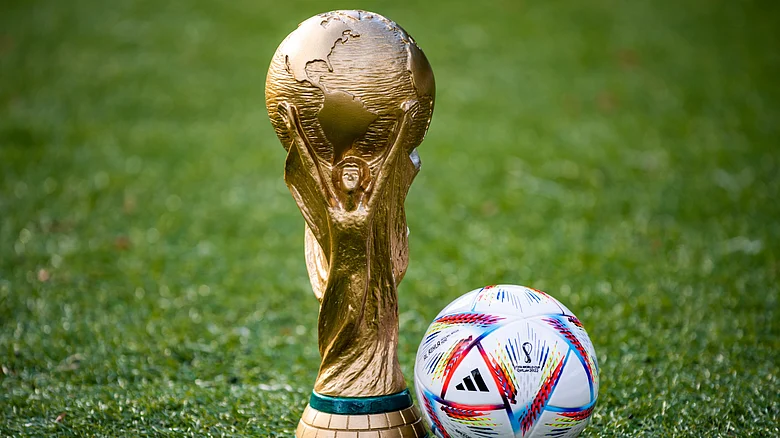

Ferran Torres scored the decisive extra-time goal at MetLife Stadium to secure Spain's second FIFA World Cup title against Argentina.
Spain received a record total payout of $53.5 million, while runners-up Argentina earned $36.5 million from FIFA's expanded prize pool.
The defeat marked the end of Lionel Messi's final World Cup appearance, preventing Argentina from retaining their global crown.
Spain defeated Argentina 1-0 in extra time at MetLife Stadium as Ferran Torres' extra-time winner secured their second World Cup title. This triumph earned the Spanish team $51 million in performance-based rewards, whereas the Argentine squad took home $34 million for finishing second, Business Standard reported.
FIFA also awarded each finalist a $2.5 million preparation grant. Consequently, the total direct payment from FIFA reached $53.5 million for Spain and $36.5 million for Argentina. The financial gap between winning and losing the final was $17 million.

1 October 2026
Get the latest issue of Outlook Business

The defeat carried immense sporting weight. Argentina missed the chance to become the first nation since Brazil in 1962 to retain the trophy, marking a subdued end to Lionel Messi's final World Cup appearance. Spain completed a European Championship-World Cup double, reclaiming the trophy after a 16-year wait.
Funding the Expanded Format
FIFA allocated an overall $871 million for the 2026 tournament, the publication reported. This package includes about $703 million in performance-related payments and $120 million in preparation grants.
Advertisement
The governing body increased the top two prize tiers by $1 million compared to the figures first announced in December 2025. National federations successfully lobbied for this adjustment, arguing that the original allocations did not fully cover the high travel and logistical costs across the United States, Canada and Mexico.
The 2026 tournament expanded to 48 teams from 32 and introduced a Round of 32. Under this expanded format, every participating team was assured of at least $12.5 million, which combined a $10 million baseline performance payment with the $2.5 million preparation grant. The 16 teams that reached the new knockout stage each collected $12 million.
Advertisement
A Historical Financial Surge
Historical figures show massive economic growth. During the 1982 World Cup in Spain, the total distributed prize money was $20 million. By 2026, the performance-linked pool alone had risen to about $703 million, a nominal increase of more than 35 times.
Winners' payments have grown steadily. The 2002 champions earned $8 million, which rose to about $20 million in 2006. Spain collected $30 million in 2010, Germany received $35 million in 2014 and France earned $38 million in 2018. Argentina collected $42 million in 2022. Spain's 2026 champions' payout of $51 million is a 21% increase over 2022.
The overall performance pool grew by nearly 60%, from $440 million to about $703 million. This expansion funded the 16 additional guaranteed team payments and the new Round of 32 knockout rewards.
Unrivalled Global Commercial Power
The data suggests that FIFA's revenue reached over $10 billion for the 2022-25 cycle, following the $7.6 billion it generated during the 2019-22 period, according to Business Standard report. This revenue is approximately 3.8 times that of the International Cricket Council, more than 12 times World Rugby's and nearly 35 times World Athletics' revenue.
The annualised broadcast value of the 2026 World Cup is estimated at $4.3 billion. This valuation demonstrates a scarcity premium that allows the month-long tournament to rival year-round leagues like the NFL, NBA and the English Premier League.
Spain's $51 million payout is over 20 times the men's T20 World Cup champions' prize of $2.45 million, from a total fund of $11.25 million. It also dwarfs Wimbledon's singles champions' prize of £3.6 million, from a £64.2 million overall prize pool.
Club Football Incentives
In contrast, the 2025 FIFA Club World Cup featured a $1 billion prize pool, with the champions able to earn up to $125 million. This commercial model was designed to attract elite clubs and compensate them for releasing players.
FIFA pays prize money directly to national associations like the Royal Spanish Football Federation and the Argentine Football Association rather than directly to players. These federations decide how to distribute the funds among player bonuses, coaching payments and infrastructure.
A New Elite Generation
Spain's victory highlights a new elite generation, including Lamine Yamal, Nico Williams, Rodri and Ferran Torres. These players now carry immense commercial appeal, which will boost their global recognition and club valuations.
Winning the World Cup generates long-term commercial benefits, as well. Beyond the immediate cash, victorious nations experience higher sponsorship values, increased merchandise sales, greater demand for national-team matches, improved federation negotiating power, increased youth participation, higher player valuations and greater national-brand exposure.