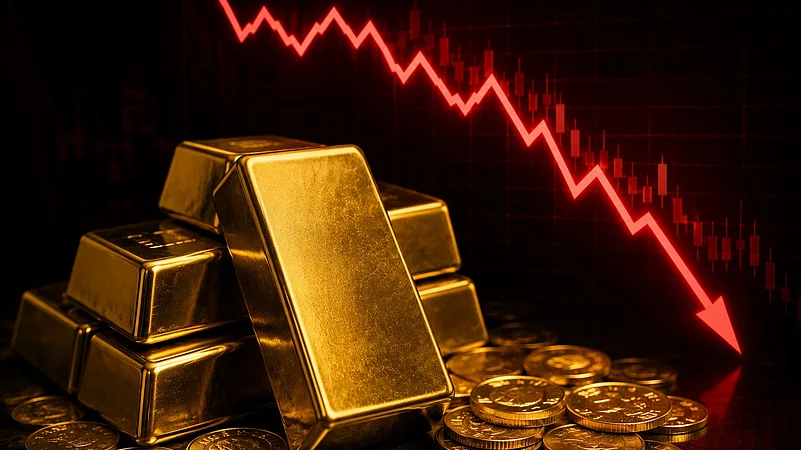
Gold prices slipped below the key $4,100 per ounce mark on Wednesday as a stronger US dollar pressured bullion markets.
Growing expectations of higher US Federal Reserve interest rates further weakened investor sentiment toward gold.
A tech-led market sell-off also triggered fresh liquidation, though analysts say gold’s long-term outlook remains strong.
Gold prices extended losses on Wednesday, falling to their lowest level in nearly two weeks as global market sentiment turned sharply negative for precious metals amid a combination of macroeconomic and liquidity-driven pressures.
Spot gold slipped below the key $4,100 per ounce level and hovered around $4,085 an ounce during early Asian trading, extending losses after falling sharply in the previous session. US gold futures also remained under pressure, signaling continued weakness across bullion markets.
The global sell-off also spilled over into Indian commodity markets. In the previous session, gold futures on the Multi Commodity Exchange (MCX) settled at around ₹1,46,443 per 10 grams, while silver futures ended near ₹2,25,260 per kilogram, mirroring the broader weakness seen globally.

1 September 2026
Get the latest issue of Outlook Business

While gold is traditionally viewed as a safe-haven asset during periods of uncertainty, Wednesday’s sharp decline highlighted how even defensive assets can come under pressure when broader financial conditions tighten.
A Stronger Dollar Triggered the Sell-Off
One of the biggest triggers behind gold’s sharp decline has been the strengthening US dollar, which climbed to a fresh one-year high after investors increased bets that the Federal Reserve may keep monetary policy tighter for longer.
Advertisement
The US Dollar Index rose to a 52-week high of 101.42, strengthening steadily after the Fed’s latest policy signals. A stronger dollar typically hurts bullion because gold is priced globally in US currency, making it more expensive for overseas buyers and reducing international demand.
Dr. Renisha Chainani, Head of Research at Augmont, said the latest market reaction reflects how investors are rapidly repricing monetary policy expectations. According to her, “The dollar consequently holding near one-year highs is making gold less affordable for foreign buyers.”
She added that the current selling pressure is largely coming from financial and speculative positioning rather than long-term institutional demand. Structural buyers such as central banks, according to her assessment, have not significantly exited their positions so far.
Advertisement

Fed Rate Hike Fears Are Back in Focus
Investor sentiment has also weakened after growing expectations that the US Federal Reserve may have to raise interest rates further this year instead of moving toward policy easing anytime soon.
Markets interpreted the central bank’s latest policy projections as more hawkish than expected, while traders are now closely watching the upcoming US Personal Consumption Expenditures (PCE) data, the Fed’s preferred inflation gauge, for fresh policy signals.
Dr. Chainani said recent economic data has significantly shifted market expectations around future rate decisions. According to her, “Strong May payroll data shifted market bets from the timing of a cut to the odds of a rate hike, while inflation at 4.2% kept real Treasury yields elevated.”
She added that traders are now pricing an 88% probability of a December rate hike, sharply higher than before the latest Federal Open Market Committee meeting. Higher interest rates generally reduce gold’s attractiveness because bullion does not generate income, unlike bonds and other fixed-income assets that become more attractive in a high-rate environment.
Tech Sell-Off Forced Investors to Raise Cash
Apart from monetary policy concerns, a sharp correction in global technology and AI-linked stocks has emerged as another major factor behind gold’s decline.
As technology stocks retreated from recent highs, investors facing losses in equities increasingly began liquidating profitable assets elsewhere to raise cash and meet margin requirements. Gold, despite being a defensive asset, became one of the immediate sources of liquidity.
Jateen Trivedi, Vice President Research Analyst – Commodity and Currency at LKP Securities, said the weakness in bullion is being driven more by liquidity pressure rather than a sudden bearish shift in investor sentiment toward gold. According to him, “The recent weakness in gold is not because investors have suddenly turned bearish on bullion, but because a sharp sell-off in AI and technology stocks has triggered a broader liquidity event.”
He said investors typically begin selling profitable and liquid assets when losses in other asset classes start increasing. “When investors face heavy losses in equities, they often sell profitable and liquid assets such as gold to raise cash, meet margin requirements and reduce leverage,” he said.
Trivedi added that the current phase is unusual because both equities and gold are declining simultaneously as investors prioritise liquidity over asset allocation preferences.
Geopolitical Risks Failed to Support Bullion
Normally, geopolitical uncertainty tends to support gold prices as investors move toward safe-haven assets during periods of global instability. However, that pattern weakened considerably this week despite continuing uncertainty surrounding diplomatic developments between the United States and Iran.
US President Donald Trump said on Tuesday that Iran had agreed to indefinite nuclear inspections, although Tehran later disputed those claims, raising fresh questions over the durability of the fragile diplomatic understanding reached between the two countries last week.
Under normal circumstances, such uncertainty would support gold demand. However, markets are currently giving greater importance to monetary policy concerns and the strength of the dollar rather than geopolitical risks.
Trivedi said gold’s traditional safe-haven role has not disappeared, but short-term liquidation pressure is currently dominating market behavior. According to him, “Once the liquidation pressure subsides, gold’s traditional safe-haven appeal could re-emerge, especially if economic or geopolitical uncertainties persist.”
The easing of immediate West Asia conflict concerns has also reduced some of the geopolitical premium that had supported bullion prices earlier.
Correction or Start of a Bigger Pullback?
Despite the sharp decline, analysts say the current weakness looks more like a temporary correction rather than the beginning of a larger structural reversal in gold prices.
Dr. Chainani said the latest fall should be viewed as part of a cyclical correction within a broader long-term bull market rather than a fundamental breakdown in gold’s long-term outlook. According to her, “Today’s decline is best characterised as a cyclical correction within an intact structural bull market, not a fundamental breakdown.”
She pointed out that gold had previously fallen nearly 33% during the 2008 financial crisis before eventually tripling in value during the years that followed. According to her assessment, the $4,000 to $4,060 range remains an important support zone, while a deeper fall below $3,600 remains a low-probability risk rather than the base case.

What Should Investors Watch Next?
Markets are now closely watching upcoming US inflation data and further signals from Federal Reserve officials, both of which could shape gold’s near-term direction.
If inflation remains stubbornly high, expectations of additional rate hikes could strengthen further, keeping pressure on bullion in the short term. However, analysts say the broader long-term case for gold remains supported by strong institutional demand and continued central bank buying.
Dr. Chainani said the larger structural outlook for gold remains positive despite the near-term weakness. According to her, “The structural bull case remains compelling despite near-term headwinds.” She pointed out that central bank purchases touched a record 1,237 tonnes in 2025, while major institutional forecasts remain significantly above current market levels.



On whether investors should view the current dip as an opportunity, she said medium-term investors may still consider gradual accumulation. “Every major institutional year-end forecast sits 25 to 44% above current levels, and none have been withdrawn,” she said.
For now, however, markets remain focused on two dominant factors — higher US interest rates and a stronger dollar — both of which continue to overshadow gold’s traditional safe-haven appeal.