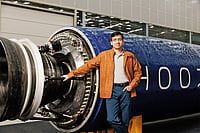
Abhiir Bhalla defines the current global instability as a poly-crisis of climate and conflict
Military emissions remain a significant "off-the-books" contributor to global carbon footprints
India has a strategic opportunity to lead global climate governance amid shifting international alliances
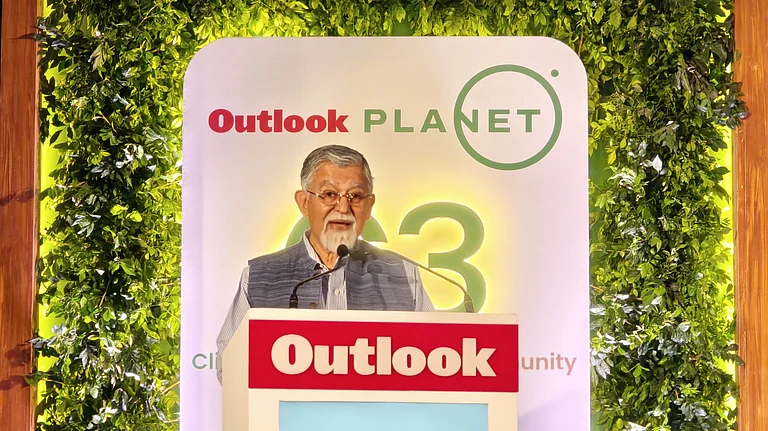
At a time when young people are navigating climate shocks, wars, job insecurity and technological change, sustainability advocate and youth environmentalist Abhiir Bhalla made a forceful case for treating youth not as future stakeholders, but as the generation already living through the consequences of today’s choices.
Speaking at the “Youth Ki Awaaz” session at Outlook Planet C3, Bhalla argued that climate change, conflict and career disruption are no longer separate issues, but parts of the same global crisis.

1 October 2026
Get the latest issue of Outlook Business

Framing the moment as a “poly-crisis,” Bhalla said his generation has grown up with “real-time footage of war, of climate disaster and political collapse, all on the same device.”




He noted that millions of children live in conflict zones and pointed out that war itself is a major carbon emitter, yet remains largely outside formal climate accounting. “There are entire wars happening off the climate books,” he said, referring to the exclusion of military emissions from mandatory reporting under global climate frameworks.
Bhalla also linked geopolitics to climate leadership, saying the United States’ retreat from multilateral climate commitments has created a vacuum that other countries must fill. In that context, he argued, India has a crucial opportunity.
Advertisement
“The rules of global climate governance are being written right now without the US at the table,” he said, adding that countries such as India, South Africa and Brazil can shape the next phase of climate norms.
Turning to jobs, Bhalla dismissed the fear that artificial intelligence will wipe out green employment. “AI is going to supercharge” the green transition, he said, explaining that climate action needs data analysis, emissions mapping, energy optimisation and supply-chain tracking.
He pointed to projections that India could generate millions of green jobs by mid-century, including in smaller cities. But he warned that awareness remains limited, saying only a small share of urban youth can even name a green job or access training for one.
Advertisement
Bhalla grounded his message in his own work in the Andaman and Nicobar Islands, where he said community-level sustainability projects had improved waste management, expanded solar adoption and generated local revenue.
He also recalled launching Swachh Chetna at 16 and eventually securing a formal MOU with Delhi Metro after months of persistence. “The career of the future is not a job title, but a mindset,” he said.
Closing with a call to action, Bhalla argued that climate is ultimately about elections, governance and daily choices. “We are not the generation of the future but we are the generation of now. And what we decide in this decade, in our vote rooms, in our voting booths, in our labs and at our metro stations will determine whether the next generation gets a livable planet or a grievance.
Youth ki awaaz sunni padhegi. Not because we are loud but because we are right,” he said.