





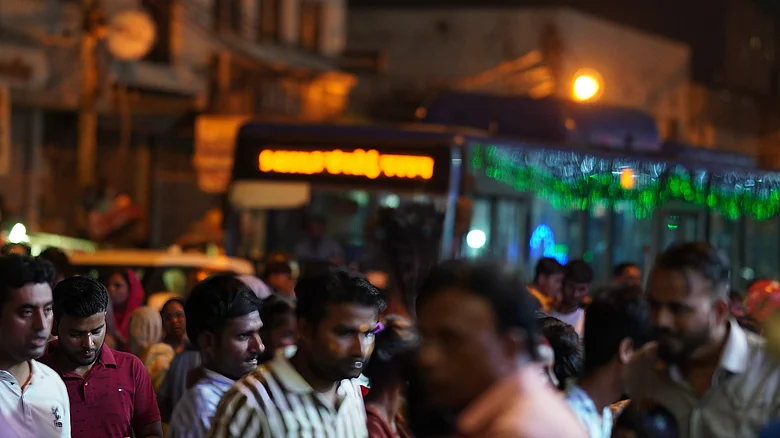

Women face structural barriers in urban transport, limiting mobility and economic participation.
Trip-chaining and safety concerns reshape travel patterns, often overlooked by planners.
Data gaps, weak policy integration, and low representation hinder gender-responsive transport systems.
Every morning, over 200mn women across India navigate the same invisible tax: the cost of being female in a city not designed for them. Urban mobility in India is typically framed as an infrastructure deficit — too few buses, too little frequency, low service quality. But at its core, this is a problem of design.
Our transport systems have been built around the needs and schedules of the 9-to-5 workforce that was, historically, modelled around a 35-year-old, able-bodied man. The result? Women make less than half as many trips as men, or they don’t leave the house at all. This structural exclusion carries an enormous economic price. Over the past decade, closing the workforce participation gap between women and men could have added $2.9trn to India's GDP.

1 October 2026
Get the latest issue of Outlook Business


Case of Trip-Chaining
The constraints women face is largely invisible to planners who do not look for them. When women travel, they are disproportionately reliant on walking and public transport, while shouldering domestic and caregiving responsibilities alongside paid work. This generates what researchers call 'trip-chaining': combining school drop-offs, market visits, healthcare appointments and the commute to formal employment. These are not the linear, peak-hour journeys that most transit systems are optimised for. Poor infrastructure and service levels — infrequent or unreliable schedules, absent real-time information and non-existent or expensive last-mile connectivity – all have a higher impact on a woman’s ability to navigate a city.
Additionally, safety concerns frequently impact women's mobility, particularly in public transport, and more so at night. As a result, they turn down night shifts, decline opportunities that require longer travel and select more proximate but lower-ranked educational institutes. Often, they end up spending more time and money on ‘safer’ modes or routes of transport – options available only to a privileged few.
Advertisement
Addressing these contextual challenges means rethinking frequency and availability of transport services, improved access to information, and more seamless transportation networks covering metros, buses, trains, autorickshaws and pedestrian infrastructure. It means better lighting, surveillance, trained staff, active grievance mechanisms, transit hubs with crèches, clean restrooms and accessible last-mile links to ensure commuting is seamless and does not require a separate trip for every errand.
When the quality of public transport improves, women are among the first and most consistent users. The introduction of free bus travel for women in Delhi, Tamil Nadu, Karnataka and Telangana has been transformative. In cities with fare-free schemes, women account for 47% of daily bus ridership versus 35% elsewhere. But affordability alone is insufficient. If the bus does not come on time or is overcrowded, uncomfortable or dangerous to board, waiving the fare will not improve the mobility experience. This is important considering the number of people using public transport in India is projected to fall from 75.7% in 2000-01 to 44.7% in 2030-31 — a trajectory with severe consequences for traffic congestion, urban air quality and carbon emissions.
Advertisement
India has a decade of evidence from gender-responsive mobility pilots and initiatives —Bhubaneshwar’s disaggregated ticketing system to collect and analyse gender-specific transit usage patterns, Delhi’s reservation of electric auto-rickshaw permits for women drivers, Surat’s pink auto scheme offering women drivers for women customers, and Hyderabad’s SHE Shuttle services providing last-mile connectivity in the city’s IT corridor are some examples.

Plugging the Data Deficit
While many of these initiatives didn’t move beyond their pilot stages or faced implementation challenges, they taught us one thing – interventions can work and can be scaled up with the right institutional architecture. For long-term success, three interlocking conditions are necessary: gender-disaggregated data from transit agencies, gender-responsive planning and policy mandates and meaningful representation of women in transport decision-making at every level.
First and foremost, we need data. You cannot manage what you do not measure. Most Indian transit agencies do not routinely collect and publish data disaggregated by passengers' gender, trip purpose or travel time. They use averages to represent the travel patterns of the entire population — a figure that systematically underrepresents women. Analysing data, broken down by gender and deploying a standardised gender audit framework for transport systems, are achievable steps that can give planners a clearer picture of who is being left behind and why.
Second, gender responsiveness needs to be integrated across state and national plans and policies, with concrete measures and budget allocations. This bakes equity and inclusion into the system rather than treating it as a one-off intervention. While the conversation is slowly evolving and shifting away from being purely about safety and access, the gaps show up when the rubber hits the road – in infrastructure investments, route planning, fare structures and design elements.
Third is to ensure greater representation of women, not just as front-line workers but as transport planners and policy makers. Globally, women account for less than 20% of the transport and logistics workforce. Transport systems staffed largely by men will, in the absence of deliberate mechanisms, reflect the lived experience of that workforce. The ongoing investments in mass transit infrastructure and the electric mobility transition offer new entry points to ensure a more diverse transport workforce. The choices made today will determine whether we reproduce old exclusions or break them.



For the vision of a truly Viksit Bharat to come alive, we need to transform the systems that shape India’s future beginning with improving the life of every person and every journey they make. India's women are not asking for special treatment. What they need is evidence-backed design interventions, a policy making process that centres gender and the opportunity to be active agents in the rooms and shop floors where decisions are made.
(Madhav Pai is CEO, WRI India, while Chaitanya Kanuri is Associate Director - Electric Mobility with the Sustainable Cities and Transport team in the same organisation. The views expressed are personal.)









