




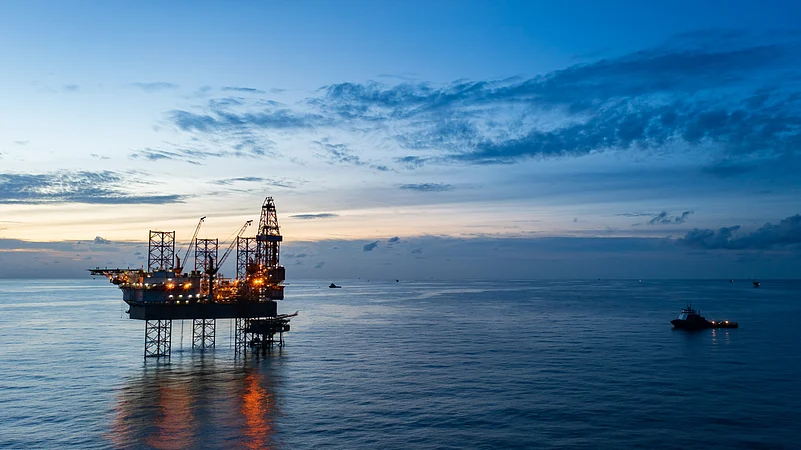

Southeast Asia enters Deepwater Gas Boom 2.0 as older reserves decline.
New projects aim to unlock nearly 28 tcf gas across region.
India ramps offshore push to cut import dependence and boost security.
Southeast Asia is entering a second wave of deepwater gas development as shallow-water and onshore fields mature, according to a Wood Mackenzie report published in April 2026. Deepwater resources, once considered high risk, have shifted from the margin to a core component of regional energy security.
The first wave of Asian deepwater projects, also known as Deepwater 1.0, took place between 2008 and 2017, during which approximately 23 tcf of gas (4bnboe) was developed. This period saw the first-ever deepwater gas projects in Malaysia, India and China. However, development slowed in subsequent years due to commercial, strategic, technical and regulatory challenges.

1 September 2026
Get the latest issue of Outlook Business

At present, a new wave of projects is coming up. Developments such as Kelidang in Brunei; North Ganal, Rapak, Ganal and South Andaman in Indonesia; and Rosmari-Majoram in Malaysia are expected to monetise nearly 28 tcf of gas, supplying domestic markets as well as LNG export facilities.

Role of SURF Technologies
Advances in subsea infrastructure, particularly SURF (Subsea Umbilicals, Risers and Flowlines) technologies, are playing a significant role in enabling deepwater oil and gas fields. These technologies are specifically designed to operate in extreme depths as well as difficult underwater conditions.
Advertisement
Improved flexible risers and high-pressure-resistant flowlines have advanced production efficiency, while rising investments in deepwater exploration have increased demand for such systems. As shallow reserves decline, deepwater resources are becoming increasingly important in meeting global energy demand.

Cost Pressures Remain a Challenge
Despite the renewed momentum, deepwater projects remain capital-intensive. The April 2026 report by Business Research Insights further stated that high installation and operating costs for subsea infrastructure continue to be a major barrier.
Deepwater and ultra-deepwater projects require sophisticated technology together with specialised equipment and skilled workforce, leading to high initial investments. Underwater maintenance operations along with repair operations in harsh offshore environments further add to costs. In addition, fluctuations in global oil prices can influence investment decisions, creating uncertainty for market developers.
Advertisement

India Pushes for Offshore Exploration
For India, this shift is significant as it looks to reduce import dependence and strengthen long-term energy security.
In India, the renewed focus on deepwater aligns with the country’s efforts to bolster domestic energy security. State-run Oil and Natural Gas Corp is preparing to invest up to $20bn to hire deep-water drilling rigs, with a tender issued recently as part of the government’s Samudra Manthan Mission.
India has long relied heavily on energy imports and just-in-time supply chains, leaving it vulnerable to geopolitical disruptions and global market volatility. Expanding offshore exploration is seen as a way to reduce this dependence.
With a coastline of over 11,000 kilometres, India’s offshore gas production has emerged as a significant contributor to India’s domestic gas output, adding about 67% of production since 2019. Latest data indicates offshore output of about 25,709mn metric standard cubic metres.
India’s total net gas production currently stands at around 35 bcm, with deepwater fields in the Krishna-Godavari basin accounting for roughly a quarter of the output. Onshore basins in the Northeast, including Assam and Tripura, have recently started contributing nearly 47% of India’s onshore production and 13% of total gas supply.
The country is estimated to have more than 170 hydrocarbon discoveries, including more than 60 offshore areas, with reserves estimated at around 2bn tonnes of oil equivalent.

Understanding Samudra Manthan Mission
Announced in 2025, the Samudra Manthan Mission launched by Prime Minister Narendra Modi to accelerate exploration of offshore oil and gas reserves as part of India’s broader push towards energy self-reliance under the Atmanirbhar Bharat 2047 vision.
In addition, the government has taken several steps under the programme including seismic surveys, well drilling and allocation of reserves through the National Seismic Programme. According to reports, the Ministry of Petroleum and Natural Gas has also earmarked ₹3,200 crore to begin work on four stratigraphic wells.
Despite being one of the world’s largest consumers, India continues to import nearly 90% of its crude oil needs and about 50% of its LNG and LPG requirements. Strengthening domestic exploration particularly in deepwater could be critical to ensure long-term energy security.








