
Grain diversion for ethanol has fuelled the food-versus-fuel debate, while industry says most feedstock comes from surplus stocks and by-products.
Water use and distillery waste management remain key environmental concerns as ethanol production expands.
The government continues to back ethanol blending for energy security despite growing public scrutiny.
In India, the public campaign against the E20 mandate has gained fresh momentum over the past week. Following the success of Cockroach Janta Party, a new social media campaign named E20 Janta Party has demanded that consumers be given the option of buying 100% petrol and called for road transport and highways minister Nitin Gadkari to resign.
The campaign noted that it is not seeking subsidies, free fuel, or a rollback of ethanol-blended petrol, only that consumers be given a choice at the pump, along with transparent fuel labelling, published data on the costs and benefits of fuel blending, and independent studies on mileage, engine performance, emissions and maintenance costs.

1 September 2026
Get the latest issue of Outlook Business

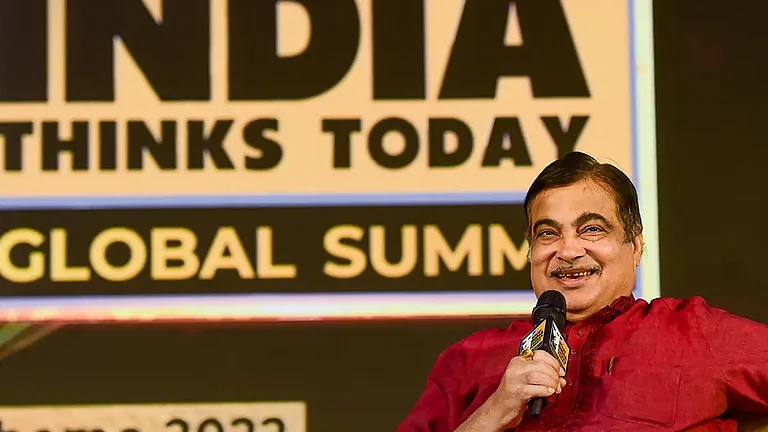
Interestingly, the social media page had already crossed 50,000 followers on X. Domestically, ethanol has been under public scrutiny since the government’s mandate for petrol blended with 20% ethanol in April 2026. In an effort to intensify India’s exploration in biofuel, Union Transport and Highway Minister Nitin Gadkari announced that India is preparing for the next phase of its biofuel transition, with plans to introduce up to 15% isobutanol-blended diesel, earlier in July.
Advertisement
Consumer Backlash Against Ethanol-blended Petrol
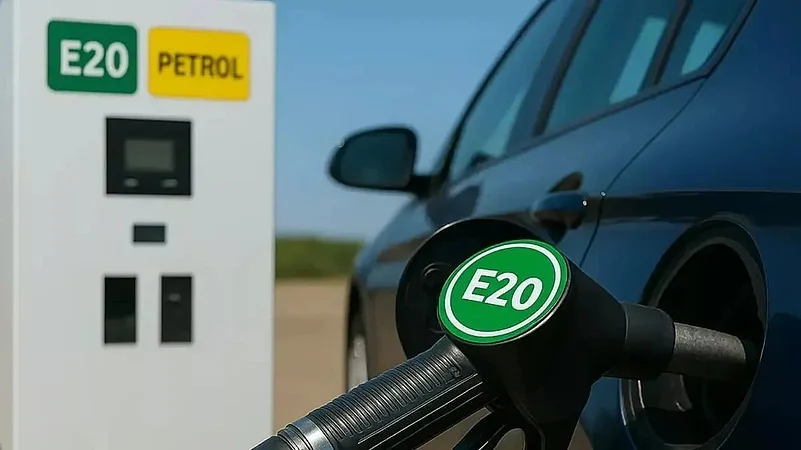
The announcement arrived amid increasing public opposition towards E20 fuel, an automotive fuel blend consisting of 20% ethanol and 80% conventional petrol, which the government introduced to reduce reliance on imported fossil fuels and increase the use of renewable resources as an energy supply.
Following the call from Tahseen Poonawalla through an Instagram post, motorists gathered at Jantar Mantar on 05 July to protest against the policy. Notably, the Delhi Taxi and Tourist Transporters and Tour Operators Association has since announced a march to Parliament on 4 August against E20 petrol, alleging that the ethanol-blending policy has reduced fuel efficiency, raised maintenance costs, and affected engine performance, particularly in older vehicles.
Advertisement
Following the announcement, the Indian government sought vehicle manufacturers and oil marketing companies to address the growing backlash. On 4 July, vehicle manufacturers and industry experts defended the government by saying that they have “not identified any issues of concern linked to the use of E20 fuel” in a press conference conducted at the National Media Centre.
Inflation On The Plate
According to Department of Commerce data, India produced 150.18 million tonnes of rice and 43.41 million tonnes of maize in FY 2024-25. A PIB release from April 2026 put sugarcane output for the same year at 454.61 million tonnes. To meet the E20 mandate, a portion of this output has been redirected toward ethanol.
In a written reply to a question from MP Balwant Baswant Wankhade on 17 December 2025, the Food and Public Distribution Department stated that the FCI had allocated 5.2 million tonnes of rice and 12.75 million tonnes of maize for ethanol production in 2024-25. From August 2025, India's sugar diversion is at 4 million tonnes for the same period.
While these allocations represent a relatively small share of overall grain production, their significance becomes clearer when viewed in terms of ethanol output, as blending targets are measured in litres of ethanol rather than tonnes of grain. Based on Department of Food and Public Distribution (DFPD) estimates of ethanol yields, 450 litres per tonne of rice and 380 litres per tonne of maize, the Food Corporation of India's allocation of 5.2 million tonnes of rice could produce around 234 crore litres of ethanol.
Similarly, 12.75 million tonnes of maize could yield about 484.5 crore litres, taking the combined potential ethanol output from the two grains to an estimated 718.5 crore litres. Against that, the country's blending and industrial requirement, per the National Single Window System (NSWS), stands at 1,350 crore litres (1,016 crore litres for blending, 334 crore litres for industrial use, meaning grain diversion alone, even at full theoretical yield, covers only about half the requirement.
The gap becomes evident when set against what was actually delivered. AIDA data showed that as of June 2026, cumulative ethanol supply for ESY 2025-26 stood at 717 crore litres, of which only 480 crore litres came from grain-based feedstock, against a contracted target of 1,048 crore litres.
Based on these estimates, the potential ethanol output from the allocated rice and maize was around 718.5 crore litres. However, actual grain-based ethanol supply stood at 480 crore litres, about one-third lower than the estimated conversion potential. Across all feedstocks, total ethanol supply reached 717 crore litres against contracted volumes of 1,048 crore litres, equivalent to around 68% of the target.
The figures indicate that despite the allocation of a substantial quantity of rice and maize for ethanol production, actual grain-based ethanol supply remained below the estimated conversion potential. The gap between contracted ethanol volumes and actual supply also suggests that the allocated grain alone was insufficient to meet overall ethanol procurement requirements, with additional feedstocks contributing to total supply.
Industry Backs The Policy
Bharat Independent Ethanol Producers Association (BIEPA) pushed back against the food-versus-fuel framing implicit in these numbers. According to Pushpinder Singh, President of BIEPA, against overall ethanol demand of roughly 1,300 crore litres from state-owned and private oil marketing companies, the current feedstock composition breaks down as: sugar juice and B-heavy molasses (~350 crore litres), maize, roughly 1.4 crore tonnes (~550 crore litres), and extra or substandard rice, roughly 88 lakh tonnes (~400 crore litres).
Singh said most of these feedstocks require no additional cultivation. Molasses is a by-product of sugar milling and would be produced regardless of ethanol demand; broken rice is likewise a by-product of rice milling, and the rice actually diverted to ethanol is largely overproduced or damaged grain from previous years that is no longer fit for human consumption.
Of the 88 lakh tonnes of rice allocated for ethanol production, 52 lakh tonnes comprises surplus, ageing Food Corporation of India (FCI) stocks, according to the BIEPA. Another 20 lakh tonnes has been allocated more recently and is yet to be lifted, while the remaining 36 lakh tonnes consists of broken or damaged rice procured from the open market. For sugarcane, diversion of cane juice to ethanol is permitted only in years of surplus sugar production.
BIEPA said the government follows a "switch on/switch off" approach, with such diversion disallowed during Ethanol Year 2024–25. Maize is the exception, the body said and added that ethanol-linked maize is mostly grown as a Zaid, or summer, crop on land that would otherwise lie fallow, which has allowed national maize production to rise from 316 lakh tonnes in 2020-21 to 423 lakh tonnes in 2024-25.
Water Consumption In Ethanol Production
Since the government introduced the E20 blending mandate, claims that producing one litre of ethanol requires 10,000 litres of water have frequently been cited in criticism of India's biofuel programme. However, while the figure has been widely circulated, it does not accurately reflect the water consumed in the ethanol production process itself and requires additional context.
The 10,000-litre figure was cited by Food Secretary Sanjeev Chopra at a global conference in New Delhi in 2025. However, the estimate refers to the total water footprint of crop cultivation rather than the amount of water used during the industrial production of ethanol. It includes water associated with growing the feedstock, such as rainfall and water absorbed by the crop, in addition to irrigation.
According to the Grain Ethanol Manufacturers Association (GEMA), the industrial production of ethanol consumes around 3–5 litres of water for every litre of ethanol produced. However, discussions around ethanol's water footprint extend beyond water use at distilleries. Much of the debate centres on the water required to cultivate the crops used as feedstock, particularly in regions where irrigation plays a significant role in agricultural production.
Ethanol production in India primarily uses three feedstocks: sugarcane, rice and maize. All three require significant amounts of water during cultivation, although their irrigation needs vary considerably. According to irrigation management guidelines published by Tamil Nadu Agricultural University, sugarcane, grown over about 360 days, requires around 2,200 mm of water under surface irrigation. Rice, with a crop duration of roughly 110 days, requires about 1,250 mm.
Maize has a shorter growing period of around 100 days and requires approximately 500 mm of water, considerably less than rice or sugarcane and comparable to crops such as sorghum and groundnut. This crop-level water efficiency is precisely why the ethanol industry's ongoing pivot toward maize is being framed as a partial solution to the water problem. Industry coverage of the shift notes that the move is aimed at addressing concerns over sugarcane's high-water requirement, with maize offering farmers greater flexibility across a wider range of agro-climatic regions while reducing pressure on water resources.
The shift is also shown in the feedstock mix. According to AIDA data, maize accounts for 45.68% of ethanol allocations, followed by surplus FCI rice at 22.25%, direct sugarcane juice at 15.82% and B-heavy molasses at 10.54%. Ethanol supply data for the first half of ESY 2025–26 similarly shows maize-based ethanol contributing 182 crore litres out of a total 515 crore litres supplied. Over the past three ethanol supply years, maize's share of total ethanol production has increased from 6.2% in ESY 2022–23 to nearly 50% in ESY 2024–25.
Ecological Cost
One of the most under represented impact of ethanol production is the ecological concerns it raises. The technology to tackle these concerns already exists, but enforcement of that technology is where the programme has repeatedly failed, and the stakes of that failure are rising as ethanol production scales up nationally.
Two recent cases from Karnataka and Maharashtra illustrate exactly how this failure plays out on the ground. In July 2026, the Karnataka State Pollution Control Board (KSPCB) ordered officials to physically lock the control panels of the Hiranyakeshi Sugar Factory in Sankeshwar, Belagavi district, shutting down its sugar production unit, co-generation unit, and distillery production units simultaneously, after the factory repeatedly failed to comply with pollution control norms despite prior notices.
A team comprising the tahsildar, a pollution control officer, a circle police inspector and the municipality's chief officer carried out the closure of the unit. A hearing on the alleged violations was subsequently scheduled before the factory's management in Bengaluru. The unit's former chairman told reporters he was no longer involved in day-to-day operations but said the compliance issue was "long-pending."
This is not an isolated case. In March 2026, the National Green Tribunal (NGT) directed the Kolhapur-based Appasaheb Nalawade Gadhinglaj Taluka Cooperative Sugar Factory to deposit ₹50.10 lakh as environmental damage compensation with the Maharashtra Pollution Control Board (MPCB) for polluting the Hiranyakeshi River with untreated effluent, including molasses-based discharge. The case arose from a petition alleging that the factory's release of molasses and other effluents contaminated surface water and groundwater and posed health risks to nearby residents and animals.


A joint inspection committee subsequently identified multiple deficiencies in the factory's effluent treatment plant. It also found untreated or inadequately treated effluent stored in lagoons near the factory, with the potential to overflow into nearby drains during the monsoon. The factory argued that the violations occurred over only eight days of operation and that pollution levels remained within permissible limits. The tribunal rejected the argument, noting that no such submission had been made before the pollution control board during the proceedings.
The two cases highlight instances where effluent treatment systems at sugar and distillery units were found to be non-compliant with environmental requirements. In both cases, regulatory action followed inspections and legal proceedings related to alleged pollution.
Ethanol distilleries generate vinasse, the final by-product of biomass distillation. Vinasse is produced from sugar-based feedstocks as well as starch crops such as maize, wheat and rice, and from cellulosic material including sugarcane bagasse and harvesting residues. A peer-reviewed review published in Waste Management (Elsevier) by researchers at São Paulo State University describes vinasse as an acidic, dark brown liquid with a pH of between 3.5 and 5, high organic content and a strong odour.
Citing earlier research by Cortez et al. (1992), the review states that distilleries generate, on average, 10 to 15 litres of vinasse for every litre of ethanol produced, depending on the equipment used. It further notes that vinasse's low pH, high electrical conductivity and chemical composition can alter the chemical and physicochemical properties of soils, rivers and lakes if repeatedly discharged over long periods, with documented effects on agricultural soils and other biota.
The review also states that the disposal of untreated or inadequately treated vinasse in soil and water bodies has long been recognised as an environmental concern. It discusses alternative management approaches, including fertigation, evaporative concentration and the use of vinasse for yeast cultivation or energy production, while noting that further research and improved treatment methods remain necessary.
As India's ethanol production capacity expands, the management and treatment of distillery effluent is expected to remain an important aspect of environmental compliance for the sector.
BIEPA disputed that the issues identified in the cited cases are representative of ethanol plants. Asked about vinasse treatment and disposal, Singh said the acidic effluent generated at ethanol plants is treated and recycled within the system, and that all ethanol plants operate as zero-liquid-discharge units, with no water or untreated effluent released onto land or into water bodies.
Despite concerns over vehicle compatibility, the government has continued to back ethanol blending as a key component of India's energy transition and fuel security strategy. Supporters argue that the programme can reduce crude oil imports, improve energy security and create additional markets for agricultural produce.
At the same time, the expansion of grain- and sugar-based ethanol has prompted questions. As India moves towards higher blending targets, the debate is likely to focus on how these competing priorities can be balanced while meeting both energy and sustainability objectives.