India-China ties are warming after years of border tensions, but economic dependence remains heavily skewed towards Beijing
India imported $131.6 billion from China in FY26, with electronics, machinery and other industrial inputs driving much of the exposure
India is building domestic capacity in electronics and solar, but Chinese wafers, equipment, and other inputs remain difficult to replace
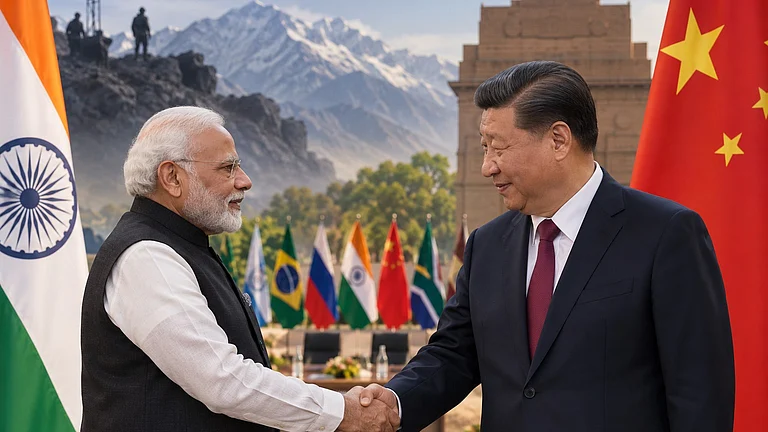
The thaw between Prime Minister Narendra Modi and Chinese President Xi Jinping at the BRICS summit in New Delhi has opened a new chapter in ties strained by the border clashes of 2020.
But beneath the diplomatic reset lies an economic contradiction: India is trying to de-risk from China even as its manufacturing ambitions remain deeply dependent on Chinese machinery, electronics, components and industrial inputs.

1 September 2026
Get the latest issue of Outlook Business

The Modi-Xi meeting saw both sides call for a longer-term approach to ties and greater business exchanges. Modi said “differences should not become disputes”, while Xi described the two countries as “partners rather than rivals”.
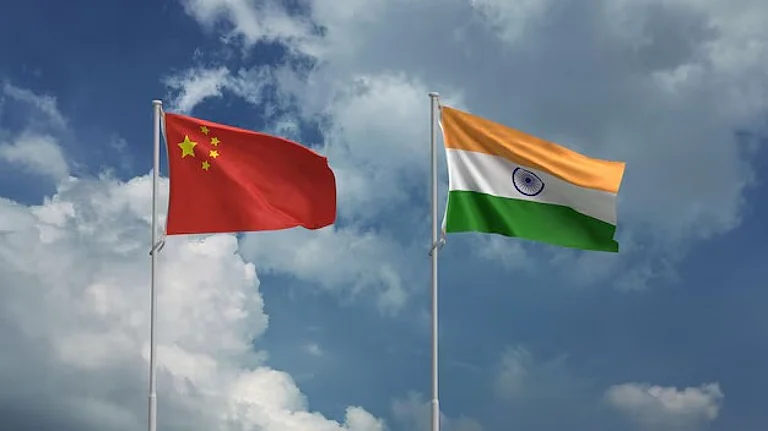



The meeting came after steps including the easing of some investment restrictions, resumption of direct flights and efforts to facilitate business links, as per a report by Reuters.
Trade Imbalance Is The Biggest Constraint
The economic relationship, however, remains sharply tilted towards China. India-China bilateral trade reached $151.1 billion in FY2025-26. China accounted for $131.6 billion of India’s imports, while Indian exports to China stood at $19.5 billion, leaving a $112.1 billion trade deficit.
Advertisement
The deficit had risen from $44 billion in FY2021 to $111.9 billion in FY2026, with Chinese imports increasing from $65.2 billion to $131.6 billion over the period. India’s exports, meanwhile, remained below their FY2021 level of $21.2 billion at $19.7 billion in FY2026.
According to a report by Koan Advisory and Institute of Chinese Studies, India’s largest deficit with China is concentrated in electrical machinery and equipment, at $43.2 billion, followed by machinery and mechanical appliances at $28.2 billion.
Organic chemicals added another $10.2 billion. Together, these categories point to dependence on the industrial inputs that support India’s own manufacturing base.
Advertisement
Building In India, But Still Needs China
This is where India’s de-risking strategy becomes complicated. The Koan Advisory-ICS report found that the number of six-digit tariff lines where China accounted for at least 80% of India’s imports rose from about 461 in 2018-19 to 636 in 2025-26. The report argued that this indicates the dependence has widened rather than simply shifted temporarily.
The electronics sector illustrates the dilemma as the Koan-ICS report put India’s FY2025-26 deficit in electrical machinery and equipment at $43.1 billion and noted that products under this category feed industries ranging from telecom and data infrastructure to power systems, electric vehicles and consumer electronics.
GTRI founder Ajay Srivastava told Outlook Business that China accounts for more than 30% of India’s industrial imports and supplies over 100 critical products. “India should selectively welcome Chinese investment where it brings technology, production and stronger supply chains, particularly in machinery, electronics and green energy,” he said.
Srivastava said India’s smartphone industry has built large-scale assembly and export capacity, but remains reliant on imported semiconductors, displays, camera modules and memory.
He said India is therefore moving up the manufacturing ladder, but remains closer to assembly than a fully integrated electronics ecosystem.
Why De-Risking Is A Long Game
The same paradox is visible in the solar manufacturing industry. Uday Doshi, founder of renewable energy consultancy Excelsior Engineering Solutions, said China accounts for around 92% of global polysilicon capacity, 98% of ingot and wafer capacity, 91.8% of solar cell capacity and 84.6% of module assembly capacity.
“India had around 173 GW of module manufacturing capacity but only 29.66 GW of cell capacity as of March 2026. Indian cell makers also remain dependent on imported wafers, production equipment and silver paste, while wafers account for around 40% of cell manufacturing costs,” Doshi told Outlook Business.

The result is that expanding Indian production does not automatically mean eliminating Chinese dependence. Doshi said Indian cell manufacturing can be around 40% more expensive than Chinese production, reflecting China’s scale, vertical integration and established supply ecosystem.
The Cost Of A Fast China Exit
Chinese equipment and components for solar, electronics and infrastructure have faced delays, while some Chinese machinery for Indian infrastructure projects was reportedly held up for more than a year. Srivastava said such delays “reflect more than administrative friction” and show how trade and technology dependence can become leverage.
That is the central tension behind the Modi-Xi thaw as India is not abandoning its effort to diversify away from China. But the BRICS meeting underlines why that process is likely to be gradual: the country it wants to de-risk from remains deeply embedded in the supply chains India needs to build its own industrial strength.
That makes a rapid reduction in Chinese imports economically difficult. GTRI’s Srivastava said India needs sector-specific industrial policies, lower manufacturing costs, stronger logistics and efforts to localise products such as motors, pumps, bearings, machine tools and industrial equipment.

Doshi similarly argued that India can substantially reduce solar dependence over the 5-10 years, but complete independence would be a much higher bar. “The priority should be building domestic equipment, wafer, materials and technology capabilities so that no single foreign supply chain becomes a critical vulnerability,” he said.