




India's food safety regulator, Food Safety and Standards Authority of India (FSSAI), has proposed mandatory warning labels on the front of packaged food products, according to a court filing cited by Reuters. The move marks a reversal from its earlier stance, coming after public criticism over insufficient nutritional information on food packaging.
As per the filing, which is not public, the regulator has suggested a red hexagon symbol for products high in two or more of three nutrients, fat, sugar or salt, the news agency reported.
FSSAI's Submission To The Supreme Court
The proposal was made in a filing before the Supreme Court, which is hearing petitions from health activists over long-delayed warning labels, Reuters reported. FSSAI told the court that the labelling approach was meant to address "the need for an effective and consumer-friendly ... labelling mechanism and to facilitate informed food choices, particularly in relation to children and other vulnerable groups of the population."

1 October 2026
Get the latest issue of Outlook Business

The regulator had considered colour-coded, interpretive warning labels since 2017 to flag high sugar, salt or fat content. However, after a meeting with food industry executives in March, it moved away from that approach and told the court in August that matching international labelling standards was "difficult." It has now proposed a black-and-white table listing nutrient content instead.



A Proposal Dropped, Then Revived
The Indian government had for years attempted to introduce such labels but dropped the plan in March after opposition from companies including Coca-Cola and industry groups representing Nestle, Reuters reported earlier this week. Following that report, consumers and health experts in India voiced concern on social media, pointing out that Coca-Cola and Nestle already use similar labels voluntarily in several European markets.
Advertisement
At a March 19 meeting with regulators, Coca-Cola India executive Mili Bhattacharya reportedly said it was "very simplistic" to assume warning symbols alone would change consumer diets, adding that doctors in India already advise patients on foods to avoid.
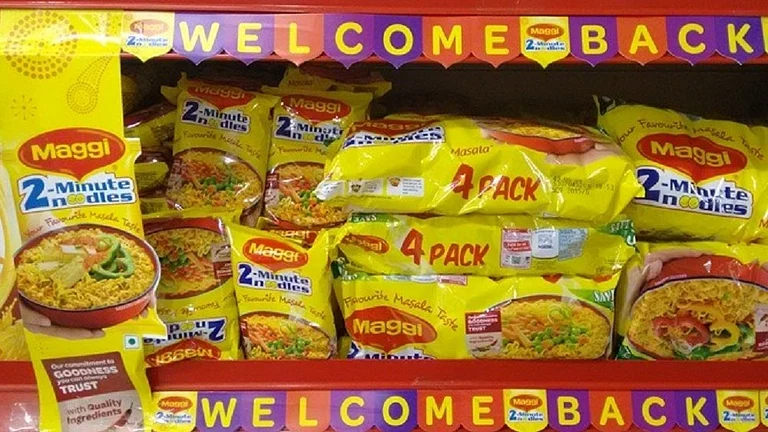
Notably, in a recent interview with the Economic Times, Nestle chief executive Philipp Navratil said Indian authorities should consult companies while drafting labelling rules to ensure the process is done "scientifically." Navratil said Nestle supports labelling for products high in sugar, salt and fat, but that manufacturers should have a say in shaping the rules. "It's always good to have a voice from companies; there might be different views (on the subject). We can be part of the debate in terms of making sure it's scientifically done," he said.
Advertisement
The Supreme Court had previously criticised the central government over delays in implementing front-facing warning labels. In February, it had asked regulators to examine warning systems such as Israel's red-and-green model, and remarked that "the world should know that India is very much concerned about the overall health of its citizens."
Industry estimates suggest nearly 80% of products in India's packaged food and beverage market, valued at more than $100 billion, could qualify as high in fat, sugar or salt. A separate Reuters report found that some companies sell different formulations of the same products across countries. A can of Fanta sold in London has 63 calories, compared with roughly three times the sugar and 185 calories in the India version. Nestle's KitKat sold in India contains 4.5% cocoa solids against at least 22% in the Australian version, while Maggi noodles sold in India use palm oil, unlike some UK versions that use sunflower oil. Certain India-made Maggi packets sold in Britain carry red front-of-pack warnings for high salt content.
A Lancet study cited by Reuters estimated that 450 million Indians could be overweight or obese by 2050.









