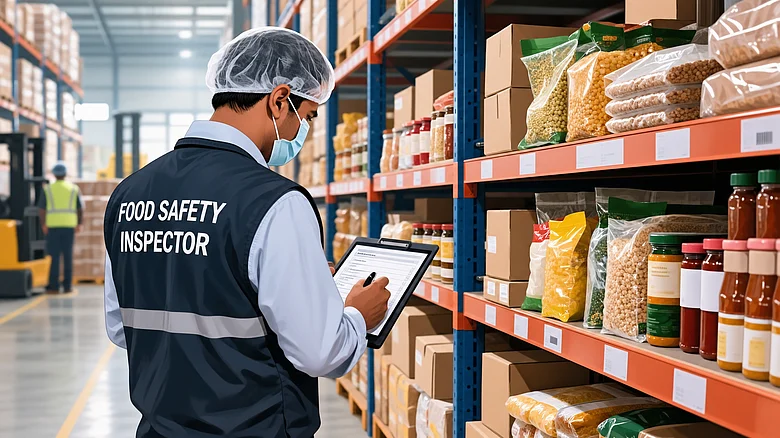

India's food regulator has launched its most aggressive enforcement campaign in history.
Big corporations are equipped to manage the new compliance burden, but MSMEs face a survival test.
The question is whether consumer protection can be achieved without crushing the small businesses that feed the nation.
The raid was over. But the footage of inspectors storming a warehouse on the outskirts of Mumbai went viral within a few hours. What Maharashtra’s Food and Drug Administration commissioner Tukaram Mundhe into the face of yet another food found sent shockwaves across the country. The food products in the warehouse made by some of the biggest brands—PepsiCo, Nestle, Coca-Cola and Unilever—were allegedly carrying tampered expiry dates and nutritional information, even as they were being prepared for export.
In recent months, the Food Safety and Standards Authority of India (FSSAI) has issued over 150 notices to major food and beverage companies, including Nestle India, PepsiCo, Abbott India, Red Bull, Danone, Mondelez, Coca-Cola, Diageo and Pernod Ricard. The violations range from misleading advertisements and false health claims to labelling non-compliances. More than 30 notices have gone to food service chains like KFC, McDonald's, Pizza Hut and Domino's, with five Domino's licenses suspended.

1 October 2026
Get the latest issue of Outlook Business

This is not a one-off blitz. Data tabled in Parliament by the Ministry of Health and Family Welfare shows that in FY 2025-26, the FSSAI and state authorities conducted a record 5,20,566 inspections, up from 4,01,391 in 2024-25 and 3,57,072 in 2023-24. Authorities analysed over 2.2 lakh food samples, of which 40,023 were found "non-conforming", meaning nearly one in every five samples tested failed to meet food safety standards. The enforcement drive resulted in 31,878 civil cases decided with penalty and 1,918 criminal convictions, according to the provisional data. Notably, authorities imposed penalties totalling ₹154.87 crore, as per an April report by PTI.



Advertisement
While this crackdown aims to protect consumers, it has ignited a debate about who will ultimately bear the cost.
The Compliance Capacity of Large Corporations
For the multinationals and large domestic players, the FSSAI's enforcement represents a significant but manageable challenge. They have the teams, the systems and the financial reserves to adapt.
Nitin Gupta, FMCG and Alcoholic Beverage Analyst, told Outlook Business that "larger FMCG companies possess a clear structural advantage due to scale, established compliance architecture, mature QA systems and deeper regulatory awareness."
The numbers bear this out. A typical mid-sized multi-state food processing enterprise is subject to more than 3,285 unique compliance obligations, which rises to 11,554 annual compliance actions when filing frequencies are considered, as per a TeamLease RegTech report. For companies with dedicated compliance teams, this is a function of doing business.
Advertisement
But the costs are real. Rishi Agrawal, CEO and Co-founder of TeamLease RegTech stated that compliance costs come in layers. At first, the direct cost will come from redesigning and reprinting packaging. The opportunity cost of teams diverted from growth initiatives. The systemic cost will rise from inventory write-offs and working capital pressures.
Consider the FSSAI's decision to bar food companies from using "100%" claims. Dabur in a writ petition submitted to the Delhi High Court stated the ban put roughly ₹150 crore of packaging inventory at risk of write-off. Marico may have a possible 2-3% hit to quarterly revenue from labelling changes on some products. Even giants feel the sting.
Yet the giants can absorb it. They can write off inventory. They can redesign packaging across hundreds of SKUs. They can hire more regulatory affairs professionals and train existing staff.
Outlook Business reached out to FMCG companies Nestle, ITC, Britannia, LT Foods and Lenexis Foodworks to comment on the matter, but all of them declined to comment.
The 2/98 Paradox
The reality is starkly different for India's 24.59 lakh food processing enterprises, most of which operate in the unregistered segment . These micro, small and medium enterprises form the backbone of the industry but lack the resources to manage the escalating compliance burden.
This creates what the TeamLease RegTech report describes as a "2/98 paradox", large and medium enterprises represent only 2% of units but contribute 60-65% of total production value . The small players are everywhere, but their margins are thin and their capacity for compliance is limited.
"For a large company, a new labelling rule is a line item. For a smaller manufacturer, it can be a cash-flow event that arrives without warning," Agrawal told us.
The TeamLease report estimates that a typical manufacturing MSME spends around ₹15.55 lakh annually on compliance, a baseline cost that doesn't include packaging redesigns or new documentation systems required by regulatory changes. Labour laws alone account for nearly 50% of the total compliance universe and nearly 29% of these obligations carry criminal provisions, including imprisonment for procedural lapses.
This is the hidden cost of regulation. It's not just about fines or penalties. It's about the constant monitoring of regulatory updates, the training of staff, the maintenance of records, the filing of returns. For a business with a handful of employees and no dedicated compliance team, it can be overwhelming.
"Compliance is not a problem you solve once. It's a continuous information-management exercise," Agrawal further said. The TeamLease report adds that "this constant change is especially difficult for MSMEs, which often lack specialised legal or quality assurance teams. These smaller businesses struggle to track and implement new rules in real-time."

The Kitchen Tests
The ground-level reality is perhaps best illustrated by what's happening in Bengaluru. The city's food safety department, as part of a wider Karnataka enforcement drive, inspected 629 Backward Classes hostels, 331 Social Welfare Department hostels, 603 Anganwadi centres, and 124 educational institutions .
Food safety inspectors raided 60 three- and five-star hotels, 4 international restaurants, and 8 warehouses. They confiscated 429 kilograms of mutton and chicken due to mislabelling or expired dates, 203 kilograms of fish with extended expiry dates, 200 kilograms of vegetables stored next to non-veg items, 76 kilograms of rotten or mouldy vegetables, 45 litres of milk or curd, and 49 litres of substandard used cooking oil .
But the focus has also turned to a less visible part of the city's food economy; home bakers, tiffin services, Instagram sellers, cloud kitchens and temporary food stalls . Under the FSSAI framework, all food business operators are required to be licensed or registered. Since April 2026, businesses with an annual turnover of up to ₹1.5 crore fall under registration .
Getting an FSSAI registration is an easy process, multiple reports said. But many continue to operate without registration. One Bengaluru-based baker told Deccan Herald she wasn't even aware that registration was required for a home business .
Karnataka's Health Minister UT Khader has backed tighter regulation, saying the government should frame rules for home-based food businesses operating through social media.
The Industry Responds
The crackdown has not gone unchallenged. Diageo, whose popular McDowell's rum was banned by FSSAI over labelling allegations, has approached the Bombay High Court. The company argues that authorities bypassed due process and acted even as FSSAI was consulting the industry on the very labelling rules at issue.
"Premature, disproportionate and commercially prejudicial," Diageo argued in its court filing. The company maintains that it complies with applicable laws.
The dispute highlights the complexity of the regulatory landscape. At the centre of the Diageo case is a disagreement over whether "artificial flavour (rum)" is an acceptable ingredient declaration. FSSAI argues that rum flavour should be "characteristic based on the natural ingredients, fermentation processes and maturation techniques".
This is the kind of nuanced interpretation that large companies can litigate. For small players, it's the kind of ambiguity that can lead to licence suspension with no legal team to contest it.
What Lies Ahead
The FSSAI is unlikely to back down. "In a country of 1.4 billion people consuming nearly 1.5 trillion meals every year, ensuring food safety is a monumental task," the regulator said last month.
The Supreme Court is scheduled to review the front-of-pack warning label proposal on September 10. The FSSAI has proposed a red-coloured hexagonal warning label for packaged foods that exceed limits for at least two of three nutrients; added sugar, salt, or saturated fat. The warning would carry declarations such as "High Fat", "High Sugar", "High Salt" or "Highly Sweetened Beverage".
The proposal has divided the industry and health advocates. Industry executives have raised concerns over the thresholds India is proposing, a red warning if added sugar exceeds 3% of solid products by weight and fat exceeds 4.2%. They argue these limits are stricter than many foreign markets and could result in a large number of products carrying warnings . The CEO of a food firm told Reuters, "Everything will be red". Health advocates, as per reports, meanwhile, argue the two-nutrient threshold creates a loophole that could allow products high in just one nutrient to escape warnings
For the big players, this is the cost of doing business in India's $100 billion packaged food industry. For the small ones, it may be the final straw.
FSSAI has taken some steps to ease the burden. In March 2026, the regulator raised the turnover threshold for basic registration from ₹12 lakh to ₹1.5 crore, exempting a vast number of street vendors and small eateries from more stringent licensing requirements. It also declared that FSSAI licences and registrations for MSMEs will now be valid for life.
But these measures may not be enough. As Agrawal put it: "Enforcement and clarity aren't a trade-off. Most of the confusion I see isn't caused by strict rules, it's caused by incomplete ones."
What small businesses need, he told Outlook Business, is "risk-based enforcement that treats a five-star kitchen and a street vendor differently," as well as "fixed transition windows before a new requirement takes effect, so businesses aren't writing off inventory overnight."
Agrawal also called for "one authoritative source for regulatory updates, instead of scattered portals," and better coordination between FSSAI and state authorities. "None of this weakens enforcement," he told Outlook Business. "It makes it predictable, which is what actually earns compliance."
Saurya Bhattacharya, Partner at JSA Advocates and Solicitors, told Outlook Business that the regulatory landscape itself has not fundamentally changed. "The distinction at present is caused because of potentially more frequent or dense coverage during the inspections, and the mainstream, digital and social media attention that it has received."
What has changed is enforcement intensity and public visibility. And that may be enough to reshape the industry for years to come.