The government has introduced a 0.4% MDR on select UPI merchant transactions above ₹2,000
PhonePe, Paytm and MobiKwik founders have backed the move as necessary for the ecosystem’s long-term sustainability
Ashneer Grover and Nithin Kamath have raised different objections, focusing on UPI’s costs and the impact of MDR
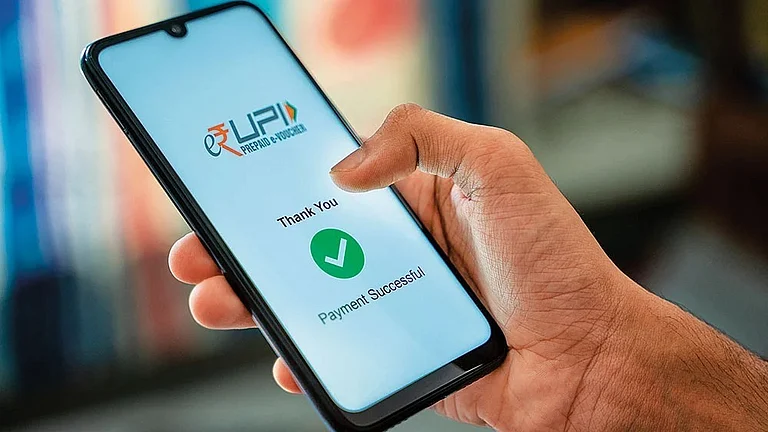
India’s Unified Payments Interface (UPI) has been free for consumers since 2020, but the introduction of a Merchant Discount Rate (MDR) on select high-value merchant transactions has reopened a fundamental question: should UPI remain free, or does its rapidly expanding infrastructure now require a revenue model?
Under the revised framework, 0.4% MDR will apply to select person-to-merchant (P2M) UPI transactions above ₹2,000, capped at ₹300 per transaction.

1 September 2026
Get the latest issue of Outlook Business

A flat ₹5 charge will apply to specified categories such as railways, telecom, insurance and fuel. P2M payments up to ₹2,000. and P2P transactions will remain free.


Ashneer Grover Questions The Financial Case
Former BharatPe cofounder Ashneer Grover has challenged the rationale for introducing MDR, arguing that the financial position of UPI’s operator does not indicate a system that needs such charges.
Grover cited NPCI’s ₹6,119 crore in cash and a pre-tax operating profit of ₹1,900 crore, in a post on X (formerly Twitter) on September 15.
Advertisement
He also questioned the wider economics of UPI, citing ₹2.87 lakh crore transferred by RBI to the government and ₹4.11 lakh crore in listed bank profits.
“Any levy on UPI is just tax collection,” Grover wrote on X. He also argued that the cost of cash infrastructure, including ATMs and cash logistics, should be considered when assessing the economics of UPI.
Nithin Kamath Sees A Problem For Brokers
Zerodha co-founder Nithin Kamath has taken a more specific position. In an X post, he said MDR was “probably inevitable” but questioned whether the proposed structure works for the broking industry.
His concern is that customers can transfer money to brokers without eventually placing a trade, leaving the broker with the payment cost but no corresponding revenue.
Advertisement
He gave an example of 10,000 customers making 50 transfers of ₹2 lakh each without executing a trade, which could potentially leave a broker with around ₹2 crore in MDR costs.
Kamath suggested a 0.02% MDR capped at ₹5 or ₹10 for broking transactions, rather than a ₹300 cap.
PhonePe, MobiKwik And Paytm Back MDR
PhonePe founder and CEO Sameer Nigam has defended the move, saying the revenue will help the industry recover operational costs after years of MDR-free UPI transactions.
“Around 96% of transactions will remain free because the majority of UPI transactions in India are below ₹2,000,” Nigam said in an interview with ANI.
He also said the additional revenue could support further investment and expansion of the UPI ecosystem.
Paytm founder and CEO Vijay Shekhar Sharma similarly called the framework a “Robin Hood” approach.
Speaking to DD News, Sharma said UPI had largely operated on a grant-based model and that charging larger transactions while protecting small merchants could create a more sustainable funding base.
“It's a long-pending issue that everyone knew would eventually see some charge come in,” he said.
MobiKwik co-founder Upasana Taku told ANI that the fintech industry broadly supports UPI MDR, while sharply criticising its opponents.
“There is no confusion; I want to clarify that everyone in our fintech industry unanimously supports UPI MDR,” she said.
UPI Is Already Being Paid For: Capitalmind's Shenoy
Capitalmind founder Deepak Shenoy argued that UPI does not necessarily need MDR because banks already benefit substantially from the deposits and “float” associated with payment accounts.
"UPI is a digital public good, high frequency and high traffic. Don't slow it down," he wrote in a blog post.
He said that banks earn significantly more from the money customers keep in savings and current accounts than the cost of maintaining payment infrastructure. He also pointed to the government's existing support for the payments ecosystem and NPCI's relatively low technology costs.
"Don't charge retail users for UPI. Don't charge small merchants for UPI. Don't even charge large merchants for UPI," he remarked.
Mohandas Pai, Niti Aayog Defend MDR
Chartered accountant and former Infosys CFO Mohandas Pai told ANI that UPI infrastructure needs continued investment as transaction volumes rise.
He argued that the cost should be shared by merchants benefiting from digital payments rather than being borne entirely by banks.
NITI Aayog Vice Chairman Ashok Kumar Lahiri, while stressing that his comments were personal and not NITI Aayog’s official position, framed the issue around the “User Pay Principle”.
“Costs are incurred in UPI; who will pay that?” Kumar remarked, as per ANI.
RBI, NPCI Back Sustainability Case
The RBI has called the introduction of MDR on large-value UPI transactions an important step towards strengthening the long-term sustainability of the digital payments ecosystem.
It said an appropriate distribution of MDR among ecosystem participants would support investment in technology, infrastructure and acceptance networks, while consumers would continue to transact free.
NPCI has similarly said the revised framework will keep consumers free of charges and protect low-value transactions and small merchants, while directing revenue from higher-value transactions towards ecosystem expansion, resilience, cybersecurity and innovation.

The framework, however, has also entered the legal arena. Advocate Anjan Datta, who filed a petition challenging UPI MDR in the Supreme Court, argued that even nominal charges could ultimately be passed on to citizens and sought a stay on the framework, per ANI.
The debate, therefore, is no longer simply about whether UPI should be free. It is increasingly about who should pay for maintaining and expanding an infrastructure that India has come to rely on at unprecedented scale.