Economic Survey to be tabled today in Parliament, setting the macro and policy narrative ahead of the Union Budget.
Growth for FY26 seen at 7.4%, with markets closely tracking signals on inflation, fiscal consolidation, and capital expenditure.
Key focus areas include jobs, private investment, exports, and the external sector, amid global trade and geopolitical headwinds.
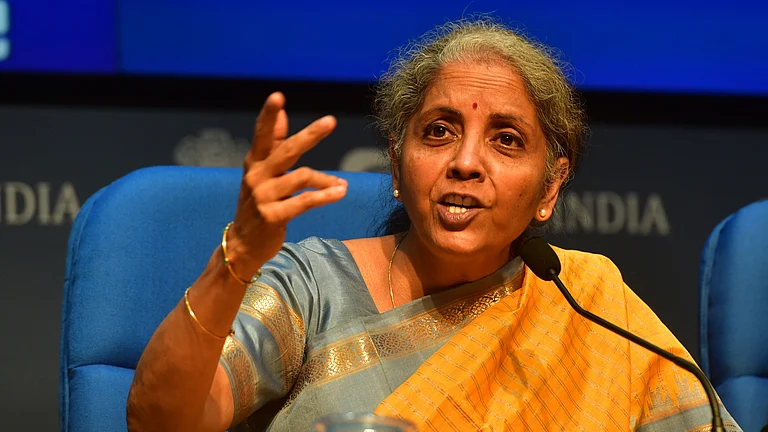
The Economic Survey for the financial year ending March 31 will be tabled before both Houses of Parliament today. The presentation of the Survey by Union Finance Minister Nirmala Sitharaman will begin at 11 am. Following the presentation, Chief Economic Advisor V Anantha Nageswaran will address the media.
The Economic Survey typically sets the tone for the Union Budget and outlines the policy framework and economic outlook for the upcoming year.

1 September 2026
Get the latest issue of Outlook Business

The Survey is prepared by the Office of the Chief Economic Advisor (CEA) under the Ministry of Finance. More often than not, the Indian economy has expanded at a pace higher than the projections outlined in the Economic Survey. Growth for FY26 is expected to be around 7.4%, in line with the First Advance Estimates released by the National Statistical Office.
Alongside growth, inflation and fiscal arithmetic are the other key components closely tracked by economists and market participants.
Advertisement
Inflation Expectations
According to reports, investors will assess how the Survey characterises food inflation—whether as episodic or structural—and the guidance it offers on global commodity trends, energy prices, and supply-side disruptions. As per the latest projections by the Reserve Bank of India, consumer price inflation (CPI) for FY26 has been revised downward to 2.0% from 2.6%. A benign inflation assessment creates space for growth-supportive policies while a cautious tone may signal fiscal restraints.
Fiscal Health
As per economists polled by Reuters, the government is likely to target a fiscal deficit of around 4.2% of GDP for FY27, lower than the 4.4% deficit target in the previous year.
Advertisement
Public vs Private Capex
According to reports, a key question ahead of the Budget is whether private investment has picked up sufficiently to allow public capital expenditure to take a breather. Public capex has anchored India’s economic recovery from the pandemic shock. Market participants will closely watch whether the Survey argues in favour of a private investment pickup or if public capex will continue to remain the primary growth engine.
Labour Market Trends
The Economic Survey is also expected to discuss labour-market trends, indicators of formalisation, and sector-wise employment generation. As per a report by Moneycontrol, economists have reiterated that job creation remains a key credibility test for India’s economic development.
Export and External Sector Risks
More importantly, the Survey will assess India’s exports and external sector, which have faced a period of turbulence during the year. US reciprocal tariffs, evolving geopolitical tensions, and trade restrictions are likely to weigh on India’s export outlook. Beyond the core sections, the stability and health of the banking sector, along with developments in agricultural and rural demand, will also be closely read.
Overall, the Economic Survey will outline the government’s growth targets, deficit goals, and the policy space available to sustain economic expansion in the world’s third-largest economy.