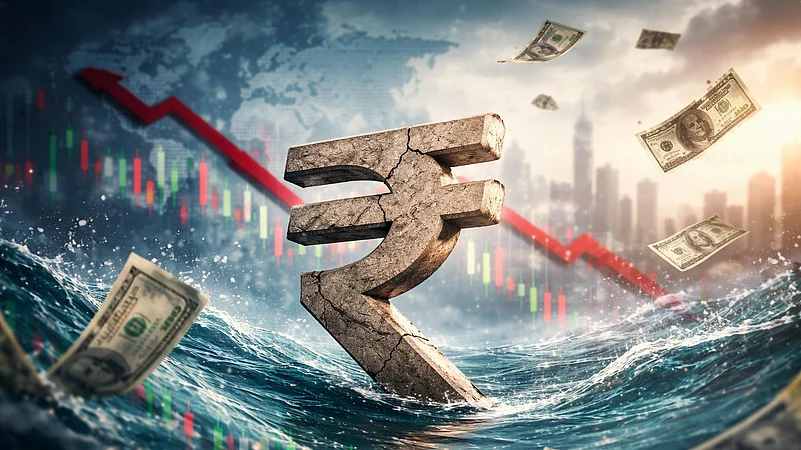

Geopolitical uncertainty and muted foreign capital inflows have pushed the rupee to record lows.
With inflation contained and crude prices subdued, policymakers see little immediate threat from a weaker currency.
Sustained capital inflows and stronger manufacturing exports are key to long-term currency stability.
The steeper-than-expected depreciation of the rupee has been driven by ongoing geopolitical volatility, the Economic Survey said on Thursday. The rupee has emerged as the worst-performing currency among its Asian peers, weakening nearly 6% against the US dollar in 2025 alone. Against this backdrop, the Survey described the rupee as a “victim of geopolitics and the strategic power gap.”
The domestic currency slipped to a record low on Thursday, breaching the psychologically crucial level of ₹92 per dollar. However, the Economic Survey noted that the rupee’s valuation does not accurately reflect India’s macroeconomic fundamentals.

1 September 2026
Get the latest issue of Outlook Business

“Growth is good; the outlook remains favourable; inflation is contained; rainfall and agricultural prospects are supportive; external liabilities are low; banks are healthy; liquidity conditions are comfortable; credit growth is respectable; corporate balance sheets are strong; and the overall flow of funds to the commercial sector is robust,” the report said. “The rupee, therefore, is punching below its weight.”
A factor dragging the rupee consistently is its trade deficit. Unlike several Asian economies such as South Korea, India runs a persistent trade deficit in goods, with its import bill often ballooning. The country relies on foreign capital inflows to meet dollar demand and maintain a healthy balance of payments. However, 2025 has seen muted inflows amid an exodus of foreign investors from Indian markets, leaving the rupee vulnerable.
Advertisement
The Survey underlined that the depreciation of the domestic currency does not pose a significant inflation risk, given subdued global crude oil prices. “It does not hurt to have an undervalued rupee in these times, as it offsets, to some extent, the impact of higher American tariffs on Indian goods,” it said.
However, it cautioned that the fall in the rupee has prompted investors to reassess their exposure, leading to reluctance in committing capital to India—an issue that warrants closer examination.
“(In the last eight months) exchange rate dynamics in India were shaped by persistent outflows of foreign investment and evolving bilateral trade developments, including tariff-related measures, which together contributed to cautious investor sentiment,” the report said. “Such factors amplified short-term currency movements even when underlying macroeconomic fundamentals remained stable.”
Advertisement
Rupee is Comfortable – in the Short Term
From April 1 to January 22, the rupee has depreciated 6.5% against the US dollar. Despite the persistent strain on the currency, the report said India’s external sector remains “comfortable” in the short run. This cautious phrasing likely hints that the resilience of India’s external buffers hinges on de-escalation of geopolitical tensions, a revival in foreign investors’ risk appetite, productivity gains, and export diversification in the medium-to- long run. This requires careful calibration of economic, monetary, and industrial policies to help make buffer-zones for India to absorb unexpected external shocks, better.
What’s in Store for Rupee?
The Economic Survey outlined three possible scenarios for the global landscape. The first is a continuation of current conditions through 2025. The second involves an escalation of existing geopolitical tensions and explicit economic coercion shaping trade and policy decisions. The third—and least likely—scenario is a systemic shock worse than the 2008 global financial crisis, triggered by a correction in a highly leveraged AI investment boom. Such a correction, the Survey warned, could tighten financial conditions and spill over into broader capital markets.
“Across all three scenarios, a common risk for India is disruption to capital flows and the consequent impact on the rupee,” the report said, even as domestic fundamentals remain strong. It urged for shaping policies that can attract sustained investor interest and generate sufficient foreign currency earnings to cover India’s import bill, and thereby providing the rupee some room to breathe.
Economists and market analysts have earlier pointed out that the apart from the policy uncertainty triggered US President Donald Trump’s tariff flip-flops, over-valuation of Indian equity market as well AI-investment boom in other Asian economies including South Korea and Taiwan, have significantly led to pressure on rupee and foreign fund outflows, essentially entering into a ‘self-reinforcing cycle’.
Despite the unpredictability of global scenario, demand for the greenback, and worries over a consistently falling rupee, the Survey states that it is usual for a country’s currency to remain under pressure as it advances toward greater economic growth. For emerging market currencies, this remains a reality as the import dependence for high-tech goods meets a phase of narrow exports growth and muted capital inflows.
However, a key point highlighted in the Economic Survey is that, a widening current account deficit may not always necessarily lead to sharp depreciation in the domestic currency as currency movement is also dependent on capital inflows.
“In FY08, FY18 and FY22, despite a rapid expansion in imports, the rupee appreciated, supported by robust net foreign investment inflows,” the report said. “These episodes underscore that exchange-rate movements are influenced not merely by the size of the trade deficit, but by the composition and stability of capital inflows.”

Boosting Manufacturing for Currency Stability
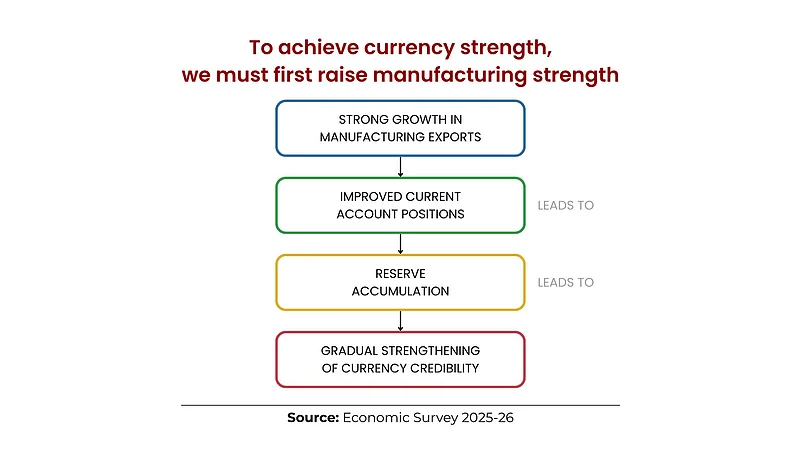
The report stated that what stabilizes a currency is an ‘economy that reliably earns foreign exchange.’ Drawing parallels from other Asian economies, strong manufacturing exports remain one of the key factors that can improve current account positions, accumulating forex reserves, and gradually strengthening the currency credibility. The report noted that unless India’s export capacity expands in line with its import bill, growth will continue to weigh on Balance of Payments (BoP).
Although India’s services export is the key engine for foreign currency earnings, the report explicitly states that services exports alone will not substitute for the necessary scale of economies, subsequent employment generation, and manufacturing export growth, seen in large and fast growing economies.
Industrial policy, including careful protection of sectors, is required to shape the course of sustained economic growth alongside export-driven economic expansion and currency strengthening. Access to imported capital goods, investments in technical education, and improved infrastructure for research and development, help boost the manufacturing sector faster.
With the US reciprocal tariffs still remaining intact, India has actively shown efforts to diversify its market access and trade strategy, as evident from the trade agreements New Delhi sealed with the UK, Oman, New Zealand, and the European Union. However, the survey maintained a cautious tone on the outlook for medium-term as global developments continue to be complicated.
The challenge for India is not just rapidly expanding exporting or improving manufacturing, but to position itself as a global hub across value chains.
Taken together, the assessment suggests that policymakers, including the government and the Reserve Bank of India, are not particularly alarmed about the rupee’s valuation. As Chief Economic Advisor V. Anantha Nageswaran said, the government is “not losing sleep over the declining rupee.”