Petrol prices topped ₹ 100 across most Indian cities after fourth fuel price hike, with Mumbai at ₹ 108.45, Hyderabad at ₹ 112.81, Kolkata at ₹ 110.64, Chennai at ₹ 105.33 per litre.
Diesel nears ₹ 100 mark pricing at ₹ 100.94 in Hyderabad, ₹ 99.82 in Kolkata, ₹ 97.83 in Mumbai, ₹ 97 in Chennai following ₹ 2.61-2.71 per litre price increase.
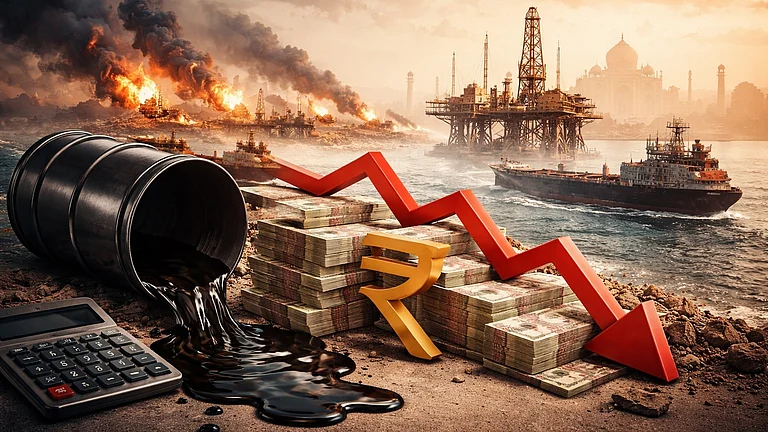
Cumulative fuel price increases nearly touched ₹ 7.5 per litre since May 15 when revisions resumed after prolonged freeze amid rising global crude oil prices and weak rupee.
Petrol prices were raised by ₹ 2.61 a litre and diesel by ₹ 2.71 on Monday, the fourth increase in less than two weeks that extended a delayed pass-through of soaring global crude oil costs triggered by the Iran conflict.
The latest increase took cumulative hikes since May 15 to nearly ₹ 7.5 per litre.
In Delhi, petrol prices rose to ₹ 102.12 per litre from ₹ 99.51, while diesel climbed to ₹ 95.20 from ₹ 92.49, according to industry sources.

1 September 2026
Get the latest issue of Outlook Business

Fuel prices have now reached their highest levels since May 2022 after remaining largely frozen for more than two years, barring a ₹ 2-per-litre cut in March 2024 ahead of national elections.
The hike came as global oil prices fell sharply amid tentative hopes for a deal to end the US-Israel war on Iran. Brent crude, the primary benchmark for global oil prices, fell more than 5 % after the US and Iran agreed in principle to reopen the Strait of Hormuz.
Advertisement
Global crude oil prices had surged more than 50 % since late February following US-Israeli strikes on Iran and disruptions to shipping through the Strait of Hormuz, a key global oil transit route.
State-run retailers had delayed passing on higher input costs for weeks, a move the government said was intended to shield consumers from inflation. Opposition parties, however, accused the administration of holding back price increases until after key state elections.
The May 15 increase came after the ruling Bharatiya Janata Party (BJP) expanded its electoral footprint by winning three of five state and UT elections, including West Bengal.
Advertisement
Since the start of war, domestic cooking gas LPG prices have been raised by ₹ 60 per 14.2-kg cylinder and that of compressed natural gas (CNG) by ₹ 4 per kg since mid-May.
Despite the price increases, auto fuels petrol and diesel, and domestic cooking gas LPG continue to be sold at a substantial loss. Besides the three fuel, state-owned fuel retailers -- Indian Oil Corporation (IOC), Bharat Petroleum Corporation Ltd (BPCL), and Hindustan Petroleum Corporation Ltd (HPCL) -- have paused increase in jet fuel (ATF) rates.
The three firms together control 90 % of India's fuel market.
Congress leader Rahul Gandhi attacked Prime Minister Narendra Modi over the latest fuel hike, accusing the government of burdening consumers after state elections ended.
"Petrol and diesel prices are being increased in instalments so that people's pockets are quietly picked," Gandhi said in a post on social media, calling Modi "Mahangai Manav Modi" -- a play on words linking the prime minister to inflation.
"Mehangai Manav Modi strikes again," he said in the post. "For months, I had been warning of an impending economic storm. But Modi Ji, true to form, was busy with elections at the time and the moment the elections ended, he hiked the prices of petrol and diesel by ₹ 8." And, this upward trend will only continue, he added. "'Mehangai manav' Modi has just one job: promises during elections, and attacking people's pockets at other times," Gandhi said.
Retail fuel prices were first raised by ₹ 3 per litre on May 15, followed by a 90-paise increase on May 19 and another hike on May 23, when petrol prices rose by 87 paise and diesel by 91 paise per litre.
Prices vary across states due to local levies.
After Monday's increase, petrol in Mumbai was priced at ₹ 111.21 per litre and diesel at ₹ 97.83, while Kolkata rates rose to ₹ 113.51 and ₹ 99.82, respectively. In Chennai, petrol cost ₹ 107.77 and diesel ₹ 99.55 per litre.
Private fuel retailers also moved prices higher alongside state-owned firms. Nayara Energy had earlier increased petrol and diesel prices by ₹ 5 and ₹ 3 per litre, respectively, in March, while Shell plc raised petrol prices by Rs 7.41 and diesel by as much as ₹ 25 per litre from April 1.
Jio-bp, the fuel retailing joint venture between Reliance Industries Ltd and BP Plc, adjusted pump prices in line with state-run retailers.
The back-to-back increases are expected to add to inflationary pressures and raise transportation and logistics costs across the economy.

India's retail inflation accelerated to 3.48 per cent in April from 3.40 per cent in March, while wholesale inflation climbed to a 42-month high of 8.3 %, driven largely by higher fuel and energy costs.
The fuel price increases come amid broader efforts by the government to contain India's oil import bill and reduce fuel consumption.
Prime Minister Narendra Modi last week urged citizens and government departments to conserve fuel, encourage remote working and reduce non-essential travel as elevated energy prices pressure foreign exchange reserves and threaten to widen the current account deficit.


Several state governments have already directed departments to curb travel and reduce office attendance.
Industry officials said the latest revisions appeared calibrated to partially ease pressure on oil companies without triggering a sharp inflation shock, though they acknowledged the increases would add to price pressures.
Prashant Vasisht, Senior Vice President and Co-Group Head, Corporate Ratings, ICRA Ltd, said, "Despite the latest hike in retail prices of auto fuels, oil marketing companies' under-recoveries remain stubbornly high due to increasing losses in domestic LPG sales and a high premium to the crude marker." ICRA estimated that at crude price of $ 120-125 per barrel and considering past 10-year average crack spreads of auto fuels, oil marketing companies are incurring a loss of about ₹ 700-800 crore daily on the sale of auto fuels and domestic LPG, even after factoring the fuel price hike. "This high level of under recoveries is unsustainable."