






Five Indian states have crossed the World Bank's upper-middle-income threshold, but the piece argues this masks stark internal disparities.
The analysis contends that income thresholds measure outcomes, not the productivity transformation that produces sustainable prosperity.
Even in high-performing Karnataka, over 72% of the non-agricultural workforce remains informally employed.
Five Indian states, Delhi, Karnataka, Telangana, Tamil Nadu and Gujarat, have crossed the World Bank's upper-middle-income threshold of $4,496 per capita income. Maharashtra, Haryana and Kerala missed the benchmark by less than $30 per person. This achievement is celebrated as evidence that India's development story is accelerating. It may instead expose one of India's deepest economic misunderstandings: the belief that income statistics and economic development are the same thing.
They are not.

1 September 2026
Get the latest issue of Outlook Business

A state can cross an international threshold without building the institutions, productivity and employment base needed to sustain prosperity, generating extraordinary wealth in a few cities while leaving large parts of its population behind. Yet every time India reaches a new economic milestone, it celebrates the number while asking remarkably few questions about the process that produced it.
The World Bank's income classifications were designed as analytical tools, not certificates of economic maturity. Yet they are increasingly treated as badges of arrival. That mistake matters because it obscures India's biggest economic challenge: not how to grow, but how to prevent growth from becoming permanently unequal.
Advertisement
When Income Becomes a Mirage
The first mistake is to confuse income with the process that generates it.
Economies become richer for very different reasons, from globally competitive manufacturing to booming services, urban agglomeration, remittances or commodity cycles. The World Bank's classification system records the outcome; it does not explain the mechanism.
The relevant question is which states have built an economic model capable of remaining there. History suggests this distinction matters; many countries cross income thresholds only to stagnate. Much of Latin America demonstrates that income gains without productivity gains rarely produce sustained prosperity. The middle-income trap exists precisely because income growth is easier to achieve than economic transformation. India's celebration risks confusing a snapshot with a trajectory.
Advertisement
The Tyranny of the Average
Per capita income is an average. Economies do not function through averages.
Consider Telangana. Much of the state's impressive income performance reflects the extraordinary productivity of Hyderabad. According to state government data, the capital's per capita income sits at an extraordinary ₹1,000,000 (roughly $12,000). Yet, traveling just 300 kilometers north to the rural district of Adilabad reveals a per-capita income of just ₹160,000 ($1,900), less than one-seventh of the capital's output. A handful of cities can dramatically raise state averages while masking substantial disparities elsewhere.
This phenomenon is hardly unique to India. Oil-rich economies have long demonstrated that high average incomes can coexist with weak diversification and uneven prosperity. Statistical averages smooth over differences. Economic realities do not.
The result is a peculiar paradox. Parts of Bengaluru increasingly resemble upper-middle-income East Asia, while parts of rural India remain closer to lower-middle-income economies. A state can appear affluent on paper while many of its citizens continue to live in conditions associated with much poorer societies. The question is not whether some Indian states have become richer, but whether that prosperity has become broad-based.
The Threshold Trap and The Productivity Divide
The celebration itself exposes another analytical weakness.
A state that exceeds an international threshold by a few dollars is not fundamentally different from one that falls marginally short. Yet thresholds create the illusion of structural transformation, encouraging policymakers to believe that a gradual development process has suddenly produced a qualitative change.
Economic development does not work that way. A state earning $4,490 per person is substantially identical to one earning $4,510. Thresholds create administrative categories, not prosperity. The danger lies in mistaking classification for achievement.
The most important distinction, however, is not income. It is productivity.
The states pulling away from the national average have become more productive by shifting workers from low-productivity agriculture into manufacturing and modern services, creating the structural transformation necessary for sustained growth. Comparing Bihar with Tamil Nadu or Karnataka through the lens of income alone misses the point. Income is the consequence; productivity is the cause.
Recent work by Ricardo Hausmann at Harvard's Growth Lab reaches a similar conclusion. Economies become prosperous because they develop complex productive capabilities, specifically the skills, infrastructure and industrial know-how needed to produce sophisticated goods. Income is not the cause of development; it is often its lagging indicator. The real divide in India is not between rich and poor states, but between productive and unproductive economies.
Why Success May Not Travel, and The Age of Divergence
The success of India's richer states may be less replicable than policymakers assume. Bengaluru's technology ecosystem did not emerge overnight. Hyderabad's rise reflects decades of institutional accumulation, and Gujarat's industrial success rests on historical advantages built over generations.
Economic geography rewards concentration. Once cities acquire advantages in talent, capital and infrastructure, those advantages become self-reinforcing. If growth naturally clusters, poorer states cannot simply catch up through imitation. They require fundamentally different development strategies.
For decades, economists worried that India might not grow fast enough. That concern looks misplaced. India's more important challenge is that different parts of the country are growing at dramatically different speeds.
The assumption that poorer states will eventually converge with richer ones lacks support in economic history. Regional inequalities widened for decades in both China and the United States during periods of rapid growth. Convergence, where it occurred, was slow and politically contentious. There is little reason to assume India will prove immune to these dynamics. Indeed, India is entering an era in which economic divergence matters more than growth itself.
The Missing Variable
The most striking omission from the celebration concerns employment.
Even in a high-performing engine like Karnataka, corporate headquarters paper over a stark labor market reality: over 72% of the state’s non-agricultural workforce remains trapped in the informal sector, working without regular salaries, written contracts or social safety nets.
If states achieve upper-middle-income status while struggling with informal employment, low female labor-force participation and uneven job quality, then income growth alone is an inadequate measure of development. Economies can generate wealth without generating enough productive employment. Such growth remains economically and politically fragile. Sustainable prosperity depends not merely on how much income an economy produces, but on how many people participate in producing it.
The remarkable fact is that after three decades of economic reform, India still lacks a reliable formula for helping poorer regions replicate this success.

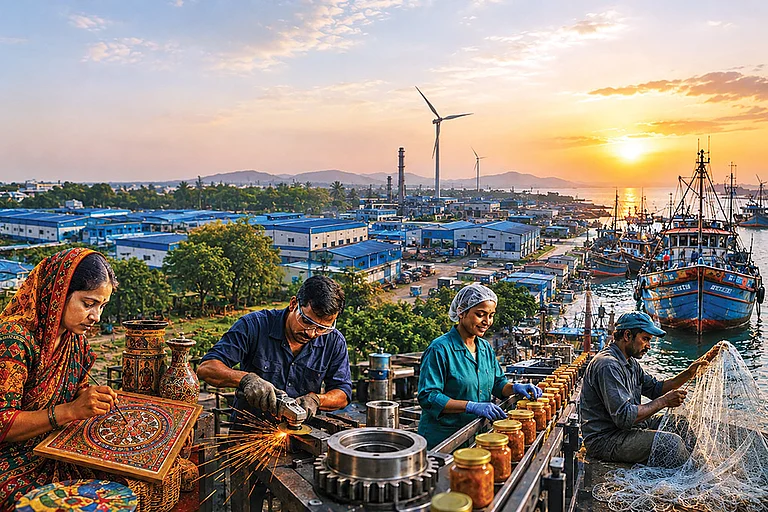

For the past generation, India's central question was whether it could grow fast enough. As that question is answered, a harder one emerges: can India prevent growth from becoming permanently unequal? The danger is not that India will fail to create rich states.
It already has.
The danger is that India will succeed in creating a handful of rich regions while failing to build a prosperous nation.
Disclaimer: The views expressed in this article are those of the author and do not necessarily reflect the views of the publication








