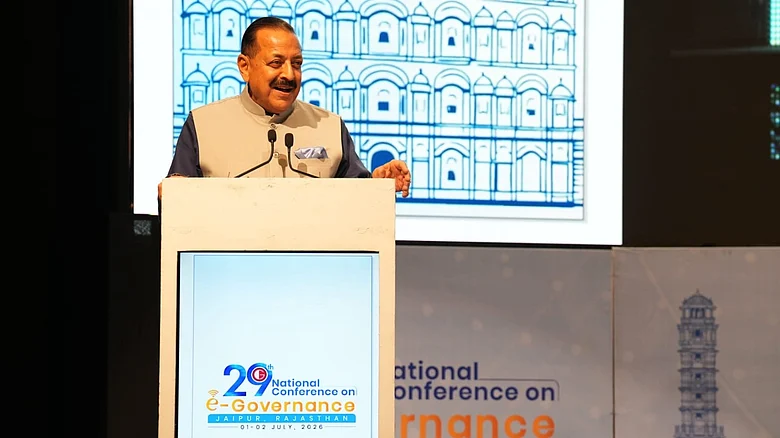
Artificial intelligence (AI) is no longer an optional technology but an essential component of governance, and the real challenge lies in ensuring that humans use it responsibly to build a more transparent, accountable and citizen-centric government, Jitendra Singh, Union Minister of State (Independent Charge) for Science & Technology and Minister of State in the Department of Atomic Energy, said on Thursday.
Addressing the valedictory session of the 29th National Conference on e-Governance in Jaipur, Singh said governments should shift the debate from whether AI should be adopted to how it can be effectively harnessed to improve public administration.
"It is no longer a choice. It is an essential commodity now. The challenge now is how best to use it. The question actually is not on artificial intelligence. The question that we need to ask ourselves is, 'How intelligent am I to use artificial intelligence?'"

1 October 2026
Get the latest issue of Outlook Business

AI Must Strengthen Citizen-Centric Governance
Singh said the government's digital governance initiatives are rooted in Prime Minister Narendra Modi's vision of "Maximum Governance, Minimum Government," which seeks to improve transparency, accountability and ease of access to public services through technology.
He said AI should be viewed as a tool to deepen citizen-centric governance rather than as an end in itself.
"More citizen centricity, more transparency, more accountability. For optimally achieving this, the government has been trying to use cutting-edge technology to the maximum extent."
Highlighting governance reforms over the past decade, Singh cited measures such as self-attestation of documents, the abolition of interviews for certain government jobs, pension reforms and simplification of administrative procedures as examples of technology-enabled governance designed to build trust and reduce bureaucratic hurdles.
Advertisement
Hybrid Governance Model
The minister also highlighted the evolution of the CPGRAMS grievance redressal platform, saying artificial intelligence has helped improve grievance disposal rates to nearly 95%.
However, he argued that governance cannot rely solely on automation.
Singh said the government has introduced a human helpdesk alongside AI-driven grievance processing to ensure citizens receive empathetic responses after their complaints are resolved.
"I think ultimately that is the model in AI we will have to apply... after disposal of a grievance which is AI-driven, a human being speaks to the complainant."
According to him, governance should measure not only disposal rates but also citizen satisfaction, suggesting that administrative systems should evolve from simply resolving complaints to improving what he described as a "happiness index" for citizens interacting with the government.
Advertisement
Preparing for Viksit Bharat 2047
Singh said policymakers must rethink governance for Viksit Bharat 2047, warning against imagining the future through the lens of today's technologies.
He noted that technological change has repeatedly transformed society over the past two decades and urged civil servants to prepare for evolving roles in an AI-driven administrative system.
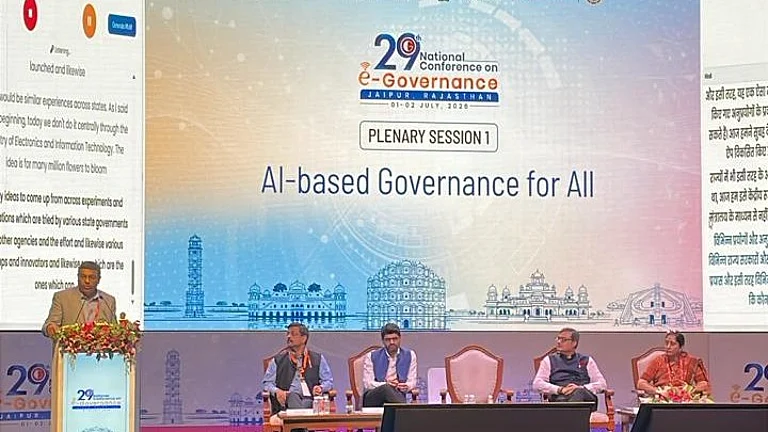
Referring to the conference's theme of AI-enabled, data-driven and secure governance, Singh said the Jaipur conference should serve as a milestone in India's digital governance journey.



"I hope the Jaipur conference will prove to be not only a milestone but also a stepping stone to India's governance journey to destination 2047."