CEA Anantha Nageswaran warned that AI poses a serious risk to Global Capability Centres (GCCs) focused on low-cost, routine and repetitive work
He urged companies to move towards innovation, high-value services and advanced capabilities
CEA cautioned that India's competitive edge could erode without stronger industry-ready talent and continuous upgradation of capabilities
Artificial intelligence (AI) poses a significant challenge to Global Capability Centres (GCCs) that rely primarily on low-cost, repetitive work, Chief Economic Adviser (CEA) V Anantha Nageswaran said on Thursday, stressing that India's long-term competitiveness will depend on its ability to move up the value chain.
Addressing the Confederation of Indian Industry's GCC Summit, Nageswaran said the government has already introduced policy measures to support the sector, but it is now up to companies to strengthen capabilities, invest in talent and drive innovation.

1 September 2026
Get the latest issue of Outlook Business

He said AI is expected to replace routine, repetitive and rule-based tasks, making it difficult for business models built solely on cost advantages to remain sustainable.


"If a centre's value rests only on doing simple tasks at low cost, then that value is under real threat. We should not pretend otherwise," Nageswaran said, as per a report by Business Standard.

"Government can build the runway, but it cannot fly the plane. The move from cost to capability, from execution to innovation, has to be made by firms and by people," he added, as per news agency PTI.
Advertisement
The Union Budget has expanded the transfer pricing safe harbour regime for GCCs, offering greater tax certainty through a uniform margin, higher thresholds and quicker approvals. The government has also introduced a national framework to encourage the expansion of GCCs into tier-II and tier-III cities, the CEA said.
AI Should Be Viewed As An Opportunity
Nageswaran described AI as a "real threat" to traditional GCCs but said India should use the technology to upgrade these centres rather than view it purely as a risk.
He said companies that successfully adapt to AI would emerge stronger, while those that fail to evolve risk losing relevance.
Advertisement
"Artificial intelligence does not build, deploy, or govern itself. Someone has to design these systems, train them, test them, correct them, and hold them to account. Someone has to decide where they should be used and where they must not be used," the CEA said.
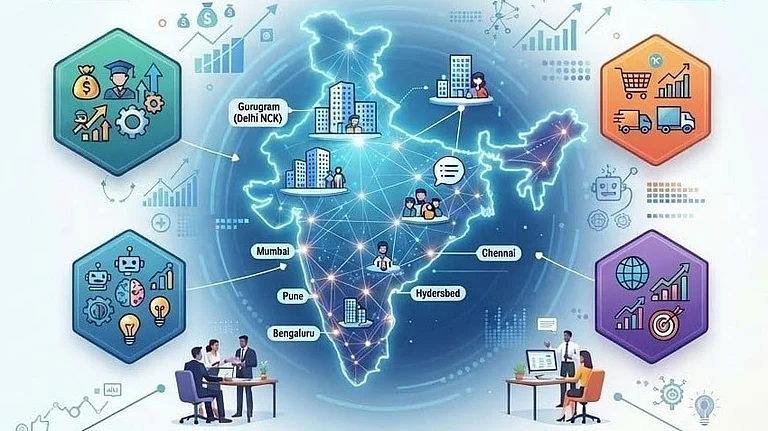
He reasoned that AI does not, therefore, empty these centres. In the centres that are run well, AI raises the value of each person who works there. "The centres that stand still will suffer. The centres that move up will thrive," he remarked.
India Must Strengthen Talent Pipeline
The CEA identified skilling as one of India's biggest challenges, noting that while the country produces a large number of graduates every year, too few are industry-ready when they enter the workforce.
He urged closer collaboration between industry, academia and the government to improve employability. He stressed that India should be an active participant in shaping the technology instead of merely responding to it.
He warned India's current advantage could diminish as rival countries strengthen their capabilities and competition for skilled talent intensifies. "Success should not breed complacency," he said, as per PTI.