



Imagine a crowded street in a town. A man starts hurling slurs and accusations at a passerby. A scuffle breaks out. In a civilised society, there are guardrails against such escalations. Bystanders intervene. Police will arrive. Laws exist to determine who is responsible.
Now imagine the same confrontation unfolding on social media. One person posts an accusation, another amplifies it and suddenly thousands of 'users' are piling on. Content is reshaped and stripped of context. Algorithms double down on the outrage by pushing the 'viral' content to millions of screens. Within hours, what began as a dispute between two individuals can inflame an entire city, trigger mobs or even spark riots.
When the Arab Spring erupted in 2011, social-media platforms were celebrated as engines of democratic awakening. The narrative was seductive: technology would empower citizens, bypass censorship and usher in a new era of participatory politics. The reality turned out to be complicated. Across the world, the same networks that mobilise protest also accelerate misinformation and factional propaganda. Why does this happen?

1 October 2026
Get the latest issue of Outlook Business

While social media has come to influence public discourse at a scale much bigger than any news publication in history, it is exempt from the legal and ethical guardrails that govern publishers. Their fact-checking systems are not robust enough to moderate every piece of content. As a result, they have enjoyed unfettered growth and passed on the fallout of their toxic business model to society at large.
Big Tech often argues that making them liable for misinformation might make them financially unsustainable as the costs of moderation and lawsuits will pile up. That’s akin to saying making food safe to eat would make restaurants unviable. Any business that profits at society’s expense and shifts its burden onto others has no right to exist.
In May 1951, Prime Minister Jawaharlal Nehru introduced the First Constitutional Amendment, allowing “reasonable restrictions” on free speech. It was controversial, but the rationale is instructive. The colonial era had already seen controversies around inflammatory pamphlets such as Rangeela Rasool, which sparked communal riots in the 1920s.
A New York Times report from May 17, 1951, quoted Nehru as saying, “It has become a matter of the deepest distress to me to see the way in which the less responsible news sheets are being conducted...poisoning the minds of the younger generation and degrading their integrity and moral standards.”
Traditional media organisations are hardly flawless. But they operate under a structure of accountability. Editors review stories. Publishers defend editorial positions. Readers can challenge journalists. A pub-lication’s credibility, once damaged, is difficult to rebuild.
Big Tech, by contrast, is the Wild West where mis-information is bred and spread with impunity. Their legal shield, a provision called ‘safe harbour’, came up in the US in the '90s to protect the growth of the internet—and was quickly adopted by democratic societies like India. They argued that they shouldn't be made liable for misinformation as they were neutral whiteboards where any user could ink their views. Policymakers, lawyers and citizens across the world bought into this oversimplification and are paying the price.
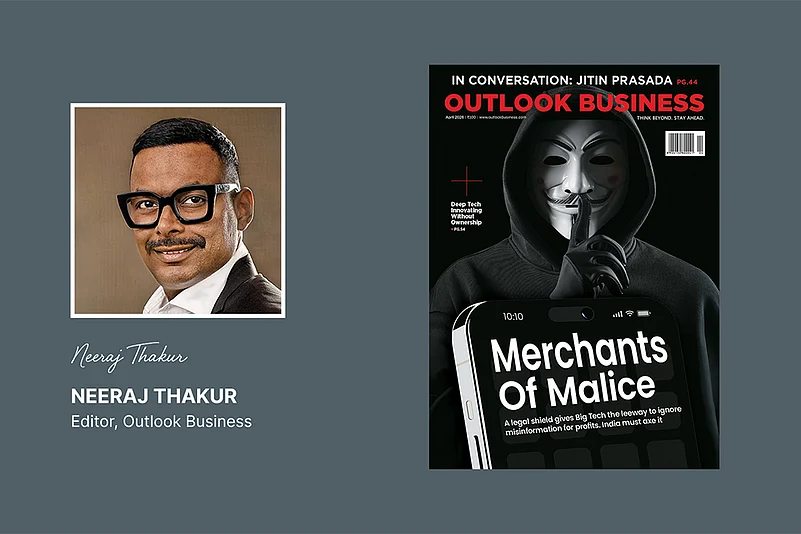
Our cover story sheds light on how a handful of technology behemoths are milking this ‘safe harbour’ at the altar of the country’s social harmony and economic aspirations. It is incumbent on free societies to revisit the leeway given to these giants. While our focus is India, it is nevertheless a case study for policymakers and the public everywhere to ponder upon.



