
India–EU FTA removes or cuts tariffs on 96% of traded goods, opening preferential access to the EU’s $750 billion electronics market.
Electronics exports could rise to $50 billion by 2031, supported by access to advanced European machinery and technology.
Industry seeks duty rationalisation, long-term policy certainty and higher R&D support ahead of the Union Budget.
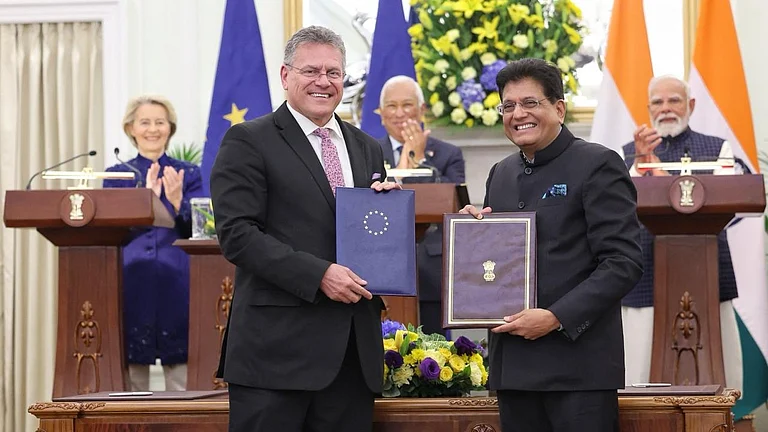
The conclusion of the India–European Union Free Trade Agreement (FTA) on Tuesday has opened up massive market access for Indian exporters and manufacturers. Often described as the “mother of all deals”, the India–EU FTA has eliminated or reduced tariffs on over 96% of traded goods. The agreement is expected to double EU exports to India by 2032.
In FY25, bilateral trade between New Delhi and Brussels totalled $140 billion, making the European Union India’s largest trading partner.

1 September 2026
Get the latest issue of Outlook Business

The FTA has unlocked significant opportunities for Indian textiles, gems and jewellery, and particularly for electronics manufacturers. Indian electronics manufacturers are expected to gain preferential access to the EU’s nearly $750 billion electronics market, according to reports. The renewed opportunity is likely to push electronics trade to $50 billion by 2031.
Moreover, Indian manufacturers will gain improved access to critical high-end European machinery and technology required for advanced manufacturing of complex products, including semiconductors and electronic components, The Economic Times reported, citing industry executives.
Advertisement
“The agreement aligns directly with India’s shift from scale-led domestic manufacturing to export-oriented integration with global value chains, while promoting inclusive growth across regions and skill levels,” said Pankaj Mohindroo, Chairman of the India Cellular and Electronics Association (ICEA). “In electronics, the FTA creates a credible pathway to build exports of nearly $50 billion by 2031 across products such as mobile phones, consumer electronics and IT hardware, with the potential to exceed $100 billion in the following decade—anchored in manufacturing depth, job creation, innovation, and India’s emergence as a trusted global supplier.”

Advertisement
According to reports, the historic trade deal is also expected to include mutual recognition of certifications, which would shorten qualification cycles and ensure Indian-origin products meet European standards. Previously, the sector faced higher tariffs, with televisions attracting duties of up to 14% and lighting products around 3%, which are now expected to be rationalised to duty-free levels under the new agreement. Contract manufacturers are also eyeing new opportunities in the EU market over the short to medium term.
India’s electronics trade with the EU currently stands at nearly $18 billion. The agreement is also expected to encourage European companies to anchor manufacturing and sourcing operations in India.
“Reduced tariffs and easier market access to European technology and manufacturing equipment can accelerate India’s journey toward self-reliance and global competitiveness,” said Ravi Saxena, Chief Executive Officer of Wonderchef. “This will allow deeper integration into global value chains, particularly in consumer appliances, emerging semiconductor manufacturing, and smart devices.”
Other industry experts highlighted that the timing of the deal coincides with accelerating domestic manufacturing and said preferential access to the EU market would enhance India’s global competitiveness.
“For an industry that has grown from under $30 billion a decade ago to over $100 billion today, the FTA provides a strong export multiplier by opening doors to the EU’s $700-plus billion electronics market,” said Tushar Badjate, Director at Badjate Stock Shares Pvt Ltd. “More importantly, it encourages a shift from assembly-led production to higher value-added manufacturing, including design, R&D and component ecosystems.”
While remaining optimistic about the FTA, industry stakeholders are now calling for policy prioritisation ahead of the Union Budget. Key demands include rationalisation of import duties on critical raw materials, long-term policy certainty for ODM-led manufacturers, incentives for design ownership, and increased budgetary allocation for research and development.
The Union Budget for FY27 will be presented on February 1 by Union Minister for Finance and Corporate Affairs Nirmala Sitharaman.