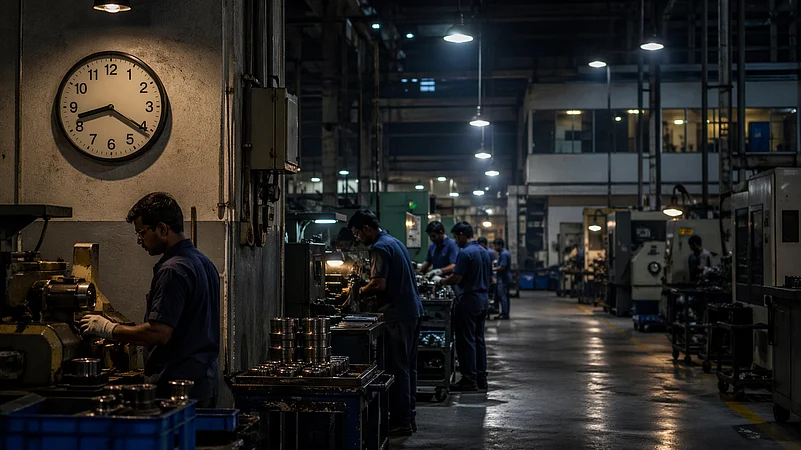

Employees across India will receive double overtime pay under new wage rules effective April 1, 2026, improving clarity
Weekly work is capped at 48 hours, with extra time treated and paid as overtime
Daily shifts may reach 12 hours, but weekly work must stay within 48-hour limit
Employees across India will now get double pay for overtime under new wage rules that came into effect on April 1, 2026. The aim is to make pay rules clearer and more uniform across sectors.
The rules fix the weekly work limit at 48 hours. Any work beyond this limit will be counted as overtime and will be paid separately by employers in most of the industries.
Daily shifts can go up to 12 hours, but companies must ensure total weekly hours do not cross 48. This gives flexibility in scheduling while keeping a fixed overall limit.

1 September 2026
Get the latest issue of Outlook Business

Employers must also track extra work time closely. This is to ensure workers receive correct overtime pay on time and help avoid payment disputes.

Overtime Pay Rules
Overtime will now be paid at double the usual hourly rate in most cases, meaning workers earn two hours’ pay for every extra hour worked.
Short extra work periods will also be counted. If an employee works 15 to 30 minutes beyond shift time, employers must round it up to 30 minutes for payment.
Advertisement
States may set limits on overtime within a three month period. Generally, workers can log around 125 to 144 extra hours, depending on local rules.
If an employee resigns or is removed from service, companies must settle all pending dues as soon as possible. This includes any unpaid overtime payments.
The new labour framework also merges nearly three dozen older laws into four codes. The aim is to reduce complexity and make rules easier to follow for companies while improving worker protections.
Salary Structure Changes
Basic pay will now make up at least 50% of an employee’s total salary package. This will increase deductions such as provident fund and gratuity contributions.
Advertisement
Because of this, some employees may see lower monthly take-home pay. However, long-term savings for retirement are expected to improve.
Sanchita Tuli, HR Director at Great Lakes Institute of Management, Gurgaon, said the new structure may slightly reduce in-hand salary but will improve retirement benefits through higher provident fund contributions.
She also pointed out that blue-collar workers may see stronger gains because of double overtime pay. However, white-collar employees may not see major benefits, especially if overtime work remains limited.



However, she added that implementation will depend on state governments, as the rules will apply only after formal adoption at the state level.