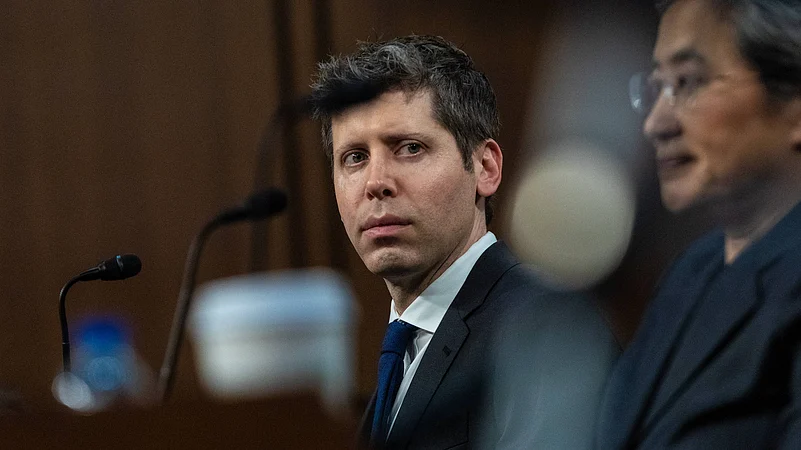

Court filings reveal Altman holds stakes in companies tied to OpenAI.
Elon Musk lawsuit raises questions over governance and non-profit mission shift.
Altman denies wrongdoing, says he avoids conflicts under corporate rules.
Sam Altman, CEO of OpenAI has come under legal and political scrutiny after a court hearing revealed he holds over $2bn in organisations that also do business with OpenAI, reported Times Now.
According to Reuters, the issue emerged during the ongoing lawsuit filed by Elon Musk, who is seeking $150bn in damages and wants Altman removed from his role. Musk alleges that OpenAI has drifted away from its original non-profit mission and is increasingly becoming a profit-driven company.

1 September 2026
Get the latest issue of Outlook Business

What Court Documents Show
Court documents presented during the hearing reportedly detailed Sam Altman’s investments in companies linked to OpenAI through business partnerships.
The hearing analysed if these financial ties may have influenced decisions at OpenAI. This is an allegation that Altman has repeatedly denied.
During his testimony, Altman said that he has refrained from discussions where a potential conflict of interest could arise, calling it a routine corporate governance practice.
Investments Tied To OpenAI
Court filings reportedly revealed that Sam Altman holds stakes in multiple companies that have commercial relationships with OpenAI, including Helion Energy, Stripe and Cerebras Systems.
Advertisement
The disclosures have intensified scrutiny everal major companies that have commercial ties with OpenAI, including Helion Energy, Stripe and Cerebras Systems. The disclosures have intensified scrutiny over possible conflicts of interest tied to OpenAI’s partnerships.

OpenAI Governance Under Spotlight
The Elon Musk versus OpenAI lawsuit has brought attention to wider issues of governance and transparency in AI companies.
Musk, who co-founded OpenAI in 2015 before stepping back from the organisation later, has argued the company abandoned its original non-profit vision after attracting big commercial investments, including billions of dollars from Microsoft.
Advertisement
OpenAI, for its part, said its current structure was needed to fund expensive AI research and compete globally. The court process is also looking at whether Altman’s own investments in partner companies have created situations in which business interests could conflict with OpenAI’s decision-making, Reuters reported. Altman said the company follows normal corporate procedures to deal with potential conflicts of interest, and denied any wrongdoing.