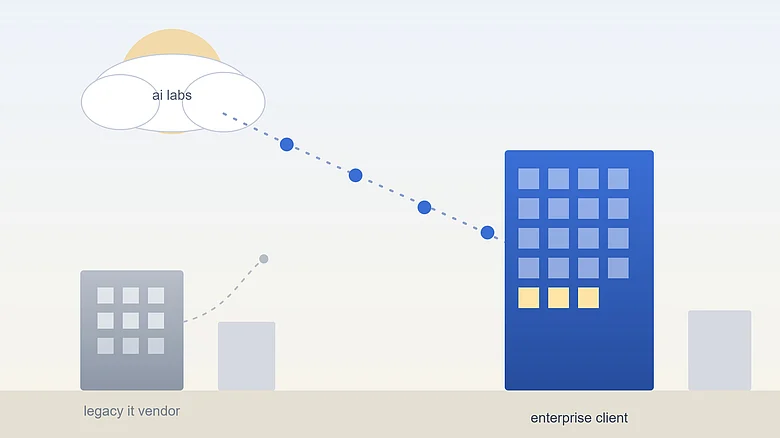

FDE model, invented by Palantir in 2005, has gone mainstream in 2026
Microsoft, Amazon, Google, OpenAI, and Anthropic all launching embedded-engineer initiatives
This directly threatens Indian IT majors (TCS, Infosys, Cognizant) and consultants like Accenture
In a quest to capture durable enterprise revenue, most major US tech and AI companies have adopted the Forward Deployed Engineer (FDE) model over the past two months.
The FDE role was invented by Palantir Technologies in 2005, in which engineers embed on-site with clients to build production systems rather than hand off software and walk away. The model which was till now limited to Palantir’s workflow, has suddenly gone mainstream in 2026.

1 October 2026
Get the latest issue of Outlook Business

On July 2, Microsoft launched "The Microsoft Frontier Company," a $2.5 billion unit embedding roughly 6,000 engineers and industry specialists directly inside client organizations to build and run AI systems. Microsoft's announcement came just two days after Amazon committed roughly $1 billion to its own forward-deployed engineering push.




Similarly, in May, Google began hiring hundreds of forward-deployed engineers to embed inside customer offices and ship production AI code, with senior packages reportedly reaching into the high $400,000s. OpenAI stood up the OpenAI Deployment Company, backed by more than $4 billion from investors led by the private equity firm TPG, specifically to embed engineers inside client organizations and deploy production AI systems. Anthropic, meanwhile, partnered with Goldman Sachs, Blackstone, and Hellman & Friedman on a $1.5 billion venture to embed engineers inside mid-sized enterprises, starting with the investment firms' own portfolio companies.
Advertisement
While this may look like a niche staffing trend, it could pose a direct challenge to the business model that built India's $250 billion IT services industry.

What is a Forward Deployed Engineer?
A Forward Deployed Engineer is a software engineer who doesn't just sit at an office writing documentation, they instead embed on-site or inside a client's cloud environment. They work alongside a customer's teams to design, build and ship production AI systems, and stay with the account until the system actually works in the real world.
The role was originally invented to solve a problem that intelligence agencies like the CIA and NSA couldn't describe through a normal sales process. Their needs were too classified, too specific, and too fast-moving for off-the-shelf software.
Advertisement
Palantir's engineers moved into government agencies, banks and eventually hospitals, building custom systems from the ground up alongside the people who'd actually use them.
Why Big Tech Switched to FDE Model?
The trigger is a data point that's been circulating in boardrooms all year. Research from MIT's Project NANDA found that roughly 95% of generative AI pilots deliver zero measurable financial impact for the companies running them.
According to a TechTimes report, the problem, AI labs have concluded, was never really the model. It's everything around it. Messy legacy data, workflows that break the moment a model meets real organizational chaos, and the sheer difficulty of getting an AI pilot to survive contact with a Fortune 500 company's internal systems. Whoever solves that "last mile" problem, not just whoever builds the smartest model is positioned to capture the real enterprise money.
Why is this a Direct Hit on India's IT Sector?
Embedding engineers inside client organisations to identify opportunities, redesign workflows and implement production systems is exactly the business that Indian IT majors like TCS, Infosys and Cognizant, as well as consulting giants like Accenture, have run for two decades.
Historically, the relationship between AI labs and Indian IT firms looked complementary: the labs built the models, while Indian services companies handled the messy, high-touch work of implementation, integration and customisation inside enterprise clients.
The FDE wave threatens to collapse that division of labour, with AI companies now doing the implementation themselves and cutting out the traditional middleman entirely.
Markets have already reacted sharply. When OpenAI announced its Deployment Company in May 2026, Infosys shares fell 3.6% to their lowest level since December 2020, TCS declined 3.5% to its lowest since August 2020, and HCLTech dropped 2.3% to its lowest since September 2023. Coforge, Persistent Systems, Mphasis, and LTIMindtree each lost 3-4%, while the BSE IT Index fell 3%.
It's showing up in workforce numbers too. According to Layofftrends data, TCS cut 23,460 jobs in FY26 as it pivots to an AI-first services model, with bench strength being reduced as fewer people are deployed per client engagement, and fresher hiring hitting multi-year lows.
Wipro reduced its fresher hiring guidance to 7,500-8,000, down significantly from earlier estimates.
Meanwhile, Global Capability Centres (GCCs) are adding 3-4 lakh jobs, partly because companies increasingly prefer to build embedded, domain-fluent AI teams in-house rather than route everything through a traditional vendor.