Tesla targets a December 2026 "tape-out" for its next-gen AI6 chips
Samsung secured a $16.5 billion deal to manufacture these 2nm chips
A single AI6 chip may match the performance of a dual AI5 system
Elon Musk on Thursday revealed that Tesla may be able to “tape out” its next-generation AI6 chips in December, Reuters reported.
In semiconductor manufacturing, “tape-out” refers to the stage at which a chip design is finalised and sent to a factory for production.
1 September 2026
Get the latest issue of Outlook Business

This follows Musk’s statement last year that Samsung Electronics would manufacture the AI6 chips. These chips are reportedly expected to be used in self-driving cars and humanoid robots at Tesla’s new factory in Taylor, Texas, after the Korean company secured a $16.5 billion deal to supply artificial intelligence chips to the automaker.


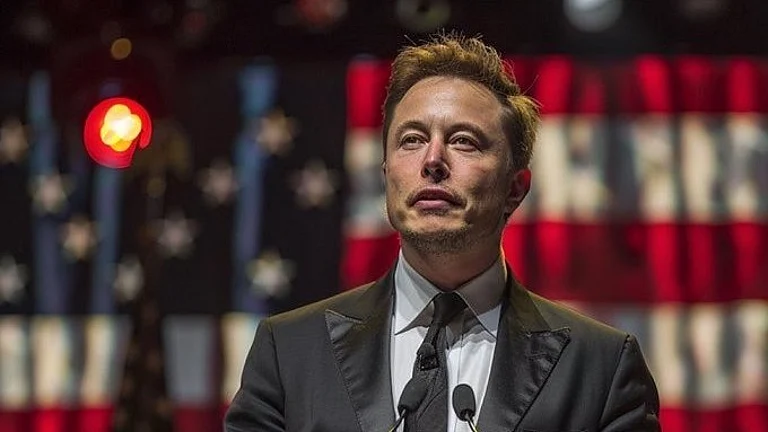
In a post on X, Musk stated that AI5 would “punch far above its weight” because Tesla’s AI software stack is designed to maximise the efficiency of every circuit.
He reportedly added that the company co-designed its AI software and hardware. While AI5 can be used for training in data centres, it is primarily optimised for edge computing applications in Optimus robots and robotaxis.
Musk also noted that there is significant room for improvement, adding that within the same half-reticle and process node, a single AI6 chip could potentially match the performance of a dual system-on-chip (SoC) AI5.
Advertisement

Terafab Project
The announcement comes shortly after Musk posted, “Terafab Project launches in 7 days” on March 14. The March 21 event is expected to mark the formal launch of Tesla’s plan to build an in-house semiconductor fabrication facility, first confirmed during its January 28, 2026 earnings call.
The project is estimated to cost $25 billion and aims to produce between 100 billion and 200 billion custom AI and memory chips annually, using advanced 2-nanometre process technology.
TeraFab is Musk’s proposed large-scale semiconductor fabrication facility designed to produce specialised AI chips internally for Tesla.
Advertisement
Often described as a “gigafactory, but much larger,” it is intended to secure high-volume chip production for AI5 processors used in autonomous driving systems, Optimus robots, and the Dojo supercomputer, while addressing supply bottlenecks.

Musk’s AI Hardware Vision
The project’s primary objective is to achieve vertical integration of AI hardware, with a targeted capacity of over 100,000 to 200,000 wafer starts per month.
It will focus on producing Tesla’s proprietary fifth-generation (AI5) and future AI6 chips for Full Self-Driving (FSD), robotaxis, and humanoid robotics.
The scale of the facility is expected to surpass the current capabilities of suppliers such as TSMC and Samsung, in order to meet the projected demand for millions of robots and vehicles. Musk has indicated that the TeraFab project is slated for launch around March 2026, with the goal of overcoming constraints in AI computing supply.