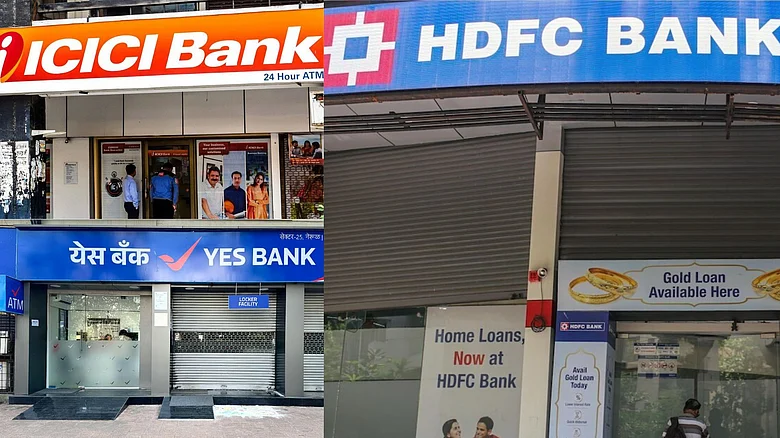

HDFC Bank remained the most stable performer, posting 9% YoY profit growth to ₹19,221 crore with improving asset quality, though loan growth and margins stayed relatively muted.
ICICI Bank stood out on profitability and efficiency, delivering 8.5% YoY profit growth to ₹13,700 crore, strong NII growth and industry-leading margins.
Yes Bank showed the fastest growth but from a low base, with 45% profit jump and improving NPAs, yet weaker margins and return ratios highlight an ongoing turnaround story.
India's three closely watched private lenders, HDFC Bank, ICICI Bank and Yes Bank, have reported their results for the fourth quarter of the financial year 2025-26 (Q4 FY26), giving investors a fresh read on how each bank is performing on profits, loan growth, margins and asset quality.
While the headline numbers were broadly encouraging, the story beneath them reveals how differently each bank is placed, and what investors might expect going forward.

1 October 2026
Get the latest issue of Outlook Business

The Numbers at a Glance
HDFC Bank, the country's largest private lender, posted a net profit of ₹19,221 crore for the quarter, a 9.1% rise year-on-year (YoY), even as interest income growth remained muted. The bank's board also recommended a final dividend of ₹13 per share.


ICICI Bank reported a standalone net profit of ₹13,702 crore, up 8.5% from ₹12,629 crore a year ago. Its net interest income (NII) grew 8.43% to ₹22,979 crore.
Yes Bank, the smallest of the three and still in the middle of a long recovery, delivered perhaps the most eye-catching growth rate. It posted a standalone net profit of ₹1,068 crore, up 45% from ₹738 crore in the same quarter last year. The bank also recorded a return on assets (ROA) of 1%, a milestone it is achieving for the first time since its dramatic near-collapse in 2020.
Advertisement

ICICI Bank: The Quarter's Star Performer
Among the three, ICICI Bank stood out for the quality and breadth of its performance. Brokerages pointed to strong credit growth, improving margins, better asset quality and a positive surprise on deposits.
Elara Capital called it "yet another strong quarter, demonstrating earnings resilience." The firm highlighted that loan advances grew around 6% on a quarter-on-quarter (QoQ) basis, net interest margins (NIM) came in at a healthy 4.32%, and slippages fell to 1.2% from 1.5% the previous quarter. Deposit growth also surprised positively, rising 11.4% YoY.
Advertisement
Credit growth, which had been sluggish in recent quarters, rebounded sharply to 15.8% YoY in Q4 FY26. Anand Rathi attributed this to a broad-based recovery, particularly in mortgages, rural lending and gold loans.
Both Elara Capital and Anand Rathi maintained a BUY rating on ICICI Bank. Elara Capital retains a target price of ₹1,783, calling it their "top pick within larger peers," while Anand Rathi has a target of ₹1,716. The latter also said it continues to prefer ICICI Bank over HDFC Bank, citing a stronger liquidity position through higher liquidity coverage ratio (LCR), cash and investments, which it believes will support sustained higher credit growth over the medium term.
HDFC Bank: Steady But Facing Headwinds
HDFC Bank's quarter was more mixed. The good news was that slippages fell to multi-quarter lows of below 1%, credit costs came in at a modest 35 basis points, and deposit growth jumped 9% on a QoQ basis. The loan-to-deposit ratio (LDR) improved to below 95%, a sign that the bank is gradually resolving one of its key post-merger challenges.
The less encouraging parts were that NII growth was weak at just 1.4% quarter-on-quarter, loan growth of 12% year-on-year still lags broader system-level growth and the bank's liquidity coverage ratio dipped further to 114%.
Adding to the uncertainty was the sudden exit of part-time Chairman Atanu Chakraborty during the quarter, an event that caught markets off guard. ICICI Securities, however, downplayed the development, calling it "a one-off inter-personal issue without material impact on business financials," while stressing that the incumbent MD & CEO's full-term renewal remains critical for continuity.
Brokerages are broadly constructive on the stock, particularly given its valuation. ICICI Securities noted that the stock is trading at historically low valuations, around 1.7x and 1.5x its estimated book value for FY27 and FY28 respectively, comparable to Covid-era lows, and maintains a BUY with a revised target price of ₹1,080.
Yes Securities also upgraded its rating to BUY with a target price of ₹1,125, saying investors should focus on the change in momentum now that the LDR-related concerns have largely faded.
Elara Capital, while maintaining BUY, trimmed its target price to ₹976 from ₹1,147 earlier, saying that "a rerating may take time given limited near-term triggers," but that the risk-reward remains favourable at current valuations. Anand Rathi upgraded to BUY with a target of ₹967.

Yes Bank: A Turnaround Story
Yes Bank's 45% profit jump and its first 1% ROA in five years make for a compelling headline. For a bank that was on the brink of failure in 2020 and required a rescue led by the State Bank of India, reaching this level is a meaningful marker.
ICICI Securities acknowledged the strong quarter, noting that the bank saw an uptick in its net interest margin and current account-savings account (CASA) ratio, and that retail slippages improved. It also pointed to a slower drag from the RBI's Rural Infrastructure Development Fund (RIDF) requirement, a mandatory allocation that had been weighing on the bank's earnings. That RIDF share has come down to 6% of assets and the bank expects it to fall below 5% by FY27.
However, brokerages are not rushing to call Yes Bank a buy. ICICI Securities has a HOLD rating with a revised target price of ₹21 (down from ₹24 earlier), warning that "retail slippages remain elevated at around 2.8% levels" and that tailwinds from security receipt (SR) recoveries will reduce in FY27.
Anand Rathi is more cautious, maintaining a SELL rating with a 12-month target of ₹19. The brokerage said it expects the bank's return on equity (ROE) "to remain in single digit in the medium-term due to its subdued margin profile and structurally higher cost base." It added that while NIMs are expected to improve directionally, they are likely to remain below 3% in the near term, and that fee income growth of just 2.5% year-on-year lagged loan growth.
Which Bank Looks Stronger?
Based on brokerage assessments and the underlying numbers, ICICI Bank emerges as the standout performer this quarter, with a clean sweep across growth, margins, asset quality and deposit mobilisation.
HDFC Bank remains a long-term conviction pick for most analysts, but the path to re-rating is likely to be gradual, with near-term challenges around NII growth, loan momentum and governance optics.
Yes Bank's recovery story is real, but it is still very much a work in progress. The bank itself has guided for FY27 growth broadly in line with the system, which signals confidence, but also suggests that outperformance is not yet on the table.