

SpaceX, OpenAI and Anthropic together carry a combined valuation of $3.6 trillion, but experts warn current prices embed decade-long perfect execution with limited margin of safety.
Indian retail investors cannot directly buy shares in these companies and must rely on the LRS route, US-listed proxies, or global ETFs and mutual funds for exposure.
Experts recommend capping allocation at 5-7% of portfolio, waiting for IPO listings, and treating these as satellite rather than core holdings.
SpaceX, OpenAI and Anthropic, among the most valuable private companies in the world, are moving toward public markets simultaneously, and Indian investors are paying close attention. Together, these companies reportedly carry a combined valuation of $3.6 trillion, a figure larger than the GDP of every country except the US, China, Germany and Japan.
But questions around whether the valuations are justified, how Indian investors can realistically access them, and whether they belong in a long-term portfolio require careful examination.

1 October 2026
Get the latest issue of Outlook Business

Companies Behind the Hype
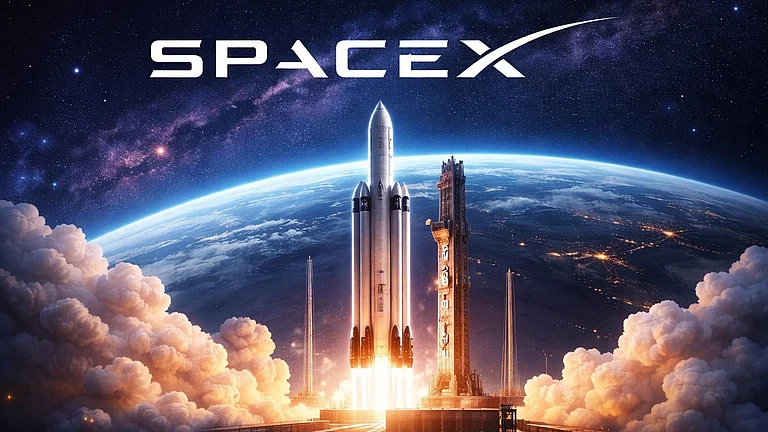
SpaceX, Elon Musk's rocket and satellite company, plans to list on the Nasdaq under the ticker SPCX, targeting a raise of up to $75 billion at a valuation of approximately $1.75 trillion, as per reports. It is planning to sell around 555 million shares at a fixed price of $135 each. Its business spans rocket launches, the Starlink satellite internet service — which operates across 155 countries with over 10 million subscribers — and an AI segment following its acquisition of Musk's xAI earlier this year. SpaceX reported $18.6 billion in revenue in 2025, with Starlink's connectivity division accounting for over 60% of that.


Advertisement
OpenAI, the maker of ChatGPT, filed its S-1 confidentially, joining the party a week after Anthropic did the same and days before SpaceX is set to hit public market on June 12. The AI giant is targeting a listing as early as the fourth quarter of 2026, with reports suggesting a valuation of over $1 trillion and a potential raise of $60 billion or more. OpenAI is generating nearly $2 billion in monthly revenue and projects its revenue will exceed $280 billion by 2030, according to reports. However, it is not yet profitable and is expected to burn nearly $25 billion this year alone on computing infrastructure.
Advertisement
Anthropic, the maker of Claude, filed its own confidential S-1 on June 1 at a valuation of $965 billion. Reports indicate that the company achieved an annualised revenue run rate of approximately $44 billion as of May 2026 and is on track to post its first operating profit of around $559 million in the second quarter of 2026.
Are the Valuations Justified?
The scale of these companies relative to Indian markets is significant. "SpaceX at $1.77 trillion is bigger than India's top five listed companies combined. OpenAI at $852 billion and Anthropic at $965 billion together exceed India's entire IT sector market cap. Together, these three private companies are worth USD 3.6 trillion that’s more than the GDP of every country except US, China, Germany, and Japan," said Hemant Sood, Founder and Managing Director of Findoc Investment. "The market is pricing decade-long perfect execution."
Santosh Meena, Head of Research at Swastika Investmart, said the companies lead genuinely transformative sectors — SpaceX in reusable rockets and satellite internet, OpenAI and Anthropic in frontier AI — with strong revenue momentum that supports significant investor interest. However, he cautioned that their valuations embed extremely optimistic assumptions about sustained dominance, rapid profitability and long-term execution. "Current prices leave limited margin of safety and carry bubble-like risks if growth disappoints or competition intensifies," Meena said, adding that these are more suitable for investors who believe in outsized long-term potential than for those with a conservative, valuation-focused approach.
A Deutsche Bank report described OpenAI's proposed listing as a rare opportunity for investors to gain direct exposure to a "pure-play AI company". However, comparisons with similarly valued public companies raise questions. Berkshire Hathaway, at a comparable market capitalisation, generated over $370 billion in revenue and $67 billion in net earnings last year, while OpenAI is generating roughly $30 billion in annualised revenue and has yet to turn profitable.
How Can Indian Investors Gain Exposure?
Direct purchase of shares in these companies is not currently available to Indian retail investors. "The realistic route is the RBI's Liberalised Remittance Scheme (LRS) window, which allows $250,000 per person annually to be remitted abroad," said Sood. "This money can buy US-listed proxies: Microsoft, an OpenAI investor; Amazon and Google, which have backed Anthropic; and Nvidia, a chip supplier to all three."
Meena added that Indian investors can also gain access through global mutual funds, ETFs, portfolio management services and alternative investment funds with US or technology mandates. Platforms such as Vested, INDmoney and Interactive Brokers facilitate direct stock purchases after listing. Pre-IPO access remains limited to high-net-worth individuals through secondary markets or specialised funds.
Risks and Opportunities
Both experts flagged high valuations, execution uncertainty and regulatory complexity as the primary risks. Meena listed currency fluctuations, tax and reporting requirements — including Tax Collected at Source (TCS), capital gains disclosures and Schedule FA filings — liquidity constraints and concentration risk as factors that make these unsuitable as large bets for most retail investors.
SpaceX's governance structure has also drawn attention. Following the IPO, Elon Musk will hold approximately 93.6% of Class B shares, each carrying 10 votes, giving him majority voting control. The company's S-1 states plainly that this will "limit or preclude your ability to influence corporate matters". For OpenAI, its dependence on Microsoft for both financing and computing infrastructure remains a key risk flagged in its own investor documents.
On the opportunity side, Meena noted exposure to high-growth AI and space themes, US dollar asset diversification and a hedge against INR depreciation.
Should These Be Part of Long-Term Portfolio?
Both experts arrive at a similar position: yes, but only in limited size and with a clear-eyed assessment of risk.
"Wait for IPO listings. Cap allocation at 5-7% of portfolio. Revolutionary companies, yes. Foundational holdings for Indian portfolios today, no," said Sood.
Meena said these companies can form a small part, 5% or less, of a well-diversified long-term portfolio for investors with high risk tolerance and a horizon of 10 years or more, as satellite holdings rather than core positions. He added that broad global indices or diversified tech ETFs offer better risk-adjusted exposure for most investors. For those who do choose to participate, discipline in position sizing and thorough due diligence remain essential, given the elevated risk of permanent capital loss from valuation corrections or unforeseen business challenges.