




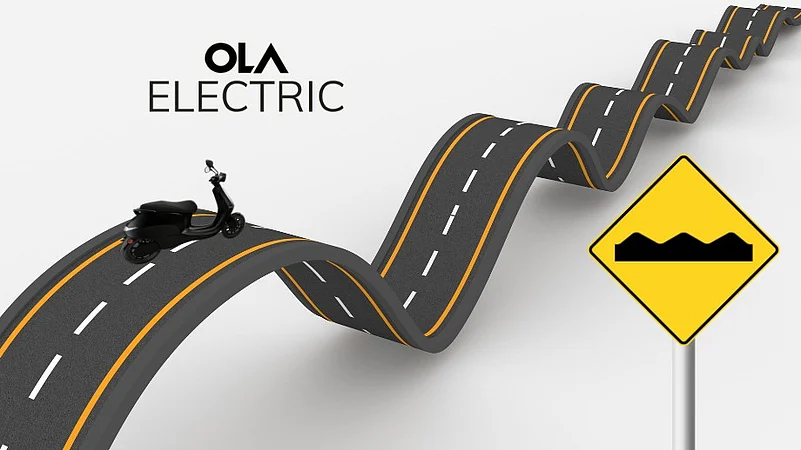

Ola Electric's net loss narrowed to ₹500 crore in Q4 FY26, down from ₹870 crore a year ago.
Revenue fell 56.6% YoY to ₹265 crore, but gross margins nearly tripled to 38.5%.
Q4 was the company's first ever operating cash-flow positive quarter, with ₹91 crore in cash from operations.
Ola Electric Mobility reported its March quarter results just minutes before market close on Wednesday, painting a mixed picture, narrowing losses on one hand and a sharp revenue decline on the other. Notably, shares of the company ended just below flat at ₹36.5 on the same day.
Net loss for the quarter narrowed significantly to ₹500 crore, down from ₹870 crore in the same period last year. Earnings Before Interest, Tax, Depreciation and Amortisation (EBITDA) loss also improved, coming in at negative ₹281 crore against a loss of ₹690 crore a year ago.

1 September 2026
Get the latest issue of Outlook Business

Revenue, however, told a harder story. It declined 56.6% year-on-year (YoY) to ₹265 crore from ₹611 crore in Q4 FY25, more than halving in twelve months. Consolidated gross margins, though, showed a dramatic recovery, rising to 38.5% from just 13.7% in the year-ago quarter.


Service Problem That Defined FY26
The management identified poor service quality as the primary constraint on demand throughout FY26. The company said that has now "materially stabilised." Average service turnaround time was cut by 88% between October 2025 and March 2026, and the service backlog was brought down sharply.
The early results are visible. April registrations were up 20% month-on-month, even as the broader electric two-wheeler industry saw a decline of 22% during the same period.
Advertisement

A Cash-Flow First
Q4 FY26 marked Ola Electric's first operating cash-flow positive quarter, with consolidated cash flow from operations at ₹91 crore, a milestone the company flagged as significant in its path toward financial stability.
Management acknowledged that gross margins may moderate in Q1 and Q2 FY27 due to commodity inflation and aggressive pricing strategies, but said the company has a "margin buffer" to stay competitive on price without compromising its position.
What Comes Next
Ola Electric's Gigafactory is entering its next phase, with the company targeting a ramp toward 6 GWh in commercial manufacturing for FY27. Beyond mobility, the factory is being positioned as a platform for energy storage as well.
Advertisement
Artificial intelligence has also been woven into daily operations, with the company handling approximately two lakh connected calls per day across sales, service and operations.









