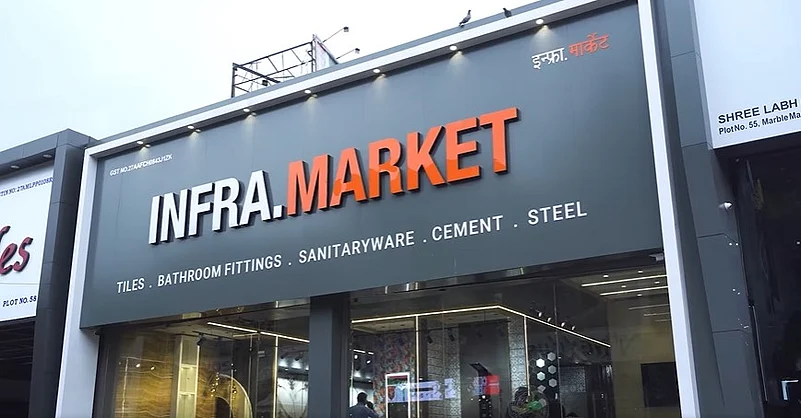
Building materials marketplace Infra.Market is exploring a potential entry into the public markets through a non-IPO route. The company is pursuing a reverse merger with Shalimar Paints, a listed entity in which it holds a 52.8% promoter stake.
If the transaction goes through, Hella Infra Market, the parent of Infra.Market, would become a material unlisted subsidiary of Shalimar Paints. Given the massive difference in the valuations of the two companies, the transaction raises questions over whether this would effectively turn Shalimar Paints into a holding company of the much larger Infra.Market business.
Additionally, the transaction raises questions about why Infra.Market would choose an alternative non-IPO route to enter the stock market, how it would affect Shalimar Paints' minority stakeholder, and what legal and regulatory rules govern such an arrangement.

1 September 2026
Get the latest issue of Outlook Business





Why the non-IPO route
Choosing a non-IPO reverse merger arrangement provides Infra.Market with a faster route to the public markets. Furthermore, the transaction is being carried out through a preferential allotment via a share swap, rather than a formal scheme of merger/amalgamation under the Companies Act, potentially making the process faster. Experts say that while the IPO route and merger/amalgamation under the Companies Act can take 6 to 18 months to finalise, the proposed structure could be completed faster.
Secondly, experts say that the proposal is aimed at strengthening Shalimar Paints and providing liquidity to Infra.Market's shareholders.
Advertisement
Anant Jain, Partner at investment advisory firm Legacy Growth, says that the proposed transaction would not achieve the listing of Hella Infra Market but would just provide liquid assets in the form of shares of Shalimar Paints to the shareholders of Hella Infra Market.
The ₹10,400 crore share-swap was not the only announcement made by Shalimar Paints on Thursday. The company also disclosed that it will raise ₹1,000 crore via QIP to fund future growth.
“The immediate objective appears to be strengthening Shalimar Paints by bringing the financial strength and scale of Hella Infra Market into the listed entity,” Jain says.
Advertisement
While the share-swap arrangement is a faster route, it could cost the Infra.Market’s investors considerably higher than traditional ways. “One trade-off is that a merger could have been more tax-efficient, whereas the proposed share swap may result in tax implications for a few shareholders of Hella Infra Market,” Jain says.

Minority stakeholders in tough spot
The share-swap arrangement of this scale directly affects Shalimar Paints' minority shareholders and would result in dilution of their stake.
V.P. Singh, Managing Partner at VPS Law Associates and a former member of NCLAT, says that the arrangement brings valuation risk, and if Hella Infra is valued richly relative to Shalimar, the public shareholders bear an economic transfer they did not choose.
“The existing shareholders of Shalimar Paints, i.e., Public shareholders and promoters other than Hella Infra Market, would be diluted upon preferential allotment of shares,” Jain of Legacy Growth says.
Furthermore, the proposed share-swap arrangement between Shalimar Paints and Infra.Market also raises questions about the protection available for the minority stakeholders. Singh says that as the arrangement falls into a related party transaction, it would require shareholder approval, in which the promoter group, Hella Infra Market, is required to abstain.
“In practice, this means the promoter group must abstain, and the transaction can be carried out only if the disinterested public shareholders approve it,” Singh adds.
Will Shalimar Paints become a holding company? What are the rules?
Currently, Hella Infra Market is the largest shareholder and promoter in Shalimar Paints. However, regulations generally do not permit a subsidiary to hold a stake in its promoter company.
Manendra Singh, Partner at Economic Laws Practice, says that Section 19 of the Companies Act, 2013 ordinarily restricts a subsidiary from acquiring shares in its holding company, subject to limited exceptions.
However, there is a caveat in the deal through which Hella Infra Market could bypass Section 19 of the Companies Act altogether. V.P. Singh says that the transaction is designed so that upon the swap taking effect, the relationship inverts: Hella Infra ceases to be the parent and becomes the subsidiary of Shalimar Paints.
If the transaction takes effect, both Shalimar Paints and Infra.Market can then argue that Section 19 was not breached because Hella Infra.Market is no longer the holding company.