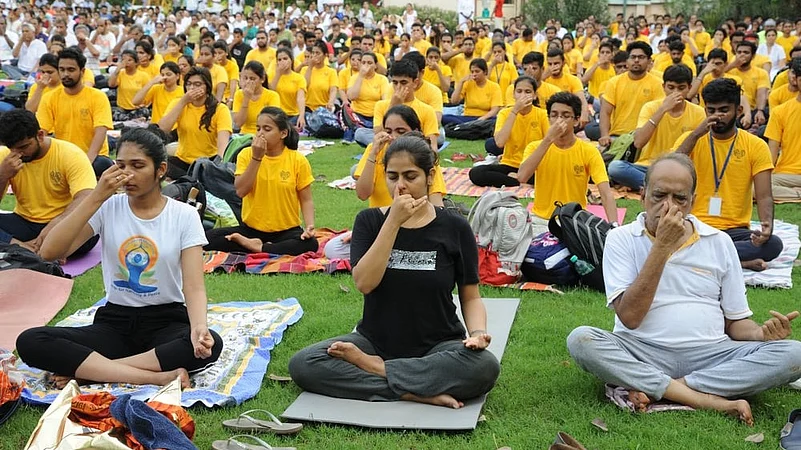

India holds a natural advantage in wellness through Ayurveda, yoga, and traditional healing, but has failed to convert it into global tourism leadership.
Countries like Thailand and Indonesia have outperformed India by aggressively marketing and packaging wellness tourism experiences.
Atmantan founders argue India must scale branding, infrastructure, and policy support to reclaim its position in the fast-growing global wellness tourism market.
Indian government has cut its tourism marketing budget by 90%. It now stands at effectively zero.
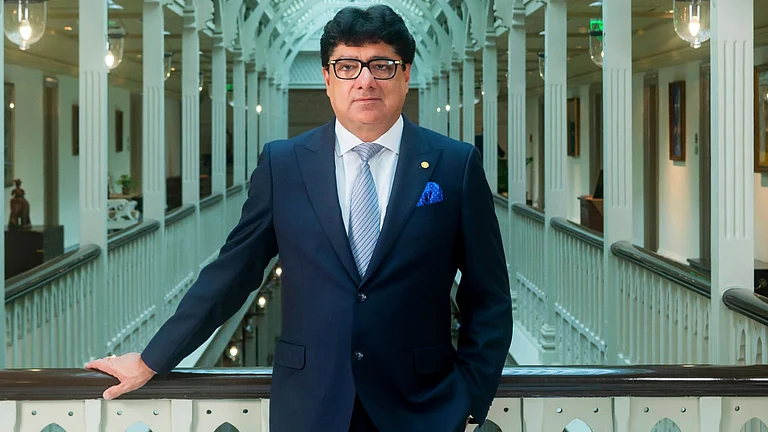
That single fact—laid out bluntly by IHCL MD and CEO Puneet Chhatwal in a recent conversation with Outlook Business—sits at the heart of one of India's most baffling economic blind spots.

1 September 2026
Get the latest issue of Outlook Business

The country that invented Yoga, Ayurveda, Vedanta and naturopathy; the healing systems that the rest of the world is now scrambling to monetise, cannot find the institutional will to tell that story to global travellers. Meanwhile, Thailand is building Ayurveda retreats. Indonesia is marketing wellness tourism aggressively. And foreign tourist arrivals to India have stagnated since the pandemic, even as neighbouring countries have surged ahead. The city of Paris alone, Chhatwal noted, receives 25 million tourist arrivals a year, two and a half times all of India.
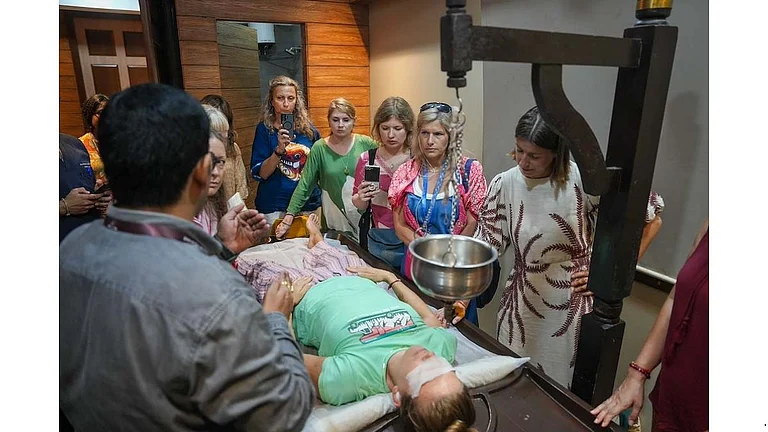


It is in this context that the story of Atmantan Wellness Centre— and the ₹240 crore deal that just reshaped its future—becomes more than a business transaction. It becomes a case study in what India's wellness sector could be, if someone would just back it properly.
Advertisement
In an exclusive interview with Outlook Business, Atmantan founders and the husband-wife-duo, Nikhil and Sharmilee Kapur speak for the first time in detail about their partnership with Indian Hotels Company Limited (IHCL), the terms they refused to compromise on, and why private capital may end up doing what government policy has so far failed to.
The Uncomfortable Numbers
Before getting to the deal, it is worth sitting with the paradox. India's traditional wellness systems are not just culturally significant, they are clinically serious. Ayurveda, Yoga is now a global industry and naturopathy, Vedanta, Unani, the breadth of India's traditional medical knowledge, has no parallel anywhere in the world.
Advertisement
And yet, Thailand and Indonesia win the race. Countries that have been borrowing from India's own playbook for decades now attract more wellness tourists, charge higher premiums and enjoy stronger international brand recognition in the space.
"Thailand is known for therapies because they started speaking about it sooner," said Nikhil Kapur, co-founder of Atmantan Wellness Centre. "India has an amazing ability to offer depth which none of the other countries have got. The only question is how do we reach the person looking for this program and say, 'Cme to India, because what we can offer you is holistic, deep and you will not find anything like this globally'."
Sharmilee Kapur points to the Ayush Ministry's efforts with cautious optimism. "The government did understand that we need to reclaim yoga, we need to reclaim Ayurveda," she said. "The thought is there. Whether it transitions into tangibles is what we have to wait and watch."
The gap between thought and tangibles, however, is where the problem lives. With the tourism marketing budget gutted and foreign arrivals flat, India is effectively leaving the field open for competitors to occupy territory that should, by every measure of cultural and scientific heritage, be its own.
The Deal: What Was Non-Negotiable
Into this vacuum steps private capital, and in this case, the most consequential hospitality company in India.
In November 2025, IHCL acquired a 51% stake in Sparsh Infratech Private Limited, the entity that owns and operates Atmantan, for ₹240 crore funded entirely through internal accruals. The acquisition came just before Atmantan marked its tenth anniversary on April 7, and it brings with it the institutional muscle, global network and brand recognition that no government campaign has yet provided.
What is telling about how the deal came together is what it did not involve. There were no bankers, formal auction or competing bids. "The discussions happened very organically," Nikhil told Outlook Business. "We were not looking to dilute our equity, and IHCL was not in any particular hurry. It just evolved." What accelerated it was a convergence of philosophy. IHCL had been quietly thinking about integrated, therapeutic wellness for years, and had taken detailed feedback from its own premium club members, many of whom turned out to be regular Atmantan guests already.
IHCL chief Chhatwal's personal conviction carried weight too. Having spent time in Germany in the early 1990s, he had observed European wellness clinics closely and long believed the model could be executed with greater depth in India. Atmantan, when he encountered it, was already doing exactly that.
But the founders drew clear lines before any paperwork was signed. The therapeutic philosophy, the operating processes, the core purpose of the organisation—what Nikhil calls the Atmantan DNA—were entirely non-negotiable. "These cannot be diluted," he said. "Our partners understood that, and they have invested a lot of time in truly understanding what Atmantan is."
The governance structure that emerged reflects that understanding. IHCL holds 51%, the founders retain 49%, and Nikhil and Sharmilee continue as founder-CXOs, operationally in charge. "We're still at the helm of things," Sharmilee said. "Only better. That's what happens with good partners."
The Expansion Roadmap
For IHCL, this is a platform bet, not a property acquisition. Chhatwal described the vision as scaling Atmantan to four to five properties across India over the next five years, with a longer-term eye on international markets. "Taj has global recognition," he told Outlook Business. "Can Atmantan get that global recognition in a few years from now? Yes, for sure it can."
New centres are already in development, one near Mumbai targeting active adults between 55 and 80, and others planned for Hyderabad, North India and Kerala. Nikhil is firm that scale will not come at the expense of depth.
The founders are also beginning to reckon with a younger demographic. Gen Z, they acknowledge, is drawn to wellness but on different terms; community-driven, diagnostic-heavy, tech-integrated and unwilling to surrender their phones for 10 nights. Atmantan's current model will not bend to accommodate that. But Nikhil hints that an entirely new format, purpose-built for a younger audience, could eventually be part of the story. "Here, mobile is enemy number one," he says. "But for a 20-year-old, maybe we need to see how to integrate tech as part of the journey."
Private Capital Filling a Policy Vacuum
What the Atmantan-IHCL story ultimately illustrates is the cost of institutional inaction. Wellness tourism is a high-value, high-dwell-time segment, and isitors stay longer, spend more and return more frequently than conventional tourists. For a country with India's heritage and growing hospitality infrastructure, the math should be straightforward.
"Wellness consumers spend a lot more money, spend a lot more time, and if the experience is delivered well, they keep coming back," Nikhil said. "Wellness should take centre stage in how India presents itself to the world."
The building blocks are, slowly, coming together; better infrastructure, a major hospitality group now invested in the sector and a rising domestic wellness consciousness. But the missing piece remains an institutional commitment to marketing India's wellness story at the scale and consistency that the opportunity demands.
India invented the sciences. It has now found the corporate backing. What it still lacks, the Kapurs suggest, is a government willing to match that ambition with real money and a coherent strategy.
Until then, the risk is clear, that India will keep building world-class wellness destinations and Thailand will keep getting the credit.