


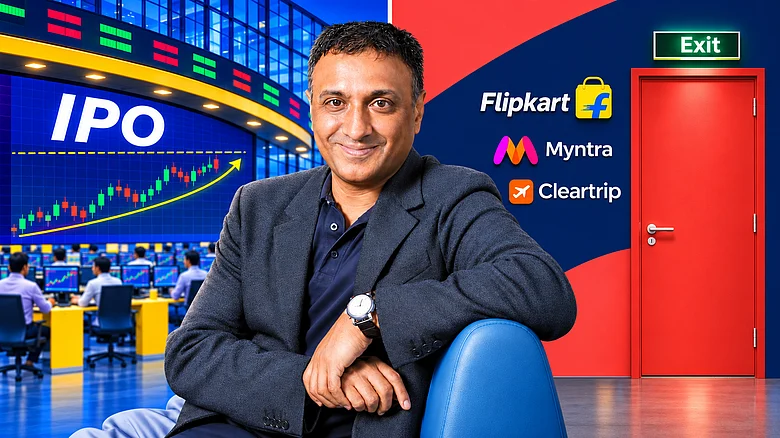
Flipkart CEO Kalyan Krishnamurthy's departure comes at a crucial juncture, with Walmart pushing the company to achieve profitability before its long-awaited IPO.
While a limited stock-option buyback offered some employees a chance to cash out, former employees remain locked out as the listing timeline remains uncertain
Flipkart's aggressive expansion into quick commerce and food delivery has added to the challenge of reining in losses, leaving its next CEO to balance growth with profitability
In March, Flipkart moved its domicile from Singapore to India. It was a step towards a domestic listing. In May, the company put that IPO on hold. Six months later, the man who had run Flipkart for nearly a decade is set to quit the company.
On November 25, Flipkart announced that group chief executive Kalyan Krishnamurthy would leave the company after more than 11 years. It did not give a reason for his departure. Balaji Thiagarajan, its chief product and technology officer, will lead Flipkart alongside the board until a successor is named.

1 November 2026
Get the latest issue of Outlook Business

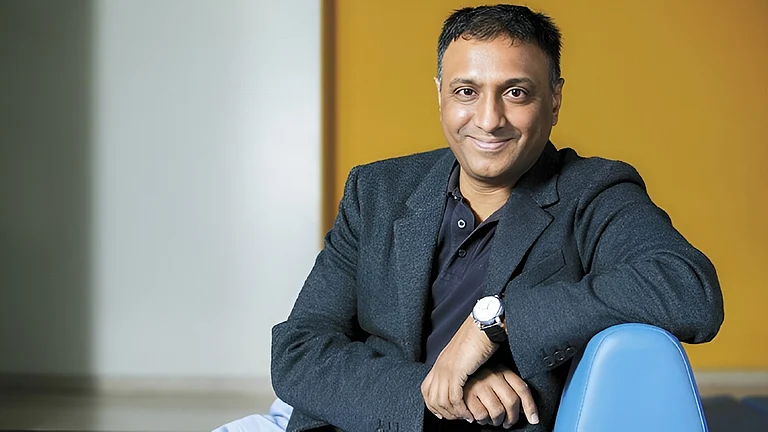


Krishnamurthy is stepping down at a tricky point for Flipkart. The Walmart subsidiary wants to turn a profit before it goes public. His successor will have to get it there while investing in growth, from expanding quick commerce to building out its foodtech business.
The leadership change also follows a string of senior departures. By October, 14 senior executives had either left Flipkart or were on their way out. For some executives, the uncertainty over when they could cash out their stock options reportedly weighed on their decision to leave.
Advertisement
For the company, volatile markets and a crowded pipeline of public issues had weighed on its decision to put its IPO on hold in May. For managers who had counted on the listing, the delay raised a more immediate question.
When would they get to cash out the options they had spent years accumulating?
Flipkart had offered employees a limited way to sell in July this year by allowing eligible employees to cash out up to 5% of the outstanding options that had vested over the previous three years.
But that still leaves executives with much of their compensation tied up in Flipkart, while former executives did not even get to participate in the buyback. The question now is how much longer they will have to wait to unlock that value.
Advertisement
The Great Cash-Out Wait
Flipkart announced a $50 million programme in July 2025 to let employees cash out some of their stock options. A second window depended on the company meeting business milestones. The board approved that tranche in July 2026, after Flipkart put its IPO on hold.
Employees on the rolls as of July 15, 2026, could cash out up to 5% of the outstanding options that had vested between July 16, 2023, and July 15, 2026. The price was ₹713.40 per option, with payouts scheduled for August. The window was open only to current employees.
That left former employees, who were excluded from the buyback, without a clear route or timeline to cash out their vested options.
In October, former executives, including Mukesh Bansal, Ankit Nagori and Sanjay Baweja, wrote to Walmart’s board seeking a full cash-out of their vested options. More than 1,000 former employees joined a wider appeal to be included in the buyback.
Walmart and Flipkart acknowledged employees’ concerns about realising the value of their equity and told the media then that an IPO remained on the agenda. However, no timeline was given for the listing.
But a catch was now attached to the IPO: the company would look to turn profitable before listing.
In March, the company moved its domicile from Singapore to India. Two months later, after Walmart CEO John Furner visited Bengaluru, he reportedly set a new target for Flipkart to reach EBITDA breakeven by the end of FY27 before considering an IPO or another external fundraise.
The push for breakeven also matters for the price Flipkart can ask investors for on Dalal Street as several new age companies eye profitability before going IPO.
At its last private fundraise in May 2024, the company was valued at $36 billion. The July buyback price implied a valuation of about $38.2 billion, while earlier reports suggested that Flipkart had eyed a $50 billion valuation for its listing.
Stronger earnings could give Walmart a better case for a higher valuation. Employees holding vested options have a different stake in the timing, as each delay extends their wait to cash out. And profitability still seems elusive.
The Price Of Chasing Growth
After his first stint as interim chief financial officer between May 2013 and November 2014, Krishnamurthy started his second innings at Flipkart in June 2016 as head of its category design organisation and was appointed group CEO in November 2018 after Binny Bansal’s exit.
His appointment came at a turbulent time for Flipkart, which had faced a series of valuation markdowns by global investors. Also, the company was losing ground to Amazon.
Krishnamurthy focused on strengthening key categories such as smartphones and driving sales through events such as Big Billion Days.
He also steered Flipkart's expansion into newer businesses. Under his leadership, the company acquired travel platform Cleartrip in 2021, launched the social commerce app Shopsy the same year and entered quick commerce with Flipkart Minutes in August 2024.
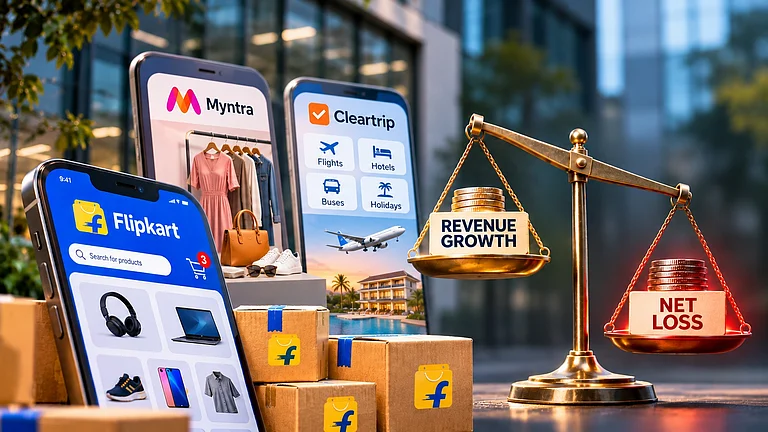
The expansion was reflected in the company's growing revenues. Flipkart India, one of the group's main entities, reported revenue of about Rs 21,000 crore in FY18. By FY26, the group's consolidated revenue, which includes its ecommerce, fashion and travel businesses, had grown to Rs 1,45,880 crore.
But the group’s net loss narrowed just 2% YoY to ₹8,468 crore in FY26. The picture was worse at its marketplace business, where operating revenue fell 19% to ₹16,295 crore, while net loss more than tripled to ₹5,498 crore from ₹1,694 crore in FY25.
Even Myntra, which had been the only profitable business within the group in FY25, slipped into the red, reporting a net loss of ₹579 crore in FY26.
One reason profitability seems elusive is the expansion of Flipkart Minutes. Its expansion could make it harder for the company to break even. Each new dark store adds inventory, staffing and delivery costs, while order volumes take time to grow.
The company has been doubling down on its quick comm arm as it faces intense competition from already established quick commerce players such as Blinkit, Zepto and Instamart.
Besides, a foray into the newly ventured food delivery business would require further investment as Flipkart works towards breakeven.
But Flipkart has its reasons for doubling down on these offerings. Quick commerce and food delivery can give customers more reasons to return between bigger purchases.
They also offer access to large markets with significant growth potential. That would give Flipkart a stronger growth case to take to public investors and help justify its valuation.
And the growth has started reflecting in the numbers. By June 2026, less than two years after its launch, Minutes had reached 1,000 micro-fulfilment centres across more than 130 cities and 8,000 PIN codes.
Kunal Gupta, who heads Minutes, has argued that profitability will come with scale. How quickly each store builds up orders will help determine how much Flipkart has to spend to get there.
That is the business Krishnamurthy’s successor will inherit. Flipkart needs to spend on the services it is counting on for growth. It also needs to show that growth can narrow its losses. Until then, the IPO seems to remain on hold and employees/executives are still waiting for a way to sell their stock options.