
How investor behaviour is becoming more structured and less cycle-driven as volatility reshapes allocation strategies
The growing emphasis on balancing returns with capital preservation and liquidity in portfolio construction
How wealth platforms are evolving to deliver more integrated, solutions-led engagement to clients
The increasing sophistication of family offices and their expanding role across investment opportunities
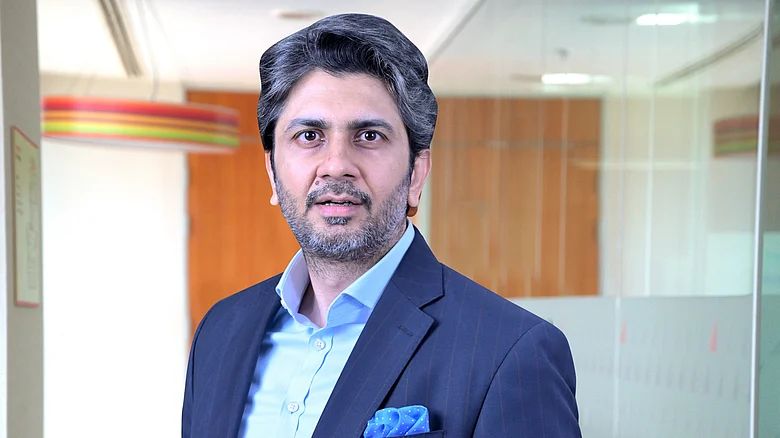
Family offices in India are rapidly evolving into institutional-grade investors, reshaping how capital is allocated across asset classes and cycles. In a conversation with Outlook Business, Anuj Kapoor, MD & CEO, Private Wealth at JM Financial Services, points to a clear shift from opportunistic, cycle-driven investing to more structured, diversified and strategy-led allocation frameworks, driven by volatility, generational change and a maturing wealth ecosystem.
Kapoor also discusses the firm’s positioning in an increasingly crowded private wealth space, the growing preference for capital preservation and liquidity alongside alpha, and the rising sophistication of family offices that are now actively participating across IPOs, pre-IPO opportunities and alternative assets.

1 October 2026
Get the latest issue of Outlook Business

Edited Excerpts:




Wealth space is getting very crowded. How are you positioning yourself, especially in private wealth amongst the competition?
It is definitely getting crowded, you see new names coming in very frequently. But the approach here is not really about pushing products, it is more about being a one platform solutions provider. The idea is that you are already working with promoters on their business side, capital, M&A and so on, so extending that conversation into personal wealth, family structures, succession and all of that. It is more about offering a full solution rather than a product. Also, there is a clear effort to stay open architecture. Even today, the share of in-house products in client portfolios is quite low, and the idea is not to push proprietary products but to give the best solution, wherever that comes from.
Advertisement
But eventually you would want to scale your own products as well, right?
Yes, but not just for the sake of it. The way we look at it is that if we enter a space, it has to be with conviction and with a long-term view, not because something is trending in the market. So for example, in performing credit, we have decades of experience, that is something we understand across cycles. Similarly, with the pre IPO fund, there is a clear right to win because of the investment banking franchise. So we will build products, but only where we believe we have an edge, otherwise it is perfectly fine to work with third-party managers instead of manufacturing something just to fill a gap.
Advertisement

On HNIs and UHNIs, is allocation still cyclical or has it become more structural now?
Earlier it used to be more cyclical, but now it is becoming more structural. Part of it is because of the environment, there is so much volatility that playing cycles becomes difficult. The ecosystem itself has evolved, family offices have become more formal, wealth management has matured and access to products is better. So the way people are allocating capital today is much more structured, it is not just about taking a view on equities or one asset class, there is more focus on diversification, global exposure and consistency in strategy.
Within that, what are you seeing more of today, appetite for alpha or focus on protection and liquidity?
There is clearly a shift happening. Earlier, a lot of portfolios were skewed towards alpha generation, now it is becoming more balanced, with a lot more focus on preservation, downside protection and liquidity. This has played out over the last five to seven years, you have had multiple events, covid-19, credit events, global uncertainty, so naturally behaviour changes. Also, there is a generational shift happening, the next generation is a lot more structured in how they think about capital. So you are seeing more conversations around structured products, private credit, arbitrage and long short strategies, which was not the case earlier.
Family offices are clearly becoming more institutional and are coming up in a big way. How do you see that evolution?
It has changed quite a bit. Earlier, family offices were not really formal structures, it was more internal, someone managing books and helping the promoter take decisions. Now they are much more structured and behave like institutions, in many cases they are quicker and more nimble than institutions, they can take large calls and move fast. You are seeing them participate actively in IPOs, pre IPOs and alternatives, and their approach to capital is also much more organised now, with clearer allocation buckets and more formalised decision making.
How are you reading the current FII behaviour in Indian equities right now?
It is largely a risk-off environment, so capital is moving towards developed markets and safer assets, and emerging markets like India are not the first preference in such phases. For flows to come back, you need more stability globally, and then either valuations correct further or earnings catch up. Valuations have corrected, but just looking at past averages may not be enough, the world is changing, sectors are getting disrupted, so forward expectations will matter more than historical benchmarks.
How do you see your private wealth business going forward from here?
Overall, quite positive. If anything, volatile markets make it more important to stay close to clients, that becomes even more critical. The focus is on growing the UHNI and HNI base with a solutions-led approach, and at the same time there is a shift towards more recurring, fee-based income and not just transactional business. We have reached a certain scale now, and with the platform, product capabilities and linkages in place, this is an important growth area going forward.