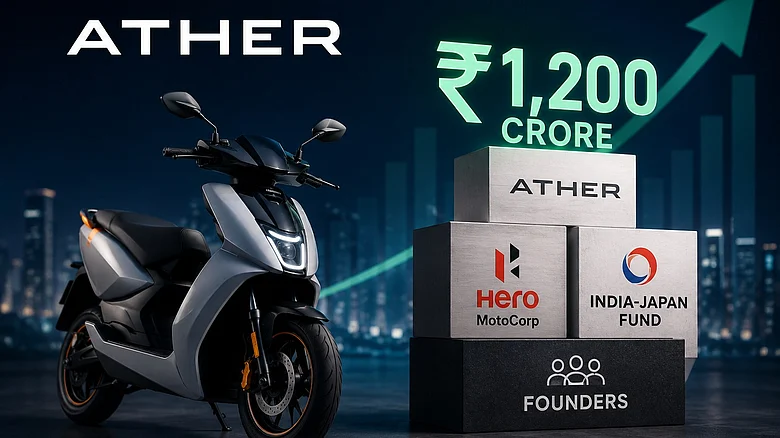

Ather Energy has launched the first tranche of its ₹2,500-crore fundraising programme, with Hero MotoCorp, the India-Japan Fund and its founders investing ₹1,200 crore.
The funding comes as Ather expands manufacturing, retail presence and prepares to enter the mass-market electric scooter segment.
Experts say the investment reflects growing confidence in India's EV ecosystem, though execution will remain key in a highly competitive market.
Electric two-wheeler maker Ather Energy has kicked off the first leg of its ₹2,500-crore fundraising programme, bringing together a mix of strategic, institutional and promoter capital.
The Bengaluru-based company will raise ₹1,200 crore through a preferential issue, with Hero MotoCorp investing ₹960 crore, the government-backed India-Japan Fund (IJF) contributing ₹200 crore and Ather's co-founders committing ₹40 crore.

1 October 2026
Get the latest issue of Outlook Business

The fundraise comes just over a year after Ather's ₹2,981-crore initial public offering (IPO) and at a time when competition in India's electric two-wheeler market continues to intensify. So why are these investors backing Ather now, and what does it say about the company's future?
Who Is Investing in Ather?
The largest contributor to the fundraise is Hero MotoCorp, which will invest ₹960 crore through convertible warrants. Hero is already Ather's biggest shareholder, holding a 29.48% stake as of June 30, 2026. The latest investment reinforces a relationship that began nearly a decade ago and underlines Hero's long-term commitment to the EV maker.
Advertisement
The second investor is the India-Japan Fund, which will invest ₹200 crore through an allotment of equity shares. The $600-million bilateral fund was established by the Government of India and the Japan Bank for International Cooperation (JBIC) and is managed by the National Investment and Infrastructure Fund (NIIF). The fund typically backs businesses that support India's long-term industrial and infrastructure development.
Ather's founders, Tarun Mehta and Swapnil Jain, will together invest ₹40 crore. Founder participation is often viewed as a positive signal, indicating continued confidence in the company's long-term strategy.
Advertisement
Why Are Investors Backing Ather?
The fundraise comes at a time when India's electric vehicle market is entering a new phase of growth. Investors are increasingly looking beyond vehicle manufacturers and backing companies building the broader EV ecosystem.
Hari Krishna, Founder and CEO of Green Drive Mobility, says the investment reflects confidence not just in Ather but in India's broader electric mobility story.
"Ather Energy's ₹1,200 crore fundraise reflects the growing confidence investors have in India's electric mobility ecosystem and its long-term growth potential," he says.
He points to estimates from the India Energy Storage Alliance (IESA), which project annual EV sales in India to reach 30.4 million units by 2032, while the EV component market is expected to grow from ₹41,000 crore in 2025 to ₹3.02 lakh crore by 2032.
According to him, sustained investment will be essential to support innovation, localisation and the scaling of EV businesses as adoption accelerates.
Akshit Bansal, Founder and CEO of EV charging company Statiq, believes the nature of investment in the sector is also evolving. "Investor confidence in India's EV sector has reached a new phase. The industry is no longer seen as experimental; it is becoming essential," he says.
According to Bansal, investors are now backing companies that combine vehicles, software and charging infrastructure rather than focusing on individual products.
Why Hero MotoCorp's Bet Matters
Hero's participation is perhaps the strongest endorsement in the fundraising round.
Already Ather's largest shareholder, Hero's decision to invest another ₹960 crore suggests confidence in the company's long-term growth despite intensifying competition from TVS Motor, Bajaj Auto and Ola Electric.
The investment also comes as Ather continues to improve its operational performance. During FY26, the company reported a 66% increase in vehicle volumes and significantly expanded its retail footprint, growing its store network from 351 outlets to 700.
The company has also strengthened its market position. According to Vahan data, Ather remains India's third-largest electric two-wheeler manufacturer. In June, it recorded 29,422 vehicle registrations, giving it a 16.2% market share.
What Comes Next for Ather?
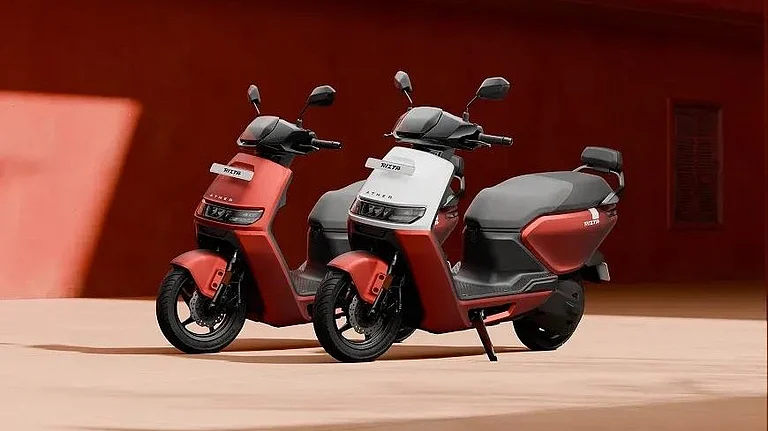
The fundraise comes as Ather prepares for its next phase of growth. One of its key priorities is the upcoming EL platform, which will take the company into the ₹1 lakh-₹1.25 lakh electric scooter segment.
According to CEO Tarun Mehta, the segment accounts for nearly 45-50% of India's electric two-wheeler market and is expected to be a key growth driver over FY27 and FY28.
The company has also expanded its retail network from 351 stores to 700 over the past year while strengthening its position as India's third-largest electric two-wheeler maker.
Can Fresh Capital Help Ather Take On Rivals?
The funding undoubtedly strengthens Ather's balance sheet, but it also comes at a time when rival EV makers are raising fresh capital to fuel their next phase of growth. Earlier this month, Ola Electric raised ₹780 crore through a qualified institutional placement (QIP), reflecting the ongoing investment race in India's electric two-wheeler market.
Abhinav Kalia, Co-Founder and CEO of ARC Electric, says the participation of Hero MotoCorp, the India-Japan Fund and Ather's founders sends a positive signal about the company's long-term prospects.
"The participation of strategic investors such as Hero MotoCorp, alongside institutional backing from the India-Japan Fund and additional founder commitment, sends a positive message about Ather's long-term prospects and the broader maturity of India's electric mobility ecosystem."
However, he cautions that funding alone will not determine market leadership.
"Capital alone does not determine market leadership. Companies such as TVS Motor, Bajaj Auto and Ola Electric each bring distinct strengths in scale, distribution, brand equity and execution capabilities."
According to Kalia, Ather's long-term success will depend on how effectively it deploys the fresh capital to drive innovation, improve operational efficiency and expand market penetration.
What It Means for India's EV Sector
Ather's latest fundraise reflects how India's electric mobility sector is moving into a new phase, with investors backing companies that have established products, expanding operations and long-term growth plans.
Akshit Bansal says the industry's focus has now shifted from proving EV adoption to building the ecosystem needed to support it. "The question has shifted. It's no longer about whether EV adoption will happen, but about who is committed to building the foundations of this transformation."
He says companies that integrate vehicles, technology and charging infrastructure are likely to play a bigger role in shaping the next phase of India's EV journey.



The fundraise could also have implications for the corporate mobility segment. Sriram Kannan, Founder and CEO of RouteMatic, says, "As enterprises increasingly transition towards electric fleets, the need for a robust ecosystem of reliable OEMs, advanced technology, charging infrastructure and dependable after-sales support becomes even more critical."
According to Kannan, continued investment across the EV value chain will help accelerate innovation, improve product availability and support wider adoption of electric fleets by businesses.