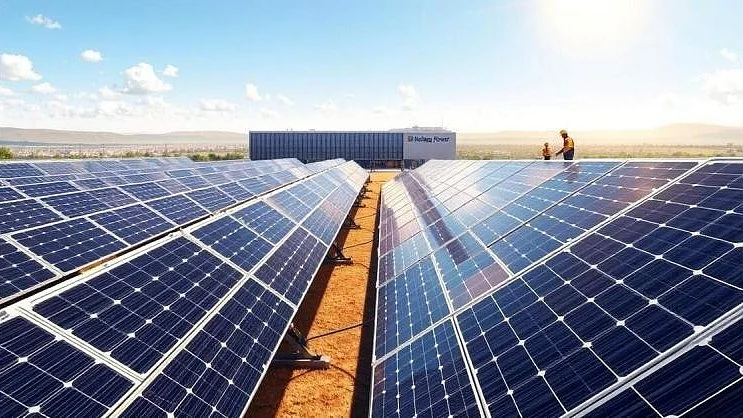

•Adani Green profit jumps 34% on higher power sales and utilisation.
•Revenue and EBITDA grow in double digits on capacity expansion.
•Debt rises as company speeds up green energy expansion.
Adani Green Energy reported a strong March quarter performance, with net profit rising 34.3% year-on-year (YoY) to ₹514 crore, compared with ₹383 crore in the same period last year, driven by higher electricity sales and improved capacity utilisation across its renewable portfolio.
The company’s consolidated performance reflected robust momentum in its core power business, with revenue from operations rising 16% YoY to ₹3,094 crore. Strong energy demand and improved execution helped boost sales, while overall quarterly revenue climbed to ₹3,737 crore, marking a growth of nearly 14%.

1 September 2026
Get the latest issue of Outlook Business

Energy sales also surged 34%, reinforcing the company’s position as a key beneficiary of India’s expanding renewable energy sector.
Operating performance remained solid, with EBITDA increasing 20% YoY to ₹2,944 crore. The company’s EBITDA margin stayed exceptionally strong at around 91%.
Management attributed the improvement to better operations and maintenance practices, which helped drive higher electricity generation at lower costs.

Capacity Expansion Drives Growth
A key driver of the performance was the addition of 5.1 GW of renewable capacity during FY26, significantly boosting operational scale. As a result, operational capacity rose 35% YoY to 19.3 GW, supported by faster greenfield project execution compared to the previous year.
Advertisement
The company also expanded its battery energy storage capabilities, operationalising 1,376 MWh of BESS capacity at Khavda, strengthening its integrated renewable portfolio.
Sagar Adani, Executive Director, Adani Green Energy, said the company’s 5.1 GW greenfield addition marked the highest annual capacity expansion globally by any company outside China, taking total operational capacity to 19.3 GW. He also highlighted progress at the Khavda project, described as the world’s largest renewable energy plant, alongside major strides in energy storage.



He noted that the company installed 1.4 GWh of battery storage in FY26, among the largest single-location deployments globally, aimed at strengthening grid stability and building a “future-ready energy ecosystem.” He also added that the pumped hydro storage project in Andhra Pradesh is progressing steadily.
Advertisement
While growth remained strong, the company’s net debt increased significantly during the year to ₹91,252 crore from ₹64,462 crore.