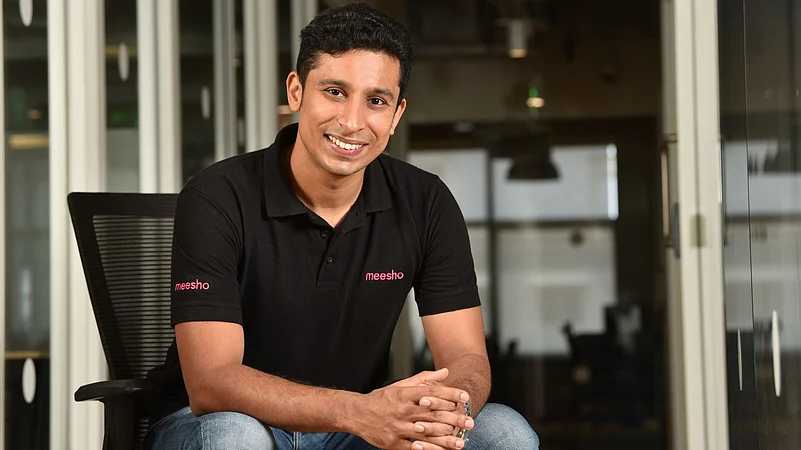

Meesho's pre-IPO anchor allocation sparked discontent, leading to major institutional buyers withdrawing their bids
The controversy centers on SBI Mutual Fund receiving a disproportionate allotment
Protesting investors, including Capital Group and Nippon India, complained of preferential treatment and a lack of transparency
Ecommerce major Meesho’s pre-IPO anchor allocation on Tuesday had sparked discontent among a section of Qualified Institutional Buyers (QIBs), which led to some investors reportedly withdrawing from the anchor round in protest.
The controversy emerged when the anchor allocation disproportionately favoured SBI Mutual Fund, which received a significantly larger allotment than several other institutional investors that had placed comparable bids. SBI MF’s consolidated allocation amounted to about ₹603 crore, which is roughly 24–25% of the ₹2,439-crore anchor book.

1 September 2026
Get the latest issue of Outlook Business

Although the investors pulling out did not have any major impact on the IPO’s overall demand or the mutual-fund schemes’ NAVs, the incident sparked a broader debate about the need for clearer and more transparent norms around anchor allocations.


The dispute between the issuers and investors was not a legal battle but mainly about fairness, transparency and market practice.
Anchor Allotments: How It Works?
Anchor investors are large QIBs who are offered shares one day before the public offer opens, at the final issue price within the price band.
Sebi allows an issuer to allocate up to 60% of the QIB portion to anchors, and one-third of the anchor portion is to be reserved for domestic mutual funds.
Advertisement
Anchor allotments are generally discretionary, the issuer (in consultation with lead managers) negotiates allocations with institutions based on investor appetite, perceived strategic value and long-term alignment.

Meesho IPO: Anchor Allocation
Meesho raised about ₹2,439 crore from its anchor book ahead of the IPO. Meesho’s anchor allocation letter shows that SBI Mutual Fund received roughly ₹603 crore of that anchor pool, which is about a quarter of the total anchor amount.
Other large investors that were finally allotted material amounts included sovereign/sovereign-backed pools and global managers (GIC/Government of Singapore, Fidelity, BlackRock, etc). But several large institutions including Capital Group, Aberdeen, Norges Bank, ICICI Prudential AMC, Nippon India, Nomura, among others pulled out of or protested the anchor round complaining the SBI allocation was disproportionate and that similar bids by them weren’t treated equally.
Advertisement

Why Investors Protested?
There were two overlapping reasons why the allocation triggered strong objections.
First, there was a perception of preferential treatment. Several large investors had expected allocations comparable to SBI Mutual Fund but were offered far smaller tickets, prompting them to withdraw in protest. Allotment figures showed the “yawning” gap in allotment sizes. SBI MF received roughly ₹603 crore, while other major asset managers were allotted in the ₹48-100 crore range.
Second, investors pointed to a lack of transparency. Anchor allocations are discretionary and generally take place behind the scenes. On this, investors argue that without clearer, codified standards on fairness, issuers can favour certain institutions, whether for strategic considerations or due to prior commitments, which ultimately undermines confidence in the process.
A recent Moneycontrol report noted that Meesho’s management, not the investment banks, made the final call and honoured a previous commitment to SBI MF.

Might be Unfair But not Illegal
Under Sebi’s ICDR (Issue of Capital and Disclosure Requirements) framework, anchor allocations are permitted and can be discretionary as long as issuers comply with the prescribed guardrails, such as minimum and maximum allocation thresholds and the reservation norms for domestic mutual funds.
While the regulations lay out structural requirements, including the minimum number of anchor investors depending on the bucket size and the historical rule that one-third of the anchor portion be reserved for mutual funds, they do not mandate pro-rata entitlements across all bidders. This built-in discretion often makes anchor allocations contentious, even when they remain fully compliant with the law.
Sebi is unlikely to intervene in the Meesho anchor allocation episode unless a formal complaint is submitted or a specific breach of rules comes to light. Although the regulator has been updating anchor-investor norms in recent years to improve transparency and broaden participation, the framework still leaves room for issuer-led judgment within the permitted limits.
Meesho IPO Details
Meesho has set its IPO price band at ₹105–₹111 per equity share. The offering comprises both a fresh issue and an offer for sale (OFS). The subscription window opened on December 3 and will remain open until December 5, 2025.
The company aims to raise ₹5,421.20 crore, including ₹4,250 crore through fresh shares and ₹1,171.20 crore via OFS. The IPO is proposed for listing on both the BSE and NSE. Investors may apply in lots of 135 shares each.
The most likely allotment date is December 6, 2025; if that date is delayed because it falls on a Saturday, allotment may instead occur on December 8. KFin Technologies has been appointed the registrar for the issue.
As of 5:00 PM on Thursday (December 4, 2025), the IPO had seen strong demand across categories. QIBs were subscribed 6.96x, NIIs 9.18x and retail investors 9.14x, taking the overall subscription to 7.97x. The issue remains open for bidding and closes tomorrow, Friday, December 5, 2025.