
Anthropic launched Claude Opus 4.5, setting a new benchmark for AI coding and agentic capabilities
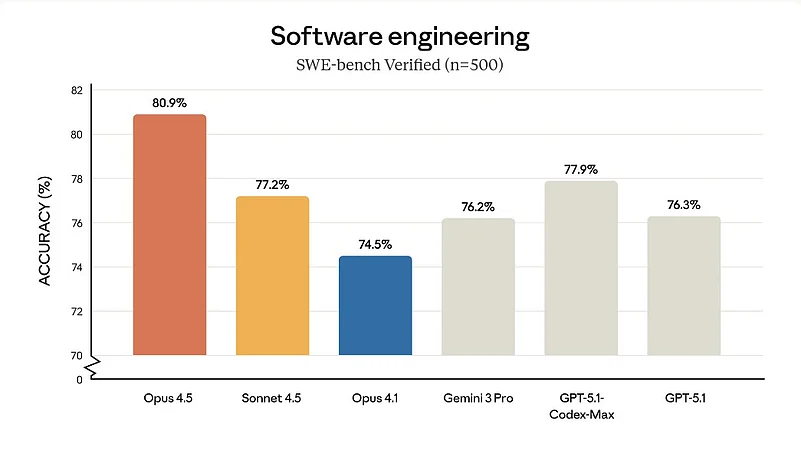
The model achieved 80.9% accuracy on the rigorous SWE-bench assessment, outperforming rivals
Opus 4.5 scored higher than any human candidate on Anthropic's internal performance engineering take-home exam
Anthropic last week launched Opus 4.5, the latest and most powerful iteration of the AI start-up's flagship large language model, Claude. The highlight of the announcement was a series of benchmarks and test results that positioned the new model as clearly superior to anything else available when it comes to writing code.
On SWE-bench (Software Engineering Benchmark), one of the most demanding real-world programming assessments, Opus 4.5 achieved 80.9% accuracy, outpacing rivals like Gemini 3 Pro (76.2%) and GPT-5.1 Codex Max (77.9%). More striking still: during internal testing, the model completed a take-home exam for performance engineering candidates—and scored higher than any human candidate tested by Anthropic. Internal testers reported that tasks deemed "nearly impossible" for its predecessor just weeks ago now fall comfortably within Opus 4.5's reach. The recurring feedback was disarmingly simple: it just "gets it."

1 August 2026
Get the latest issue of Outlook Business



So the question becomes unavoidable: Are human coders going the way of lamplighters and telephone operators—another casualty of the relentless march of technology? Or will software engineering always require something that even the most sophisticated AI cannot replicate?
Software engineering remains one of the most lucrative professions globally, with coding traditionally positioned as the core skill for entry and advancement in the field. A large-scale displacement of humans by AI in this field will not only have a massive impact on the white-collar professional landscape in advanced economies like the US, but also pose considerable challenges to countries such as India, with large parts of its economy dependent on the spending power of its millions of high-earning software professionals.
Advertisement
As per the US Bureau of Labor Statistics, roughly 1.66 million people work as software developers or software engineers in the country. The average annual salary for an entry-level engineer is about $101,200 (Rs 90 lakh/year), while mid-tier engineers earn approximately $132,270 (Rs 1.2 crore) a year.
By comparison, AWS Marketplace lists Claude for Enterprise at $40 per user per month (25-seat minimum), amounting to at least $1,000 per month or around $12,000 (Rs 11 lakhs) annually, for a single enterprise deployment. This means for any small or large corporation, it will be economically efficient to replace the low and mid tier engineers with an AI model. Moreover, a single AI instance may be able to generate more code than a single human coder.
Advertisement
Agentic AI
The threat of AI displacing humans became a real possibility when ChatGPT 4, released in early 2023, showed massive improvements over its predecessor in a variety of tasks including coding, spurring futurists to predict an end to human coding in the near future. However, since then, the concerns over the immediate death of human coding have abated somewhat as AI chatbots have tended to exhibit a tendency to get ‘bogged down’ and ‘lose the plot’ when it comes to longer and more complicated projects involving thousands of lines of code.
The AI industry has responded to the challenge with Agentic AI, which helps to keep the AI more focused on a core purpose.
In its latest release notes, Anthropic seems to claim its latest model is capable of tackling complicated tasks that require sustained focus. Anthropic revealed that during internal testing, evaluators observed that Claude Opus 4.5 can handle ambiguity and reason through tradeoffs without step-by-step guidance. When presented with a complex, multi-system bug, Opus 4.5 was able to identify the root cause and determine the appropriate fix independently.
Anthropic said it conducted a “notoriously difficult” take-home exam to prospective performance engineering candidates, which also serves as an internal benchmark for testing new models. Notably, within the prescribed two-hour time limit, Claude Opus 4.5 achieved a higher score than any human candidate to date, it said. The gains reflect the model’s ability to not only generate code but also understand existing repositories, propose patches and solve complex software bugs end-to-end.
Adam Wolff, Member of the Technical Staff at Anthropic remarked that the new Claude Code model offers a glimpse of the future where, potentially as soon as the first half of next year, traditional [coding] as it exists today may be “done.”
“Soon, we won't bother to check generated code, for the same reasons we don't check compiler output,” Wolff said.
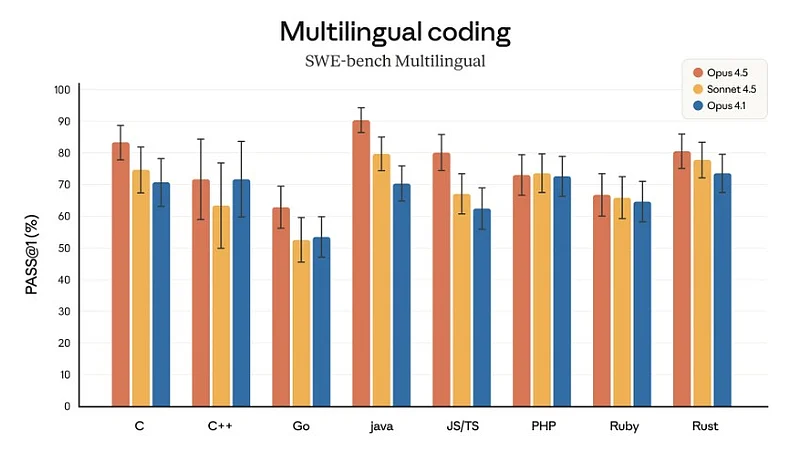
On SWE-bench Multilingual, Opus 4.5 also writes better code, leading across 7 out of 8 programming languages.
Is Coding Dead?
The key question is—do the tests accurately reflect all the aspects of a human coder required to successfully develop and troubleshoot software products. Many believe that the tests only measure technical ability and judgment, and fail to measure other crucial attributes of an experienced human coder such as collaboration, communication and the professional instincts developed over the years.
Still, an AI model outperforming strong candidates on critical technical skills, raises significant questions regarding how AI will reshape the engineering profession.
Pritam Crispin, co-founder and COO of VibeCoding platform VibeStudio, believes that AI models to some extent will be able to replace human coders.
He stated that AI can certainly take over a large portion of the coding workload. However, when it comes to extremely complex products, human engineers, who understand the intricacies of the stack, the limitations of the system, and the broader project context will still be required. “They will guide the AI and make high-level decisions. But for a lot of lower- and mid-tier coding tasks, I expect AI to become exponentially proficient at replacing human effort,” he said.
Abhimanyu Saxena, co-founder of Scaler and InterviewBit, believes that coding as a skill is still far from becoming redundant. He argues that coding is becoming foundational—similar to mathematics.
“You may not manually compute everything today, but your understanding of math shapes how you work with tools and technology overall…Similarly, engineers who understand coding principles will be able to use AI effectively…and build systems that scale reliably,” Saxena said.
“AI can generate code, but it cannot autonomously understand intent, negotiate trade-offs, or take responsibility for real-world product outcomes,” he added.
Future of Software Engineering
Meanwhile, what seems to be undisputed is that software engineering will evolve significantly with AI, regardless of whether code is written by machines or humans.
Saxena, for example, believes that the role will shift from writing code to solving problems and designing systems, as AI handles execution-heavy tasks. He states that engineers will act as AI orchestrators, similar to how cloud adoption created DevOps and SRE functions—prompting, supervising, and optimising AI systems.
At the same time, strong computer science fundamentals will become more important. “When AI generates code, the engineer's role shifts toward evaluating correctness, identifying failure modes, and understanding how things work under the hood. This requires deeper conceptual clarity,” he said.
According to Wolff, coding has always been the easy part of software engineering. As it becomes increasingly redundant, an engineer’s real challenge will be managing requirements, goals, and feedback, determining what to build and ensuring it actually works.
“There's still so much left to do that plenty of the models aren't close to yet: architecture, system design, understanding users, coordinating across teams. It's going to continue to be fun and very interesting for the foreseeable future,” he said.