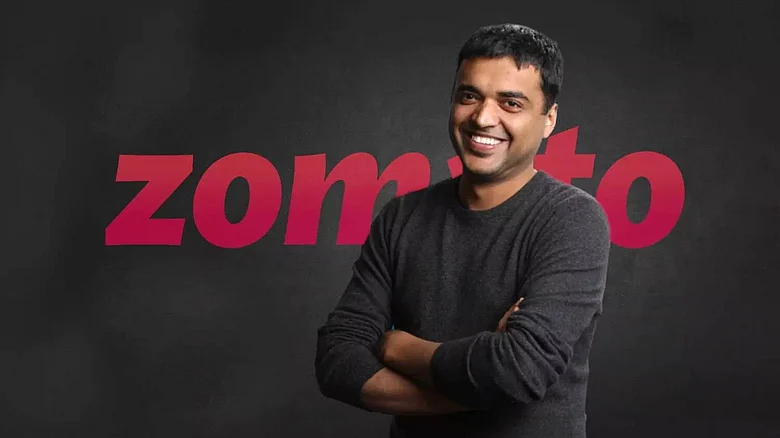

Deepinder Goyal's new health-tech start-up, Temple, is raising $50 million (around ₹450 crore) in a seed round
Temple is linked to Goyal’s "Gravity Ageing" hypothesis that gravity-induced reduced blood flow is a driver of brain ageing
Steadview Capital, Vy Capital, Info Edge, and Peak XV Partners are among the investors participating in the funding
Eternal (formerly Zomato) founder Deepinder Goyal’s wearable device start-up Temple is set to raise $50 million (around ₹450 crore) from Steadview Capital, Vy Capital, Info Edge, Peak XV Partners (formerly Sequoia Capital India), and others, Moneycontrol reported.
A group of Indian founders, including Goyal, will reportedly participate in the seed round of the longevity focused start-up, which is expected to be one of the largest raised by an Indian start-up in recent years. Temple’s employees are also likely to participate, according to the report.

1 October 2026
Get the latest issue of Outlook Business





What is Temple?
Temple is Deepinder Goyal’s new health-tech and wearable venture, built around an experimental head-worn sensor designed to continuously measure cerebral blood flow.
The device is a small patch placed near the temple. It is tied to Goyal’s broader longevity and brain-health pursuits, which he has linked to research he calls the “Gravity Ageing” idea. The start-up remains in an early, experimental phase, with its website currently showing “Coming Soon,” as it works to secure seed funding.
Temple is reportedly being positioned as a research-oriented tool rather than a finished consumer product, providing real-time, continuous estimates of blood flow near the brain. Goyal has publicly connected the sensor’s development to his ongoing work on cerebral blood flow and ageing.
Advertisement
Public interest in Temple began in mid-November 2025, after photos surfaced of Goyal wearing a small white patch near his temple. The images prompted reports that he was building a dedicated company around the device and the research underpinning it.

Continue Research & Gravity Ageing Thesis
The launch of Temple follows Goyal’s recent publication, through his research firm Continue Research, of an open-source hypothesis suggesting that gravity, by chronically reducing cerebral blood flow in upright humans, may be an overlooked driver of brain ageing and, ultimately, whole-body ageing.
Advertisement
He outlined the concept in a blog post, describing how a systems-thinking insight led him from personal health optimisation to a theory he believes warrants rigorous scientific scrutiny.
At the heart of Goyal’s argument is the idea that because humans spend most of their lives upright, with the brain positioned above the heart, gravity exerts a subtle but continuous downward pressure on cerebral blood flow (CBF). Over decades, he contends, even this small deficit can lead to capillary loss and gradual brain decline, triggering a cascade of broader physiological ageing.
If the gravity-CBF hypothesis proves correct, Goyal argues that interventions addressing it could extend the period of preserved cognition and health. Rather than promising dramatic near-term leaps in lifespan, the goal is to add meaningful decades of healthier, more productive living.
He positions this view as complementary to existing ageing science, noting that evolution optimised humans for reproduction, not for the long-term maintenance of physiological function over multiple decades.